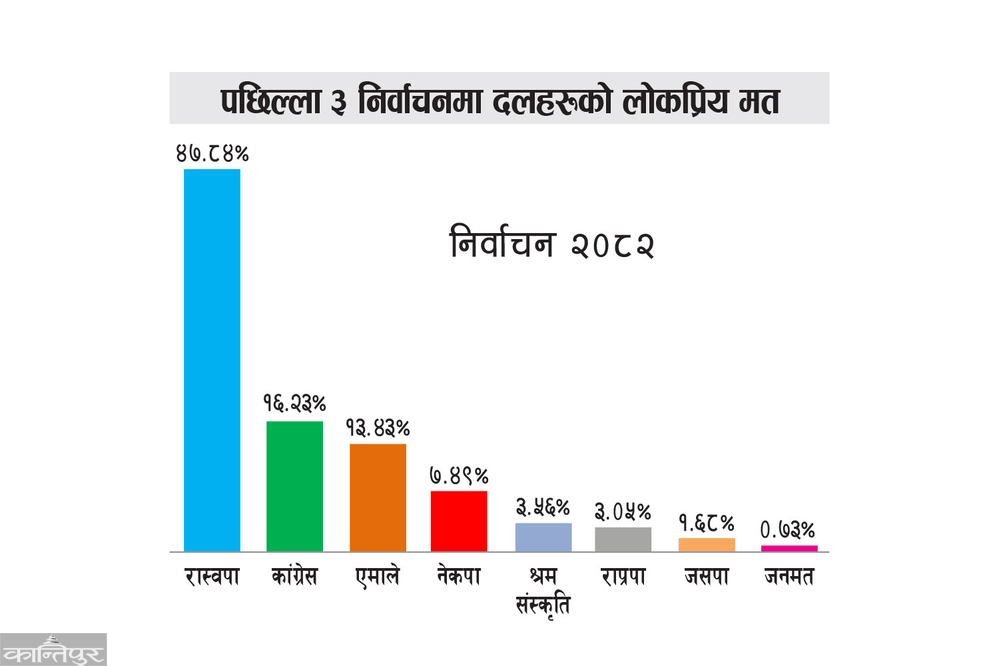
In proportional representation, the RSVP got 57 seats, the Congress 20, the UML 16, the NCP 9, the Shram Sanskriti 4 and the RPP 4 seats. The RSVP's 47.84 percent vote share is the most popular so far.
We use Google Cloud Translation Services. Google requires we provide the following disclaimer relating to use of this service:
This service may contain translations powered by Google. Google disclaims all warranties related to the translations, expressed or implied, including any warranties of accuracy, reliability, and any implied warranties of merchantability, fitness for a particular purpose, and noninfringement.
The Election Commission on Thursday wrote to the parties to select the names of candidates to be elected through the distribution of 110 seats in the proportional representation. The six parties that have crossed the 3 percent 'threshold' as per the law - the Rashtriya Swayamsevak Sanskriti Party, the Congress, the UML, the NCP, the Shram Sanskriti Party and the RPP - have received proportional representation MPs.
According to the Commission's spokesperson Narayan Prasad Bhattarai, the Rashtriya Swayamsevak Sanskriti Party has received 57 seats, the Congress 20, the UML 16, the NCP 9, the Shram Sanskriti Party 4 and the RPP 4. Spokesperson Bhattarai informed that letters have been sent to these parties to select the names of candidates and submit them to the Commission within three days.
The Rashtriya Swayamsevak Sanskriti Party, which won 125 seats in the direct representation, has received 57 seats in the proportional representation by getting a historic popular vote. It received 47.84 percent of the votes. This is the highest percentage of votes received by any party so far. The total votes cast by the Rashtriya Swayamsevak Sangh (RSS) are 5,183,493.
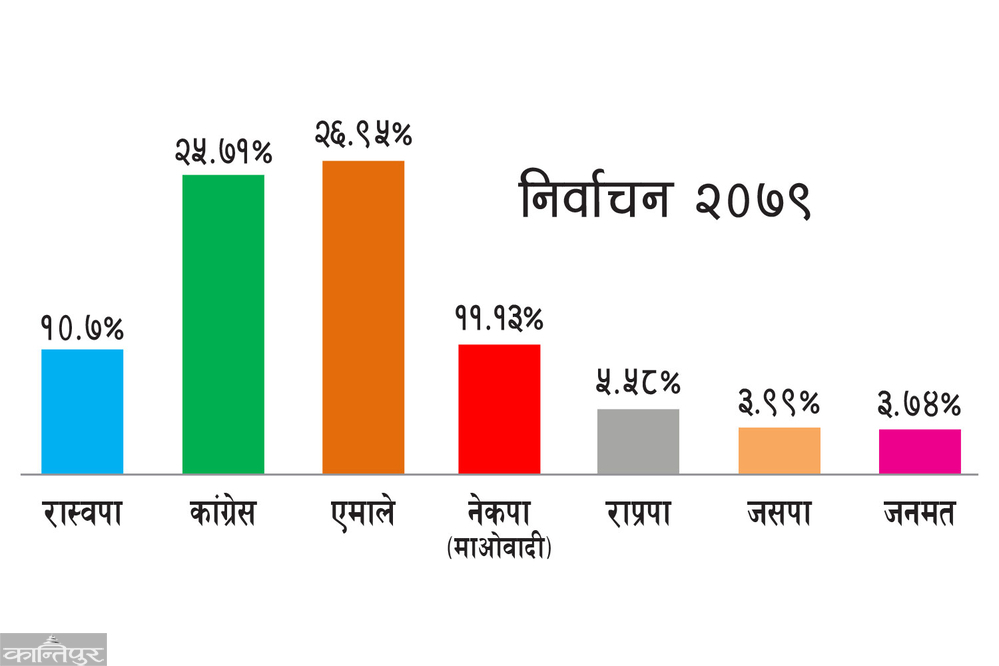
The Rashtriya Swayamsevak Sangh (RSS), which participated in the 2079 House of Representatives for the first time, secured 13 seats by securing 10.7 percent of the votes under the proportional representation system. In the elections held after a gap of three years, the Rashtriya Swayamsevak Sangh (RSS) secured almost 5 times more votes.
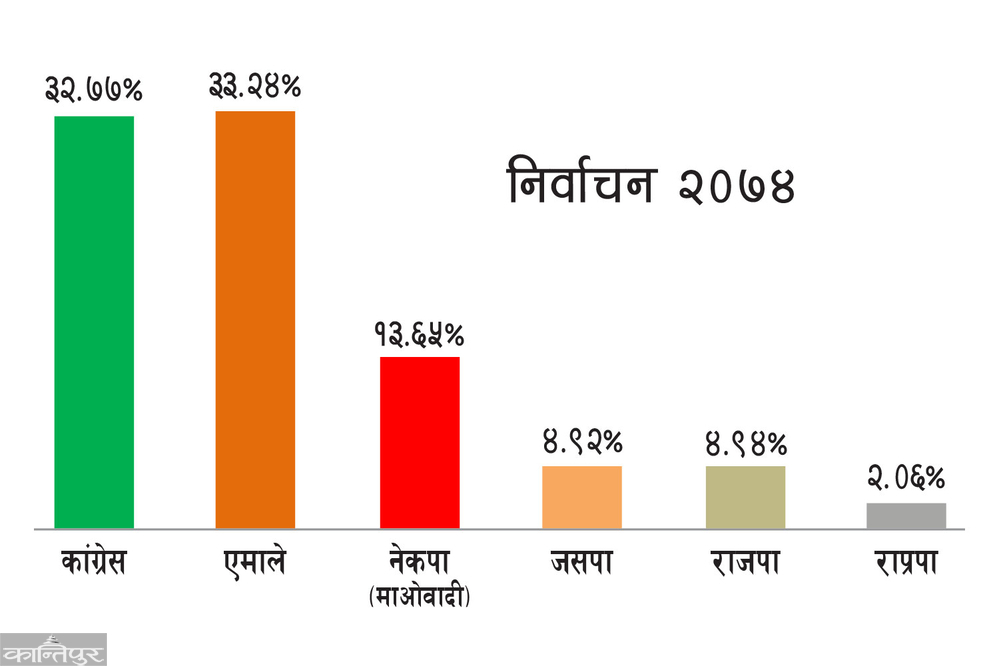
Since the 2064 Constituent Assembly elections, elections have been held under the mixed electoral system. The Maoists, which abandoned armed conflict and entered the peace process, secured the highest number of votes under the proportional representation system in the 2064 elections, with 29.28 percent, and the Nepali Congress secured the highest number of votes under the proportional representation system in the 2070 and 2079 House of Representatives elections, with 25.25 percent. Similarly, in the 2074 and 2079 House of Representatives elections, the UML secured the highest number of votes under the proportional representation system, with 37.1 and 26.95 percent, respectively.
Before that, the Congress had become the largest party in the 2048 parliamentary elections by getting 37.75 percent of the votes, the EML by 42.93 percent in the 2051 elections, and the Congress by 36.14 percent in the 2056 elections. At that time, the proportional electoral system did not exist.
The counting of votes in the proportional representation of the House of Representatives elections held on 21 Falgun ended on Thursday. According to the Election Commission, out of 12 million 1280 thousand 617 votes cast in the proportional representation, 18 million 35 thousand 25 votes were cast. After the Rashtriya Swayamsevak Sangh (RSS), the Congress came in second with 17 million 59 thousand 172 votes, or 16.23 percent of the total valid votes. It has got 20 seats. The Congress, which won 18 seats directly, has become the main opposition party in the House of Representatives with 38 seats.
In third place, UML has secured 16 seats through proportional representation by getting 14,55,885 (13.43 percent) votes. UML, which has won 9 seats directly, will have 25 representatives in the House of Representatives.
The NCP, which is made up of 25 different communist parties, has secured 9 seats through proportional representation by getting 7.49 percent votes. The total votes obtained by the party are 8,11,577. The party will have 17 MPs in the House of Representatives.
Shram Sanskriti, which participated in the election to the House of Representatives for the first time, has secured 3 seats directly. It has secured 4 seats through proportional representation by getting 3,85,922 votes. The percentage of votes obtained by the party is 3.56. Similarly, the RPP, which has been raising the issue of constitutional monarchy and Hindu statehood, has secured 4 seats through proportional representation by getting 3,30,684 votes. The RPP, which won 1 seat directly, is set to have 5 MPs in the House of Representatives.
The Madhesi parties that have been present in parliament in 4 elections since the 2006 Constituent Assembly election have dropped to 'zero' this time. The JSP and Janamat, which were in parliament after winning direct and proportional seats in the 2079 elections, could not bring any seats directly or proportionally this time. The 'threshold' is very low. The JSP got only 1.68 percent of the votes and Janamat got only 0.73 percent of the votes.
Spokesperson Bhattarai said that the names of candidates should be sent as per the percentage prescribed by law for the seats won by the party through proportional representation from women and other inclusive groups. 'The party will have to send its names to the commission after taking a decision from the central committee,' he said.
There is a constitutional provision that at least one-third of each party represented in the federal parliament should be women. Accordingly, the party should send the names of the candidates to be elected by dividing the number of women into 28.7 percent indigenous people, 31.2 percent Khas Arya, 6.6 percent Tharu, 13.8 percent Dalit, 15.3 percent Madhesi, and 4.4 percent Muslim, according to spokesperson Bhattarai.
‘The parties should send the names of the candidates to be elected to the commission by Chaitra 1,’ he said. ‘The commission will check the names sent by the parties to see if they are proportional representation as per the law and if necessary, the results will be announced.’

