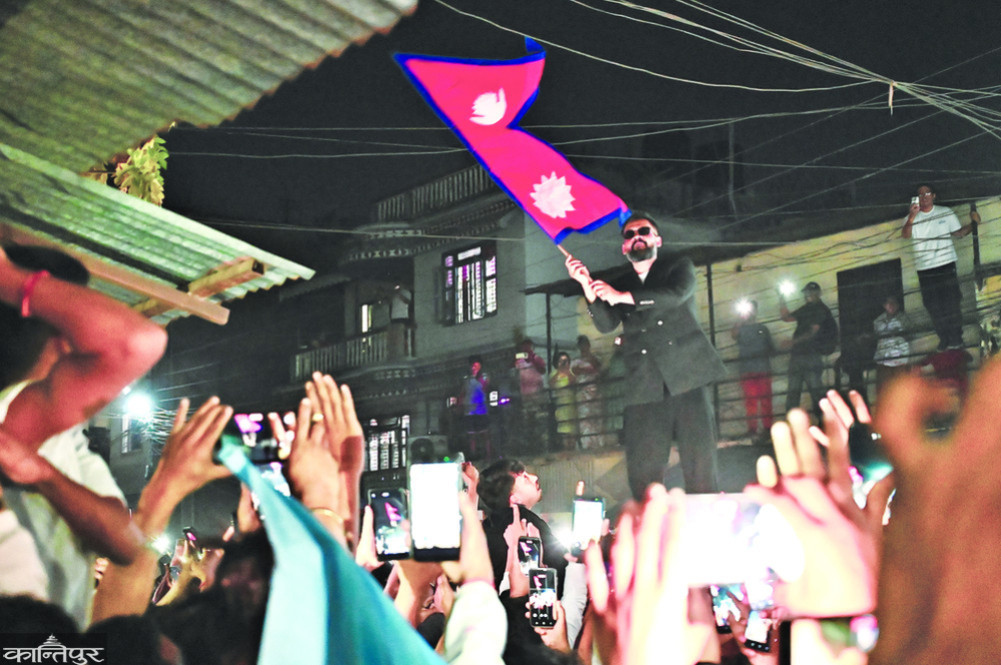
The RSP has called it development diplomacy. Experts have seen it as an effort to attract investment and cooperation without any political lines. The RSP wants to avoid the controversies seen in projects like the MCC and the BRI.
We use Google Cloud Translation Services. Google requires we provide the following disclaimer relating to use of this service:
This service may contain translations powered by Google. Google disclaims all warranties related to the translations, expressed or implied, including any warranties of accuracy, reliability, and any implied warranties of merchantability, fitness for a particular purpose, and noninfringement.
The National Independent Party (NIPP), which secured nearly two-thirds of the votes in the recently concluded elections, has promised to advance ‘development diplomacy’.
Speaking at a program organized in Chitwan on February 23 after being elected for the third time from Chitwan-2 constituency, NIP President Ravi Lamichhane said that the party is committed to a balanced foreign policy based on mutual respect.
In response to a congratulatory message sent by Indian Prime Minister Narendra Modi through social media after the elections, Lamichhane reiterated his commitment to the new government’s priority being development diplomacy.
He has expressed his commitment to developing relations between the NIP and the Nepal government based on mutual respect and shared prosperity. He has announced that the future government will strictly implement a development-focused non-aligned foreign policy. So what is ‘development diplomacy’? Many people are confused about this issue. I have a question. According to a Nepali diplomat with a PhD in economic diplomacy, development diplomacy is a relatively new term in the international arena. Such diplomacy focuses solely on development without geopolitical or security interests.
‘Such diplomacy is linked to education, information technology, agriculture, health, and other social development projects without any political interests. Many projects come with some kind of condition. However, projects under development diplomacy focus on social and infrastructure development without any political interests.’
In the past, some foreign aid projects have become controversial. This has alerted small countries like Nepal. For example, the US Millennium Challenge Corporation (MCC) that received $550 million in aid was embroiled in controversy. People have also criticized China's Belt and Road Initiative and India's high-impact community development projects. The Rashtriya Swayamsevak Sangh (RSS) wants to avoid potential controversies in seeking support for such development projects. The party will introduce specific policies to create an investment-friendly environment and ensure complete protection of investors, said its president, Lamichha. In its 100-point election manifesto, the RSS had included an agenda including seven percent annual growth, a per capita income of over Rs 43,000, and expanding the economy to Rs 4,100 billion within five years. The party has also promised reforms to attract investment, simplify the business environment, and ease financial regulation. Development diplomacy is used to achieve foreign policy goals through aid, infrastructure projects, and technical assistance.
Ashwin Kumar Pudasaini, who holds a PhD in economic diplomacy, says, ‘Development diplomacy means collaboration on development agendas, maintaining relations between bilateral and multilateral development agencies and ensuring cooperation in achieving sustainable development goals.’
He added, ‘It is a form of public and economic diplomacy for foreign direct investment. It provides development assistance to developing countries through grants, technology transfer, soft loans, capacity building,’ he said. Such assistance honors commitments to the United Nations, the United Nations Development Programme, the World Bank, the International Monetary Fund, the Asian Development Bank and agencies that assist developing countries.’
Lamichhane said his party would mutually advance development priorities, foreign policy and the interests of the private sector. Similarly, he said his party would remain firmly committed to a balanced foreign policy based on mutual respect.
‘Our relations will reach new heights by collaborating on development.’ The policies of the NCP will protect and safeguard the private sector. We will continue to work to create an environment for domestic investment and ensure investment security,' he said.
Legal expert and development consultant for large infrastructure projects Simant Dahal said that the NCP will prioritize development over traditional family, cultural and social aspects in Nepal-India relations.
'It seems that the aim is to accelerate Nepal's development by taking India's economic transformation blueprint as the basis to accelerate Nepal's own development.' This may include development assistance, loans and grants, lines of credit, Indian technical and economic cooperation programs and private investment from India,' Dahal said.
The NCP's manifesto mentions that development partnership models will be renewed. The plan aims to benefit from India's rapid progress in the past decade. The NCP believes that it will play a role in the digital sector, public infrastructure, high-quality physical infrastructure, economic formalization, balanced growth between products and services, and overall state capacity enhancement.
On the other hand, the NCP aims to prepare a structural partnership framework with China. The NCP aims to carry out such a partnership through concessional financing for world-class infrastructure, state-controlled socio-economic development programs, and inter-provincial competition models.
From this balanced perspective, the NCP's manifesto states that it will position Nepal as an active, confident, and development-focused partner while ensuring national interests.
Anika Rebecca Rajbhandari, a Yenching Fellow at Peking University and co-founder of the Araniko Project, defined development diplomacy as socio-economic development assistance. This can include various types of assistance and grants to promote state relations.
In practice, it covers topics such as hydropower, roads, trade, border infrastructure development, technical and vocational education/human resource training, university exchanges, disaster preparedness, etc. Pudasaini said that development diplomacy can be carried out through government-to-government, government-private sector, agency-agency, people-to-people and economic relations between countries. Rajbhandari said that the term is often used interchangeably with development cooperation.
‘Development diplomacy is basically the same as development cooperation, which is a term more familiar in China. Chinese government documents mention development cooperation or assistance. But the purpose of the two terms is the same,’ she said. ‘The RSVP needs to make a clear decision whether to focus on human resources, infrastructure or other areas.’