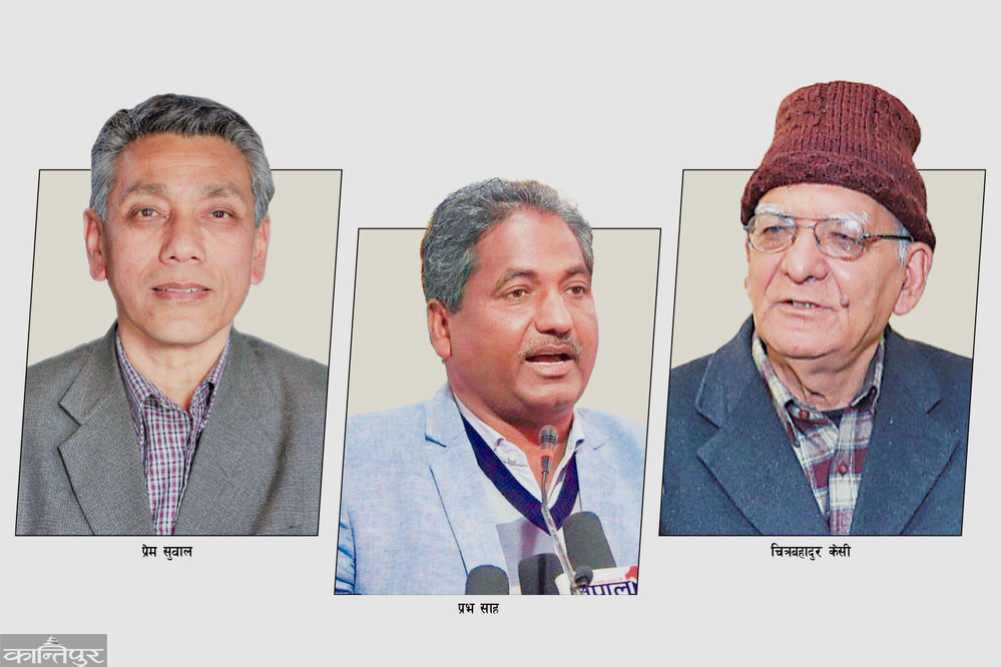
Some leaders who had previously won even when there was an alliance between opposition parties lost this time, nor did the dominance of Prabhu, who emerged from Maoist politics in 2064, persist, nor did the NEP maintain its hold on Bhaktapur. The Janamorcha turned blue in Baglung itself.
We use Google Cloud Translation Services. Google requires we provide the following disclaimer relating to use of this service:
This service may contain translations powered by Google. Google disclaims all warranties related to the translations, expressed or implied, including any warranties of accuracy, reliability, and any implied warranties of merchantability, fitness for a particular purpose, and noninfringement.
The Rastriya Janamorcha (RJM) has suffered a bitter defeat in the House of Representatives elections in Baglung, which is considered the party's stronghold. RJM had participated in this election in coordination with the Nepali Communist Party (NCP). The deposit of the RJM candidate has also been forfeited in the election.
According to the coordination, in Baglung Constituency-1, RJM's Krishna Prasad Sharma Adhikari was the candidate with the glass symbol and in Constituency-2, NCP's Gyamnath Gaire was the candidate with the star symbol. While Gaire was limited to third place, Adhikari finished fourth in Constituency-1. And, his deposit was also forfeited. The candidates of the National Independent Party have won in both the constituencies. According to the legal provision that the deposit is forfeited if the candidate does not get 10 percent of the total votes, Adhikari had to get 4,706 votes out of the 47,061 votes cast in Baglung to save the deposit. But since he received only 4,521 votes, the deposit was forfeited.
In Baglung Constituency-1, RSVP candidate Sushil Khadka won with 20,927 votes. His nearest rival Bhim Bahadur Shree Rana of the Congress got 11,944 votes and Hira Bahadur Khatri of the UML got 8,640 votes. Eight candidates, including the Rajmok Adhikari, failed to secure their deposit.
Similarly, in Baglung Constituency-2, RSVP candidate Som Sharma was elected with 12,647 votes. While Tekraj Poudel of the Congress came in second with 11,868 votes, Gaire of the NCP, who had aligned with the Rajmok, came in third with 10,709 votes.
In Baglung, where party president Chitra Bahadur KC had a strong influence, elections were often contested between Janamorcha and other parties. KC had become a 'brand' in Baglung politics. KC had a unique image with his original style and habit of making realistic comments on politics. KC has been campaigning against federalism since the constitution-making stage.
His main issue is that federalism cannot be tolerated in a country like Nepal. The same KC did not directly stand up this time, citing domestic problems. For KC to become an MP through proportional representation, the Janamorcha must cross the 3 percent 'threshold', which is unlikely. Although 70 candidates have been fielded from the Janamorcha across the country, the results have been disappointing in most places. After the security deposit was confiscated in Baglung, which is considered fertile ground for the Janamorcha, the Janamorcha's participation in the parliament is certain to be zero. And, this time, even the leftist stronghold of Baglung has collapsed.
Chairman Chitra Bahadur KC claims that there is also external influence on the party's defeat and the overall election results. He also said that the current result has come about because the major political parties in Nepal have not improved. 'I had warned the Congress, UML and Maoists in the parliament that they should improve, otherwise we will be finished. It seems that this is what happened now,' he said, 'but, the influence of the outside (America) is also equally responsible for the election results.' He claimed that he was targeted by external forces because he strongly opposed the MCC. He claims that he was also targeted by external forces from Mechi to Mahakali.
When there were 240 constituencies, there were three constituencies in Baglung. In that, the former No. 2 and current No. 1 constituencies were strongly held by the Janamorcha. Chairman Chitra Bahadur KC had been elected from there several times without an alliance. The Rajmo, which boycotted the 2048 general election, had won only one of the three constituencies in the district in the 2051 mid-term elections. Chitra Bahadur KC was defeated by a narrow margin from Baglung-2. Pari Thapa of the same party won from Baglung-3. Both KC and Thapa won in the 2056 parliamentary elections. In the first Constituent Assembly elections of 2064, only KC was elected from Baglung-2.
In the second Constituent Assembly election of 2070, the RJDM did not win any seats in Baglung. KC became an MP through proportional representation. In the 2074 election, an alliance of UML, Maoists and RJDM was formed. According to the alliance, RJDM had only two provincial MPs. However, the RJDM did not become a national party, winning all two provincial MPs. In the 2079 election, KC was elected as a member of the House of Representatives from Baglung-1 as a common candidate of the democratic alliance including the Congress, Maoists and RJDM.
From Baglung-2, the then Maoist leader Devendra Poudel won. This time, there has been a 'break' in the areas where the same party had been winning or where the same leader had been winning continuously. The 'bastions' where the same leader had been repeated from the same area have been destroyed this time. Along with continuous victories in most areas, the leaders who had built their legacy also tasted bitter defeat this time. The Rashtriya Swayamsevak Sangh (RSS) candidate got the credit for destroying the strongholds of leaders and parties in most areas. Candidates who were said to be sure of victory before the election could not even enter the competition when looking at the results. Those who came in second place have also lost by a much larger margin than the winning candidate.
This time, the election results have destroyed the traditional 'fortresses' of parties and leaders. Leaders who had won even when there was an alliance between opposition parties in the past have suffered defeat this time. In most areas, there was no strong competition between the first and second place candidates. Candidates of old and big parties, who have been maintaining political dominance until now, have suffered unexpected results. The Rashtriya Swayamsevak Sangh (RSS) party, which has given the slogan of 'change', has achieved great success. In such strongholds, the RSSP candidates have won with a large margin.
The communist strongholds under Lumbini Province have collapsed this time. The RSSP candidates have won in most of the 26 constituencies of Lumbini. In Rupandehi, Gulmi, Palpa, and Bardiya, the RSP candidates have won in areas where the Communists and Congress have been winning for a long time. Apart from the victory of coordinator Pushpa Kamal Dahal from East Rukum and Barshaman Pun from Rolpa, the NCP has lost its previous constituencies elsewhere.
Poudel's journey halted
UML leader Bishnu Poudel, who had been winning from Rupandehi-2 from 2064 to 2079, has been defeated this time. He was defeated by 28-year-old Sulabh Kharel of the Rashtriya Swayamsevak Sangh (RSS) with a huge margin of 43,689 votes. Out of the total 86,303 votes cast, Kharel received 56,550 votes. Despite being new in Rupandehi-2, Kharel received more than 65 percent of the votes. Poudel received 12,861 votes. Poudel had won by a narrow margin in the 2079 parliamentary election. In the last election, he had defeated Ganesh Poudel of the RSS. This time, however, he could not continue his victory.
Gokarna's fifth victory break
UML Vice President Gokarna Bista, who has been winning consistently from Gulmi-2, was also defeated. This time, he suffered a setback in Gulmi-2, which UML had counted on as a victory area in Lumbini Province. Although victory in other areas was not certain, the party ranks seemed confident that Bista would win the election. UML Vice President Bista was defeated by Govinda Panthi of the Rashtriya Swayamsevak Sangh (RSS). Panthi defeated Bista, who has been winning consistently since the second Constituent Assembly member election in 2070, by a margin of 561 votes. Former police officer Panthi received 16,967 votes while Bista received 16,406 votes. Bista, who has been a minister twice, is known as a development-loving and temperamental leader in the district. However, Panthi, who became a candidate for the first time, prevented Bista from winning a fifth victory.
Rana succeeds in Palpa-2
Communist candidates have been winning continuously in Palpa-2 since 2051. This time, Congress's Sandeep Rana has put a 'break' in it. Rana defeated UML's Narayan Prasad Acharya. Acharya was elected from this constituency in 2079 BS. Rana got 18,336 votes while his nearest rival Acharya got 16,811 votes.
Different results after 34 years
A Congress candidate has suffered defeat after 34 years in Dadeldhura, which has been considered a stronghold of the Congress since 2048 BS. This time, Tara Prasad Joshi of the Rashtriya Swayamsevak Sangh (RSS) has succeeded in destroying the Congress stronghold. He defeated his closest rival Nainsingh Mahar by a wide margin. While Joshi got 19,131 votes, Mahar got only 12,121 votes. Joshi had earlier been elected as a member of the Provincial Assembly as an independent candidate. This time, he resigned from his position as a member of the Provincial Assembly and filed his candidacy for the House of Representatives from the Rashtriya Swayamsevak Sangh (RSS). Joshi has a PhD from Jawaharlal Nehru University, India.
In previous elections, Dadeldhura had a different electoral scene. Sher Bahadur Deuba had been a candidate and won in all parliamentary elections since 2048. But for the first time, Deuba was not in the electoral contest this time. Dadeldhura, which has been at the center of Congress and power politics for 34 years, has come to an end with the collapse of Deuba's parliamentary journey. Deuba had won from here and became the Prime Minister five times and the MP seven times. In 2048, Deuba was not only elected as a candidate from here for the first time, but Dadeldhura also got the Home Minister. Since then, Deuba has been a player in power.
Oli's fortress collapsed
In the House of Representatives elections held after the Gen-G movement, leaders who were considered successful political players have also been defeated in Koshi Province. UML President KP Sharma Oli has been defeated by a huge margin from Jhapa-5. He was defeated by senior leader of the Rashtriya Swayamsevak Sangh (RSS) Balendra Shah. Oli had only been defeated in the first Constituent Assembly member election in 2006. This time, he, who seemed very confident of winning, had to face a bitter defeat. Shah, who reached Jhapa-5 after the RSS announced his prime ministerial candidate, received 68,348 votes, while Oli had to settle for 18,734 votes.
Celebrity promoted from 'Red Fort'
Nisha Dangi of the RSSP won in Jhapa-1, the base constituency of Congress Vice President Bishwaprakash Sharma. In Jhapa-3, which is considered the stronghold of RPP President Rajendra Lingden, who has won the election twice, he was also defeated by Prakash Pathak of the RSSP. Former Speaker Devraj Ghimire was defeated in Jhapa-2. He was defeated by Indira Rana Magar of the RSSP. LP Sanwa Limbu, who has won the election twice from Jhapa-4, was also defeated. He was defeated by Shambhu Prasad Dhakal of the Rashtriya Swayamsevak Sangh (RSS). In Morang-4 and 6, which are considered old strongholds of the Congress and the NCP, the bails of Jeevan Ghimire and Binod Dhakal of the UML were forfeited.
NCP's Amanlal Modi, who had won twice from Morang-4, was defeated this time by Santosh Rajbanshi of the RSSS. Similarly, Rubina Acharya of the RSSS destroyed the legacy of Congress leader Shekhar Koirala in Morang-6. Yogendra Mandal suffered a humiliating defeat in Morang-5. He won by a huge margin in 2079 BS but was defeated this time by Asha Kumari Jha of the RSSS.
New in Koirala's base area
This time, Congress leader Minendra Rijal and other celebrities had to face defeat from Morang-2, which has long been considered the base area of former Congress president Girija Prasad Koirala. Krishna Kumar Karki of the Rashtriya Swayamsevak Sangh (RSS) gave him a taste of defeat. Yagyamani Neupane of the RSS won from Morang-1, where the UML and the Congress have been winning alternately. Neupane defeated Khadga Phago of the Congress and Ghanshyam Khatiwada of the UML. In Morang-3, Ganesh Karki of the RSS defeated Dr. Sunil Sharma of the Congress.
Congress after 18 years
The legacy of the Congress has returned to Jajarkot after 18 years. Congress candidate Khadak Bahadur Budha defeated Shakti Bahadur Basnet of the NCP, who has won the House of Representatives three times, by a margin of 2,735 votes. Budha won by securing 20,142 votes, while Basnet was satisfied with 17,407 votes. He was elected as a member of the House of Representatives from the former Maoists in 2070, 2074 and 2079.
In the first Constituent Assembly member election-2064, the Congress stronghold collapsed after former Maoist Kali Bahadur Malla won from Jajarkot-1 and Bhakta Bahadur Shah from Jajarkot-2. Before that, Congress's Govinda Bikram Shah and Ratna Prasad Sharma were elected from Jajarkot in 2056. Congress candidates had also won in 2048 and 2051. Budha's victory, who is also the Congress district acting president, brought back the Congress legacy in Jajarkot after 18 years.
Basana after 12 years
In Dailekh, the stronghold of UML and former Unified Socialists has collapsed after 12 years. In Dailekh-1, Congress candidate Basana Thapa won with 12,372 votes, while his nearest rival Rabindra Raj Sharma of UML got only 11,796 votes. Sharma had won from UML in the 2074 election with 23,773 votes. त्यस्तै २०७९ को प्रतिनिधिसभा निर्वाचनमा १८ हजार २ सय ९७ मतसहित विजयी भएका साविक एकीकृत समाजवादीका अम्मरबहादुर थापा यसपल्ट ४ हजार २ सय ५६ मतसहित चौथो स्थानमा खुम्चिएका छन् । यस पटक थापा नेकपाबाट उम्मेदवार थिए । २०७० को दोस्रो संविधानसभा निर्वाचनयता कांग्रेसले जित हात पार्न सकेको थिएन । त्यसअघि २०४८, २०५१ र २०६४ सम्म कांग्रेसका गणेशबहादुर खड्काले जित्दै आएका थिए । २०७० को निर्वाचन पनि तत्कालीन नेकपाका उम्मेदवार थापाले नै जितेका थिए । थापाले २०५७ देखि नेपाल विद्यार्थी संघबाट राजनीति सुरु गरेकी हुन् ।
सुर्खेतमा सापकोटा
सुर्खेत–२ बाट रास्वपाका उम्मेदवार रमेशकुमार सापकोटाले ३० हजार ८ सय ४२ मतसहित विजयी मात्र भएनन्, यसअघिको कांग्रेस–एमालेको गढ पनि भत्काइदिए । उनी रास्वपाका जिल्ला अध्यक्ष पनि हुन् । २०५१ को प्रतिनिधिसभा सदस्य निर्वाचनमा एमालेका यामलाल कँडेल, २०५६ मा कांग्रेसका हृदयराम थानी, संविधानसभा निर्वाचन–२०६४ मा उनै कँडेल र २०७० मा पुनः थानी निर्वाचित भएका थिए । यसपल्ट भने कांग्रेसका नारायण कोइराला १६ हजार ३ सय ७८ मतसहित दोस्रो र एमालेका कुलमणि देवकोटा ११ हजार ५ सय ११ मतसहित तेस्रो स्थानमा खुम्चिए ।
भुत्तो भयो प्रभुको प्रभुत्व
आमजनता पार्टी (आजपा) का अध्यक्ष प्रभु साहको राजनीतिक विरासत ढलेको छ । यस पटक प्रतिनिधिसभा निर्वाचनमा उनले आफ्नो प्रभुत्व प्रदर्शन गर्न सकेनन् । उनी पाँचौं पटक संसद्को चुनावी मैदानमा थिए । रौतहटको राजनीतिमा लामो समयदेखि साहको एकछत्र वर्चस्व थियो । यस पटकको नतिजाले उनको जितको रफ्तारमा ब्रेक लागेको छ । नयाँ शक्तिका रूपमा रास्वपाको उदयले उनको ‘कोर भोट बैंक’ मा धक्का पुगेको छ । तत्कालीन माओवादी केन्द्र र एमालेजस्ता स्थापित दल छाडेर आफ्नै नेतृत्वमा आजपा गठन गरेपछि उनीसँग भएका पुराना र प्रभावशाली कार्यकर्ताको पंक्ति तितरबितर भयो ।
२०६४, २०७०, २०७४ र २०७९ को निर्वाचनसम्म प्रभुको प्रभुत्व कायम रहेको थियो । एमालेको दसौं महाधिवेशनबाट स्थायी कमिटी सदस्य बनेका प्रभुले २०७९ को निर्वाचनको मुखैमा एमाले छाडेका थिए । चुनाव जितेपछि उनले आजपा गठन गरे । रास्वपाले यस क्षेत्रमा २०७९ मा माओवादीबाट चुनाव लडेका रवीन्द्र पटेललाई अघि सारेको थियो । त्यस बेला रास्वपाका उम्मेदवार नवीन चौरसियाले १ हजार ६ मत ल्याई पाँचौं नम्बरमा थिए । अहिले २७ हजार ३ सय १८ मतले पटेल विजयी भए । लामो समय प्रभुत्व जमाइरहेका प्रभु तेस्रो भए । उनले ९ हजार ८ सय ९० मत मात्र पाए । मधेश राजनीतिमा प्रायः चर्चामा रहिरहने प्रभुको रौतहट–३ मा लामो समयदेखि एकछत्र प्रभाव रहँदै आएको थियो । तर रास्वपाको पछिल्लो जनलहरमा उनी पनि बढारिए ।
'गढ भत्किनु स्वाभाविक'
राजनीतिक विश्लेषक देवराज पोखरेल लामो समयसम्म एउटै क्षेत्रमा एउटै व्यक्ति निर्वाचित हुँदा त्यसले तयार गर्ने संरचना भ्रष्ट बन्दै जाने र समाजका लागि उपयुक्त नहुने बताउँछन् । धेरै स्थानका पार्टीका गढ र क्षेत्र लुटतन्त्रकै कारण भत्किएको उनले बताए । ‘लामो समय एउटै व्यक्ति निर्वाचित भइरहँदा सत्ताविरोधी जनमत तयार हुँदै गइरहेको हुन्छ,’ उनले भने, ‘अर्को डोमिनेसन लिगेसी हुने र त्यहाँ भ्रष्ट संरचना बन्दै जाने गरेकाले त्यस्ता गढहरू कुनै फरक मुभमेन्टमा भत्किने गर्छन् ।’
- विवेक पोख्रेल (काठमाडौं), घनश्याम गौतम (बुटवल), अर्जुन शाह (धनगढी), पर्वत पोर्तेल (विराटनगर), कृष्णप्रसाद गौतम (सुर्खेत), शिव पुरी (रौतहट) र दीपक परियार (पोखरा)