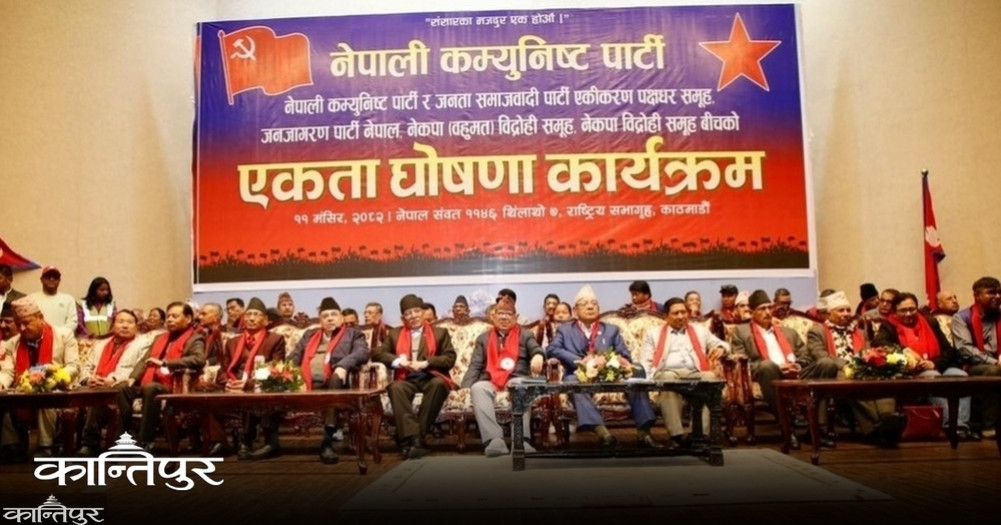
In the 2079 election, the Maoists and the Unified Socialists had 42 seats in the House of Representatives. The NCP is expected to win a maximum of 17 seats in this election. According to the proportional representation results counted so far, the NCP is expected to win 9 seats.
We use Google Cloud Translation Services. Google requires we provide the following disclaimer relating to use of this service:
This service may contain translations powered by Google. Google disclaims all warranties related to the translations, expressed or implied, including any warranties of accuracy, reliability, and any implied warranties of merchantability, fitness for a particular purpose, and noninfringement.
Nepali Communist Party coordinator Pushpa Kamal Dahal easily won the election from Rukum East in the House of Representatives election. The next day after receiving the victory certificate, he chartered a helicopter and returned to Kathmandu. His deputy, i.e. co-coordinator Madhav Kumar Nepal, finished fourth in Rautahat 1.
Nepal, including senior leaders who were candidates from Rukum East except Dahal and Barshaman Pun from Rolpa, suffered defeat. Dahal and Nepal, in accordance with the policy of preserving at least the arithmetic 42 seats of the last parliament in the House of Representatives, merged 25 parties and groups, including the Maoists, Unified Socialists, and Nepal Socialists, to form the Nepali Communist Party. But the NCP is expected to win a maximum of 17 seats in this election through direct and proportional representation.
Co-coordinator Madhav Kumar Nepal had focused on the election and merged all the parties that came into the NCP. Their attempt to split the votes by merging 25 parties did not succeed. They have won far fewer seats than expected. Seven have already been won directly, and if the candidacy of the Rastriya Swatantra Party candidate in Dhanusha 1 is rejected, it will reach eight. In the case of the RSVP, Matrika Prasad Yadav of the Maoist will win based on the counted votes.
In the 2079 election, the Maoists and the Unified Socialists had 42 seats in the House of Representatives. In this election, the NCP is expected to win a maximum of 17 seats. According to the proportional vote results counted so far, the NCP is expected to win 9.
It has won 8 seats directly. But in Dhanusha 1, the dispute of the Rastriya Swatantra Party candidate Kishori Sah Kamal has reached the court. In that area, the RSVP has the lead of Matrika Prasad Yadav of the NCP.
So far, the NCP has garnered 772,992 votes in the proportional representation for the House of Representatives. While in the 2079 BS House of Representatives election, the Maoists had received 1,175,684 votes under the proportional election system. Looking at this, it seems that the NCP has lost about 38 votes in the proportional representation.
Maoist leader Agni Prasad Sapekota said that the results of this election reminded him of 2070. The Maoists, which came first in the first Constituent Assembly (064), came third in 070. In 070, they had won 26 seats directly and 54 seats through proportional representation out of 601 seats. While in 064, they had won 120 seats directly and 100 seats through proportional representation.
Sapkota recalled that just before the 070 elections, there was a queue of people joining the Maoists. ‘At that time, there was a long line of people joining the party every day. But we had dropped from first to third,’ he said. Even after the formation of the NCP, party unification was taken to a war level. All parties, groups and individuals who came to the unification were incorporated into the party.
Due to this, the central committee of the NCP has reached 2,500. Not a single central committee has been held since the unification. The unification was carried out by keeping the elections at the center rather than on the basis of political and ideological ideas.
Sapkota said that the election was in the review phase due to unexpected results. ‘Nobody thought that this would be the outcome. Now it is time to review seriously and move forward,’ he said, ‘We were told that we would be the decisive force in this election.’
While the Rashtriya Swayamsevak Sangh (RSS) is about to win about two-thirds of the 183 seats, the NCP is in fourth place. The NCP has won the election only in areas with a Maoist ‘legacy’. NCP coordinator Dahal (Rukum East), Yubaraj Dulal from Sindhupalchowk-2 in Bagmati Province, Barshaman Pun from Rolpa in Lumbini, Gopal Sharma from Rukum West in Karnali Province, Ramesh Kumar Malla from Salyan, Mahendra Bahadur Shahi from Kalikot and Dhan Bahadur Budha from Dolpa have won.
The parties, including the Maoists and the Unified Socialists, were united in the third week of Kartik. After the formation of the NCP, the number of parties and groups had reached 25. The parties, groups and key leaders who have joined the NCP unification are Pushpa Kamal Dahal, NCP (Maoist Center), Madhav Kumar Nepal, Chairman, NCP (Unified Socialist), Mahindra Ray Yadav, Chairman, Nepal Socialist Party, Rajendra Shrestha, Coordinator, JSP Unity Support Group and Raj Karki, Chairman, NCP (Socialist).
Similarly, Chet Bahadur Pun 'Chiran', General Secretary, Nepal Communist Party, Ranjita Shrestha, Chairman, Civil Liberation Party, Prem Bahadur Singh, Chairman, NCP (Socialist), Shivalal Thapa, Vice President, JSP Nepal, Bhim Rawal, Proposer, Matrubhumi Jagran Abhiyan, Nepal, Pramod Narayan Yadav, General Secretary, Nepal Communist Party (Workers), Subash Raj Kafle, Chairman and Jana Samajwadi Party Nepal.
Other parties that will be merged into the NCP include Karnajit Budhathoki, Chairman, NCP (Maoist-Socialist), Keshav Dahal, Chairman, Maoist Communist Center Nepal, Bishnu Prasad Khanal, Coordinator, Janajagaran Party, Sharad Rasaili, Coordinator, NCP (Majority) Rebel Group, Gopal Kirati, Chairman, Patriotic Socialist Front, Gopal Pariyar, Coordinator, NCP Rebel Group, Vicharman Thing, Chairman, Greater Nepal Communist Party, Manish Limbu, Chairman, Limbuwan Krantikari Party and Suman Sayami, Senior Vice President, Rastriya Mukti Party.