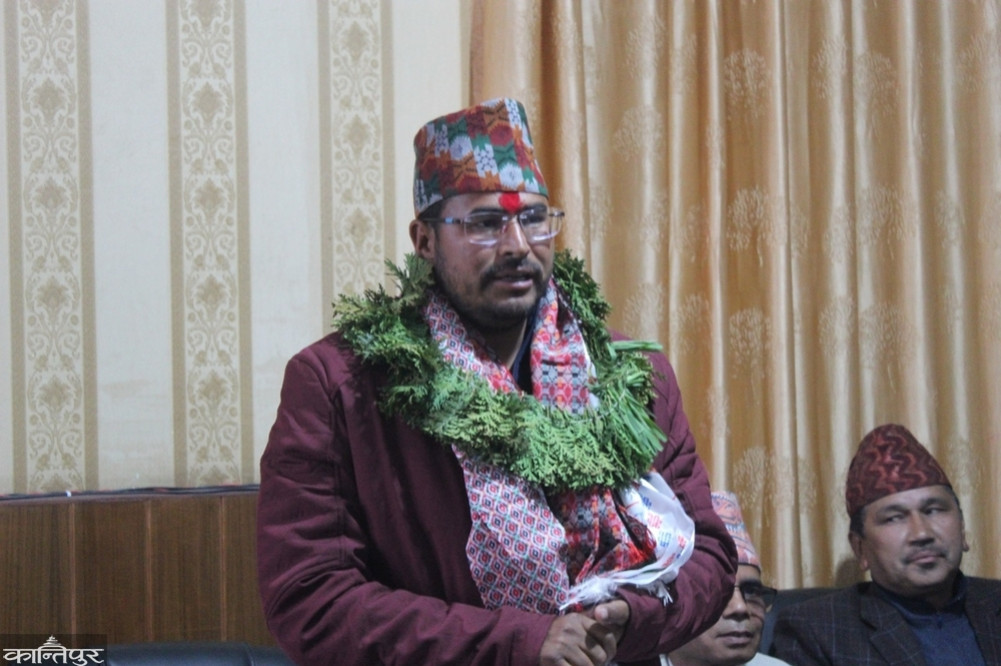
Even though the defeated parties accused him of being a retrograde and the voters of being retrograde, in practical terms this is a victory for his personality.
We use Google Cloud Translation Services. Google requires we provide the following disclaimer relating to use of this service:
This service may contain translations powered by Google. Google disclaims all warranties related to the translations, expressed or implied, including any warranties of accuracy, reliability, and any implied warranties of merchantability, fitness for a particular purpose, and noninfringement.
The election results are coming in. The wave of the RSP has swept the so-called big parties. The RPP has also fallen into this wave. This party, which carries the issue of monarchy, has been able to win only one seat in the direct election. It is struggling to remove the threshold in the proportional election.
The RPP has won one seat in Jumla. In Jumla, which is considered a stronghold of the communists, Gyan Bahadur Shahi of the RPP defeated the NCP candidate Naresh Bhandari. It was estimated that Bhandari would win due to his intelligence and gentle style.
On the other hand, the RSP wave was going on across the country. Therefore, Binita Kathayat, a former RSP MP, was also considered a strong candidate.
Thus, on one hand, Bhandari, who initiated the establishment of the Karnali Institute of Health Sciences, and with visionary plans such as the Dhauligadh Large Drinking Water Project, Chukeni Hydropower Project, and the Sinja Civilization Bill, emerged on the strength of a large organization, and on the other hand, the craze of Balen and Ravi. Therefore, the main competitor was thought to be between Naresh Bhandari and Binita. However, if elected, it was Shahi of the RPP, which had a weak organization.
Shahi, who gained popularity due to his honest and aggressive style, not only secured the post of MP, but also wrote history. The people of Jumli, who have been changing leadership in every election since 2048, 'broke' it this time, and made Shahi an MP again.
Why did this happen? How did RPP spokesperson Shahi pave the way for his second consecutive term in the House with a spectacular vote?
Personality and identity
Even though the RPP ranks have been claiming Shahi's victory as the party's victory, it is only a technicality. In fact, Jumli voters voted for Shahi as an individual rather than a party. The reason for this is his presentation in the House, his voice of personality and identity. Shahi also contributed to breaking the image of turning up one's nose in the urban area as soon as he said Jumli. Everyone had heard a Jumli MP speak and criticize from the House. The tone in which Shahi questioned the government and other parties changed the identity of not only him but also the entire district.
When someone asked, "Where is home?" and heard the answer, "Jumla," he said, "Oh, it's Jumla!" and was viewed with a negative view of backwardness, unsettled lifestyle and geographical remoteness. But after he was elected for the first time and entered the House, the questions and voices he made forced him to change that identity. Even when going from Ilam in the east to Kanchanpur in the west, the proud response that came as soon as Jumla Ghar was mentioned, ‘Oh, I am from Gyanendra Shahi’s district,’ made all the people of Jumla accept Shahi as their proud voice. For the same reason, voters did not see him as a party candidate but as the voice of the entire Karnali.
Geographical discrimination
Regardless of the analyses that came from outside, the election results of the district in the last election and this time, geographical factors also remained important. Before Shahi won for the first time, most of the leaders in the district were winning around the district headquarters. Although the district is known as the center of civilization outside, the district headquarters-centered leadership, which has been taking political advantage for a long time, continued to discriminate against Sinja and rural areas.
Even when village leaders dared to reach the upper echelons of the party, there were incidents of not only ignoring them but even physically attacking them. This attack was carried out not only by leaders but also by the so-called ‘marketer’ Rabaiya. Regarding development and participation, the district headquarters area had been adopting a discriminatory policy for a long time. Due to the hegemony of the market area and the compelling circumstances of not having a candidate from their area, rural voters, forced to vote, saw Shahi as their representative and won.
Easy availability
Let alone the issue of MPs, Shahi is a leader who is always available to everyone when the general public finds it difficult to meet even the ward chairperson. Whether in the district or in Kathmandu, he never delayed the people who wanted to meet him. His popularity among the youth also remained due to his initiative to rescue people from abroad when someone from the district was in trouble. He not only helped the people of Jumli who came to Kathmandu hospitals for treatment, but also went to the hospital to meet them.
This ease also gave the people the opportunity to get to know him closely. The presence of the leader himself in times of trouble also made him a favorite among the people. This culture is rarely seen in other leaders in the district.
Marketing of local products
Another incident that made him famous across the country is apples. Even though they are produced at a cost of billions, he played a miraculous role in the marketing of apples. Although it cannot be said that the Jumli apples found a market only because of him. But two years ago, when the apples were rotting on the road due to floods and landslides, he did not act as an MP but as a common man and saved the Jumli apples from being destroyed. Even though the apples were consumed in the market, his action acted as a catalyst for branding the Jumli apples across the country.
Not only apples, he also raised his voice in the House about other local products. Even though the opponents made fun of products such as Choto and Dantelo, even those who had never heard of him got information about them because of him.
Leadership role in the party
Although other party leaders have party organizations and influence in the district, the perception is growing that Shahi is no longer just a district-level leader. In political history, no party leader has ever been able to achieve the status of reaching the office-bearer level in any party and making decisions.
Not only this, Shahi had already established a hold on his party in front of leaders who could not fight for their constituencies by bowing down to the party leadership. Immediately after being elected for the first time, Shahi became the spokesperson and even the chief whip in the house of the national party. Shahi had increased his influence in the eyes of the district residents because of his ability to put pressure on the party and his leadership role in the house. The recognition that Shahi is the leader of Karnali, not only by the district residents but also by the people outside, also became the strength of his victory this time. Expressing gratitude to the voters and supporters after the election results, he said that even though he was in the election field with his own agenda until the voting, after the victory he became a common representative of the entire district residents. He has also expressed his commitment to raise the problems and prosperity issues of the district in a more forceful manner in the house.
The internal strife within the rival party also proved to be helpful for Shahi's victory. Internal disputes within the former Maoists (now the NCP) are not new to the district residents. In the last elections, Bhandari was accused of causing the defeat of her own party's candidates. In the 2070 elections, the work of capturing booths and flooding the ballot boxes was done under Bhandari's leadership. For the same reason, when Gajendra Mahat lost, the Congress took advantage of it.
At that time, Bhandari was affiliated with the Baidya Maoists. Even after he joined the Maoist Center, the Mahat faction had not forgotten the reason for that defeat. Similarly, in the 2079 elections, Goma Gautam Kunwar became a candidate from the Maoist-Congress alliance, and Bhandari is still accused of playing a role in his defeat. This internal strife also helped Shahi's second innings. Although he was elected, he carried the issue of the monarchy with him. Although the defeated parties accused him of being a regressive and the voters of being a supporter of regressiveness, in practice this is a victory for his personality.