After the seats are distributed based on the percentage of votes received by the party, candidates on the closed list are selected.
We use Google Cloud Translation Services. Google requires we provide the following disclaimer relating to use of this service:
This service may contain translations powered by Google. Google disclaims all warranties related to the translations, expressed or implied, including any warranties of accuracy, reliability, and any implied warranties of merchantability, fitness for a particular purpose, and noninfringement.
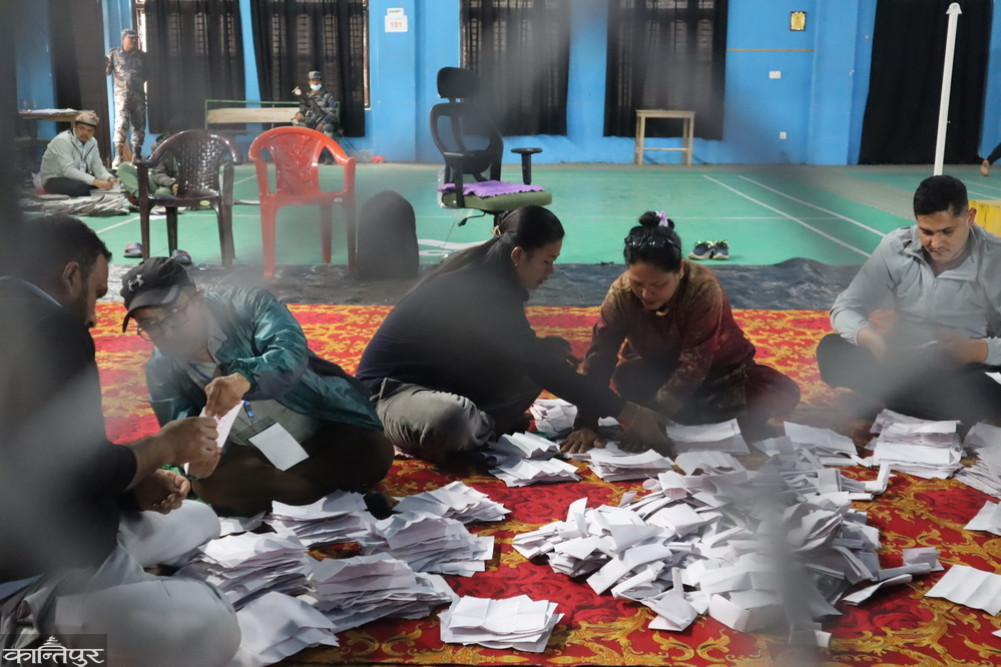
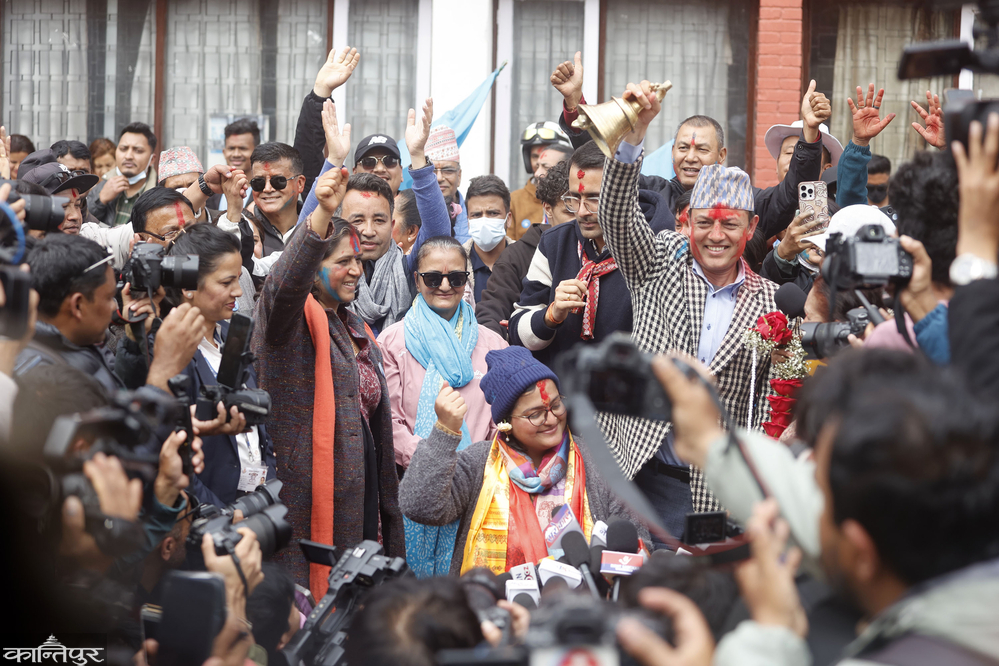
The Rashtriya Swayamsevak Sangh (RSS) is leading in most of the direct constituencies in the House of Representatives elections and is also ahead in the proportional vote count. Proportional vote counting is underway in the constituencies where the direct counting has been completed.
According to Kul Bahadur GC, assistant spokesperson of the Election Commission, the counting of proportional votes has started on Friday in Kathmandu 1, 6 and 8. As per the results till 6 am on Saturday, the Rashtriya Swayamsevak Sangh (RSS) has got 22,442 votes. This is 56 percent. The Congress, which is in second place, has got 7,505 votes. The RPP is in third place with 3,165 votes. The UML, which is in fourth place, has got 2,990 votes. The Shram Sanskriti Party (960 votes) is in fifth place and the Nepali Communist Party (951 votes) is in sixth place.
According to assistant spokesperson GC, proportional votes are counted from each counting center and sent to the Election Commission. After that, the commission distributes 110 seats based on proportional votes. To get proportional votes, a party must deduct 3 percent of the total votes.
How are proportional seats determined?
There is a constitutional provision that 110 members of the 275-member House of Representatives will be elected through the proportional system. 65 parties have submitted their closed lists of candidates to the Election Commission for the proportional system. After allocating seats based on the percentage of votes received by the parties, the candidates on the closed list are selected.
 After the final results of the proportional vote count are released, the 3 percent mark of the total votes received is made a 'threshold'. Then, the votes received by the 65 parties that participated in the election in the proportional election are compared with the 'threshold' mark. In that process, the parties that have crossed the 'threshold' limit and the parties that have not crossed the limit are divided. The parties that have not crossed the 'threshold' limit are eliminated from the selection process. The votes received by the excluded parties are also deducted from the total total votes received in the proportional election. After this reduction, the remaining votes are calculated and then the winning number in the proportional election is obtained. In this way, the eligible parties and votes are selected.
Seat extraction process
The ‘Saint Log Method’ is used to extract the winning seats in the proportional election that the parties that have crossed the ‘threshold’ will get. For this, 110 odd divisors are extracted, increasing from 1. All these odd divisors are divided by considering the votes obtained by the eligible (threshold) parties in the proportional election process as the divisor. In Table 1, as the divisors of all the parties are divided, different quotients are obtained. The largest number of the quotient obtained in this way is the elected seat. This means that there are 1 to 110 odd divisors up to 219. When all the vote results obtained by the party are divided by up to 219, a different quotient is obtained.
When dividing by each odd number, the party whose quotient is higher among the quotients obtained in that palace is the elected seat. This means that the first large quotient is followed by the second large quotient, and 110 large quotients are obtained, all of which are elected seats. The quotients obtained in this way may not belong to the same party in all the houses.
The seats won by the party are added according to which quotient, and the total winning seats of the party are obtained. This sequence continues until 110 seats are elected. Naturally, the seats are determined according to the vote result obtained by the party. This also means that more votes mean more seats, fewer votes mean fewer seats. This is how the party obtains the winning seats in the proportional election.
'Cluster' division process in the winning seats
After the winning seats are obtained in the proportional election, the party recommends the candidates in the priority order within the 'cluster' to be elected. When making such a recommendation, the number of MPs of that party in the National Assembly and elected to the House of Representatives through the first-past-the-post method determines how many will be elected in which 'cluster'. According to the provisions of the constitution, Dalits 13.8, Adivasi Janajati 28.7, Madhesi 15.3, Tharu 6.6, Muslim 4.4 and Khas Arya 31.2 should be elected. 50 women should be elected in all these ‘clusters’.
Representation from backward areas and people with disabilities should be ensured in proportional elections. A closed list of at least 11 people must be submitted to the Election Commission to participate in the proportional election system. If a party wins seats in the proportional system, how does it elect them according to the ‘cluster’? When dividing the 11 people according to their percentage, 11 people are elected, including Adivasi Janajati 3, Khas Arya 3, Tharu 1, Dalit 2, Madhesi 2. 50 percent of these 11 people should be women.
 Without reducing the number of those elected in the ‘cluster’, the number of directly elected members of that party and the number of MPs in the National Assembly and the ‘cluster’ represented have an impact on the group elected in the proportional system. After the proportional seat distribution, the number of seats won by the party directly, the number of MPs in the National Assembly, and how many of them are women should be calculated to ensure 33 percent representation of women in the federal parliament.
The Election Commission sends a letter to provide the priority order of those elected according to the 'cluster', subject to all conditions. After the letter, the Election Commission publishes a list of people elected under the proportional system from various parties based on the percentage of priority order representation received.