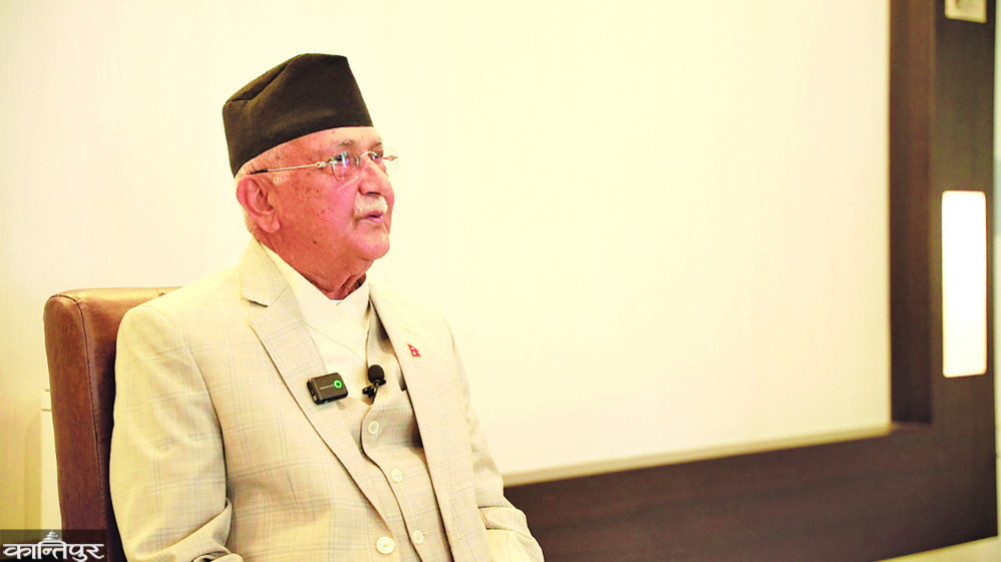
After casting his vote in Bhaktapur, Oli had told reporters on February 21, ”UML will get the majority it can. Even if it does not get the majority, it will become the main party. My party has asked me to become the Prime Minister.”
We use Google Cloud Translation Services. Google requires we provide the following disclaimer relating to use of this service:
This service may contain translations powered by Google. Google disclaims all warranties related to the translations, expressed or implied, including any warranties of accuracy, reliability, and any implied warranties of merchantability, fitness for a particular purpose, and noninfringement.
After the results of the 2079 election were made public, UML Chairman KP Sharma Oli, who had reached Jhapa to present his certificate, had spoken to journalists at Chandragadhi Airport on 8 Mangsir 2079 and said that the rise of the Rastriya Swatantra Party was a 'minor matter'. He had said, 'The Swatantra Party has emerged thanks to the grace of the media, it is not a big deal.'
However, today, the same 'minor' party that he considered 'minor' not only challenged his political legacy, but also demolished the 'Red Fort'. 'What is the margin of this constituency that always wins by a margin of 50,000 votes?' Oli had said, 'Double.' Leader Oli, who always defeats others with a large margin, was now defeated by three times more votes. While Balendra Shah of the Rashtriya Swatantra Party got 68,348 votes, Oli got only 18,734 votes.'
The election storm of the Rashtriya Swatantra Party has made UML celebrities including UML Chairman Oli Has defeated across the country . Veteran leaders of other parties have also been defeated .
When he was the Prime Minister, Oli gifted a tabla to the then Mayor of Kathmandu Metropolitan City, Balendra . There was not much discussion about why he gave that gift . However, this election seemed to symbolically play the same tabla rhythm on Oli's politics .
Oli's political character is always associated with the style of considering himself 'great' and others 'inferior' . He is considered a very confident leader . That is why he has a habit of saying whatever he wants . Despite being on the support of a transplanted kidney for a long time, he is still active in political life . The proverbs he uses to satirize his opponents also come into the news . Dozens of his video clips made public on social media during the election reflect that .
Oli kept talking till the election day. Balendra remained silent. After the election, his voice was not heard much. After casting his vote in Bhaktapur, he had told journalists on 21 Falgun, ‘UML will get the majority. Even if it does not get the majority, it will become the main party. My party has asked me to become the Prime Minister.’
In a video a few months ago, a journalist asks, ‘If you compete with Balen Shah, is your victory certain?’ Oli replies in his usual style, ‘What is the question?’
During the election campaign in Jhapa, another journalist had asked, ‘How important is winning or losing in the election?’ Oli’s answer was, ‘Of course it is important. But, for me or for others? Where did you get the word ‘defeat’ for me?’
In an interview, he had even claimed that he would win by getting the most votes in Nepal. ‘60 thousand votes come in the Sun sign. The rest of the votes are divided among 23 candidates,’ he had said.
In another video, he was asked, ‘Will the Rashtriya Swayamsevak Sangh (RSS) government be formed after Falgun 21?’ Oli had replied with a laugh, ‘There was a Rashtriya Swayamsevak Sangh (RSS) government before Falgun 21, and then it was gone.’
But time has changed. The election results after the Genji movement showed how costly it can be to consider an opponent as ‘insignificant’ in politics. Oli’s defeat was not only unforgettable, but also sure to be written in the pages of history as an example of how ‘Oli’s tendency to underestimate others can ultimately be fatal for himself. This election has also taught a lesson about the consequences of taking the emergence of new political forces lightly. Time is not always ‘right’ in politics. Sometimes the one who plays the rhythm plays, sometimes the one who listens to the rhythm. This time, Oli has reached a point where he has to listen to the rhythm.
Oli was elected from the then Jhapa-6 in 2048, 2051 and 2056 and rose to the position of deputy leader of the parliamentary party. He was elected as a member of the Constituent Assembly from Jhapa-7 in the 2070 election and was also elected as a member of the Federal Parliament House of Representatives in the 2074 election from Jhapa-5.