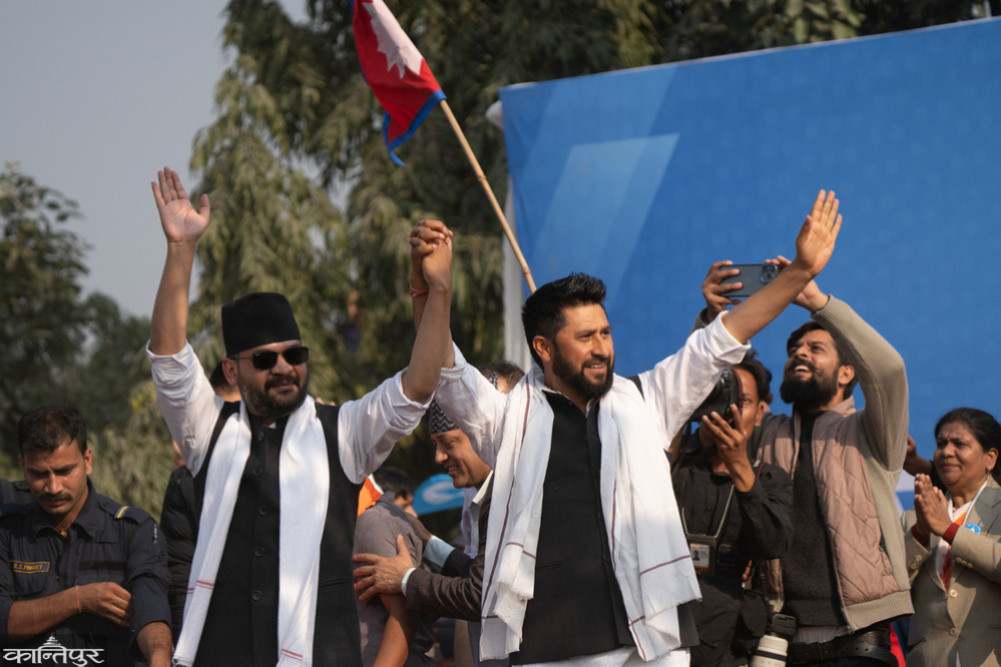
The power struggles of the old parties have created frustration and anger among the common people. As a result, the electorate has staged a 'ballot rebellion' in this election.
We use Google Cloud Translation Services. Google requires we provide the following disclaimer relating to use of this service:
This service may contain translations powered by Google. Google disclaims all warranties related to the translations, expressed or implied, including any warranties of accuracy, reliability, and any implied warranties of merchantability, fitness for a particular purpose, and noninfringement.
The preliminary vote count has shown clear signs that the 'danger bell' will ring for the Congress, UML and NCP in the House of Representatives elections. The Rashtriya Swayamsevak Sangh (RSS) which was in fourth place in the 2079 general election is certain to become the first party, judging by the current preliminary results.
The wave of 'bells' that began with the 'entry' of former Kathmandu mayor Balendra Shah is making the RSSP the largest party in the country. The Congress-UML, which was in government before the Gen-G movement, have suffered the biggest setback in this election. The Congress, which came first with 89 votes in the dissolved parliament, and the UML, which came second with 78 votes, are now in a position to pay a heavy price for the human losses caused by the Gen-G movement.
At that time, UML Chairman KP Sharma Oli was the Prime Minister and Congress leader Ramesh Lekhak was the Home Minister. The then Maoists and the Unified Socialists (currently NCP) were in the opposition. Although the Congress-UML alliance was warned as the opposition, its eyes were on the government. The coalition government had about two-thirds of the votes.
The Congress was transformed into a special general convention under the leadership of Gagan Thapa. The issue of leadership transfer had been raised in the party for a long time. The Congress, which entered the elections under the leadership of Thapa, was not liked by the voters because it had been in power for a long time.
Similarly, in the third week of Bhadra, the UML general convention had elected KP Oli as the president. It is seen that the UML will suffer a big setback if the anger among the voters turns into votes due to the Oli government, which is responsible for the Gen-G movement.
Despite supporting the Gen-G movement, public opinion has not been in favor of the NCP. The NCP seems to be struggling to become the fourth party.
After the promulgation of the constitution in 2072, the Congress, UML and NCP, which led the government in turn, could not provide good governance, control corruption, create government services and create employment as per the people's expectations. The common people were disappointed and angry due to the power game.
They have launched a 'ballot' rebellion in this House of Representatives election in search of hope for that disappointment and anger. Voters have chosen the Rashtriya Swatantra Party (RSWP) to lead the country through a mandate by electing senior leader of the Rastriya Swatantra Party (RSWP). The test of the RSWP will begin as soon as the full election results are out.
The National Independent Party (RSWP) has started its victory from Kathmandu-1. According to the initial vote count, the RSWP has left the Congress, UML and the NCP behind the RSWP.
The vote count in Jhapa-5 has shown a risk for former Prime Minister UML Chairman Oli. He has been trailed by senior leader of the Rastriya Swatantra Party (RSWP).
Similarly, in Rupandehi-2, Sulabh Kharel of the RSWP has surpassed UML Vice President Bishnu Poudel. General Secretary Shankar Pokharel is at risk in Dang-2.
UML leader Ishwor Pokharel is in third place in Kathmandu-5. Rastriya Swayamsevak Sangh (RSS)'s Sasmit Pokharel is far ahead. Congress General Secretary Pradeep Poudel is also far behind Sasmit. Similarly, in Kathmandu-4, Rastriya Swayamsevak Sangh (RSS)'s Pukar Bam is far ahead of UML Secretary Rajan Bhattarai. Bam is being followed by Congress' Sachin Timalsena.
It is equally difficult to win Congress President Gagan Thapa in Sarlahi-4. Senior leaders including Thapa are at risk due to the strong momentum of the RSS. Another Congress General Secretary Gururaj Ghimire is in third place in Morang-4. There too, Rastriya Swayamsevak Sangh's Santosh Rajbanshi is far ahead. Congress leader Shekhar Koirala is also far behind in Morang-6. There too, RSP candidate Rabina Acharya is far ahead.
Secretary Bhanubhakta Dhakal is ahead by a small margin among the UML office bearers. UML General Secretary Shankar Pokharel is unlikely to win in Dang-2.
The Congress and UML, who were previously in first and second place, will fall to second and third place. But the ongoing vote counting has indicated that the size of the parliament will be very small.
Nepali Communist Party coordinator Pushpa Kamal Dahal, who is running from Rukum East, is far ahead of the other candidates. Since the RSP has little influence in the Maoist base area, it is not difficult for him to win. Dahal, a clever player in Nepali politics, had reached Rukum East according to the policy of 'saving lives in times of famine, saving seeds in times of famine'.
Next, the NCP is also ahead in Kalikot, where the Maoists have a good influence. Mahendra Bahadur Shahi is ahead of Harsh Bahadur Bam of the Congress. Prakash Neupane of the Rashtriya Swayamsevak Sangh is in fifth place. The NCP has claimed that it is likely to win in Rukum West, Rolpa and Salyan, which are under Maoist influence. The Maoists, which came in third place in the 2079 general election, will be in fourth place this time. According to the trend of the initial vote count, it is seen that Coordinator Dahal will not have the 'magic number' in the parliament. It is seen that he will be present in the parliament. The NCP's wave is also seen to affect the Rastriya Prajatantra Party, the Madhesh-centric party Janata Samajwadi Nepal, and the public opinion. The
'The bigger the victory, the more restraint is needed'
After the Congress, UML and NCP, which have a long and struggling history, have shrunk to a smaller size, their role in the parliament will be important. Political scientists have said that the important issue is how the RSVP, as the largest party in the parliament and the party leading the government, treats the opposition parties and how it cooperates on national issues.
Political science professor Krishna Pokharel said that the test of the RSVP to run the country with restraint while respecting the mandate it has received has begun. 'According to the vote count so far, it is seen that the RSVP will become the largest party by getting the first public vote.' As the largest party, it will lead the government, he said, 'The bigger the victory in democracy, the more restraint one has to work with the opposition parties. Now the test of the RSVP has begun.'
Pokharel said that in the absence of RSVP representation in the National Assembly, the opposition parties should take the Congress, UML and NCP into confidence and work wisely and intelligently on national issues. "The success of the Rashtriya Swayamsevak Sangh (RSS) will depend on how wisely it utilizes the mandate it has received," he said. "Now, the RSSS will need collective intelligence to work according to the will of the people."