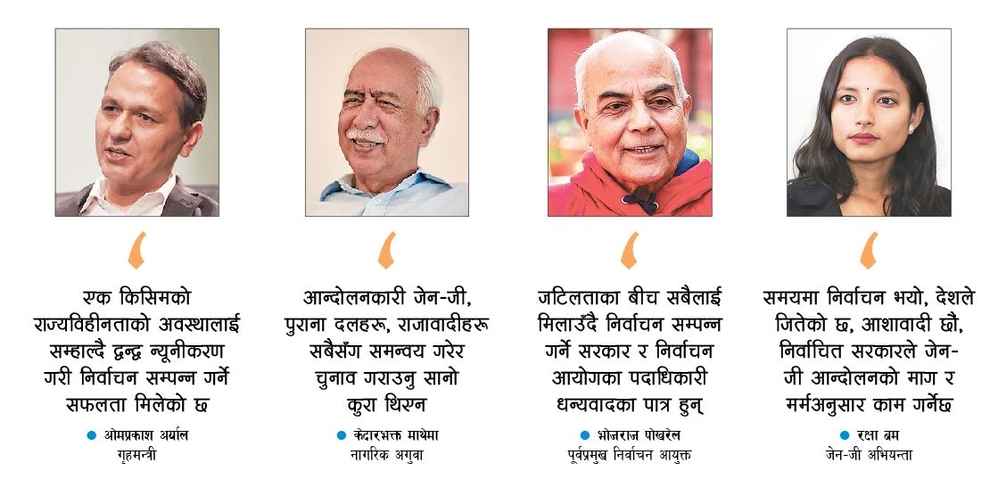
In the backdrop of the Gen-G movement on 23 Bhadra, President Ram Chandra Poudel sought a solution by going beyond the constitutional provisions and using 'big tricks', and the government was formed under the leadership of Karki. Civic leader and educationist Kedar Bhakta Mathema said that this government achieved success by 'walking on gunpowder'.
We use Google Cloud Translation Services. Google requires we provide the following disclaimer relating to use of this service:
This service may contain translations powered by Google. Google disclaims all warranties related to the translations, expressed or implied, including any warranties of accuracy, reliability, and any implied warranties of merchantability, fitness for a particular purpose, and noninfringement.
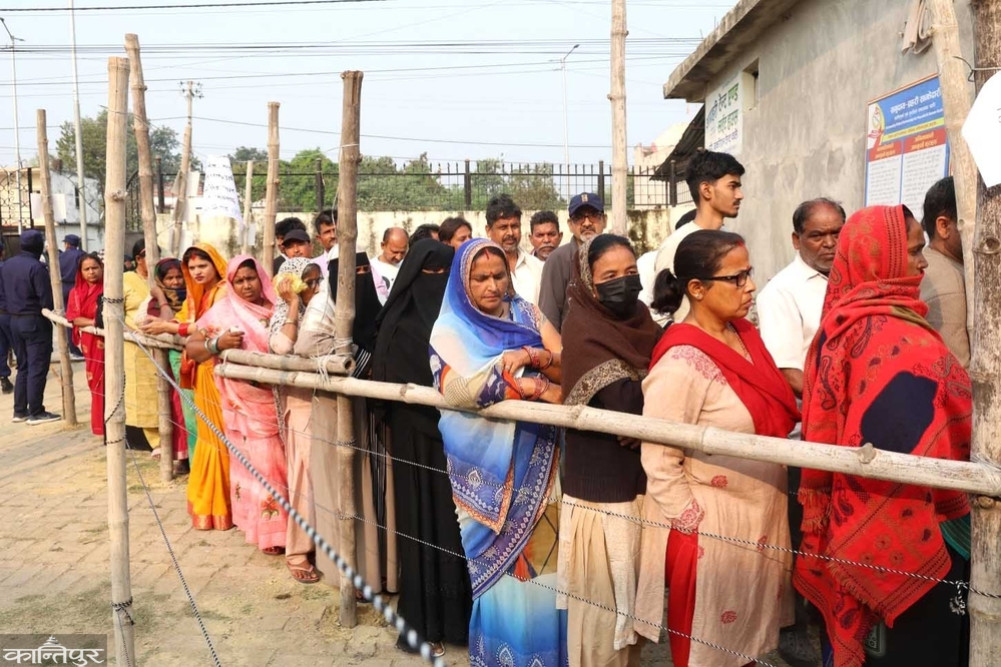
The government led by former Chief Justice Sushila Karki, which took charge amid the chaotic atmosphere created by the Gen-G movement, held elections to the House of Representatives on Thursday. With the peaceful completion of the elections, the 'constitutional vacuum' left by the dissolution of the House of Representatives on 27 Bhadra has found a legitimate outlet.
In the backdrop of the Gen-G movement on 23 Bhadra, President Ram Chandra Poudel went beyond the constitutional arrangements and sought a solution by ‘big tricks’. Civic leader and educationist Kedar Bhakta Mathema said that this government achieved success by ‘walking on gunpowder’.
‘It could have exploded as soon as it started mining,’ he said, ‘It was a success to bring it here without getting involved. It was no small matter to coordinate with the agitating Gen-G, old parties, and royalists and hold elections.’
When forming the government under Karki’s leadership, President Poudel had given a mandate to hold elections within six months. Initially, there was uncertainty about whether there would be an election or not. In the meantime, there were many rumors of changing the government and amending the constitution. However, the election was finally held. ‘There was uncertainty about whether there would be an election at all, where the constitution would go, now that is over,’ Mathema said.
Talking to Kantipur after the election on Thursday, Prime Minister Karki recalled that when she initially took charge, there was no environment for dialogue with all parties. ‘We gradually took all parties into confidence and increased dialogue and harmony,’ she said, ‘There was no alternative for all parties to come together. Everyone realized that elections were the appropriate democratic way out of that situation.’
According to the Election Commission, about 58 percent of the votes were cast in the election on Thursday. Not a single person lost their life during the election, and no constituency had to vote again. Home Minister Omprakash Aryal says that they succeeded in conducting the election by managing a kind of statelessness and minimizing conflict. ‘We normalized the situation by balancing the opposing forces,’ he said, ‘After the rule of law was guaranteed, the environment for the election was created.’
This government has conducted the election amidst the loss of life and property during the Gen-G movement and the chaos that has spread across the country. During the Gen-G uprising, 77 people were killed, and private and public property was vandalized and set on fire across the country. Former Chief Election Commissioner Bhojraj Pokharel says that he is grateful to the government and Election Commission officials for “convening everyone to the elections amidst the complications.” “I vividly remembered the situation during the 2064 Constituent Assembly elections,” said Pokharel, who was the Chief Election Commissioner in the first Constituent Assembly elections. “The elections were held in the last place amid the same challenge of whether or not they would be held.”
Anil Sinha, who worked with Prime Minister Karki as a judge in the Supreme Court when he was Chief Justice and who also holds the responsibility of Law and Industry Minister in the current cabinet, says that the government “seized this opportunity amidst enormous challenges.” “In the meantime, artificial problems arose again and again, a minefield was prepared for spreading false news,” he said. “Recently, a large crowd had started gathering to prevent the elections from taking place. In the meantime, this opportunity given by history was seized.”
Gen-G movement leader Raksha Bam thanked Prime Minister Karki, government ministers, and every mechanism in the state and voters for successfully holding the election peacefully. ‘There was a dilemma whether the election would take place or not. But the voting has been completed with enthusiasm and in a peaceful manner. This also reflects the character of our society. It seems that the society wants peace and sympathy. It seems that it is looking for good governance. Gen-Gs are enthusiastic,’ she said, ‘Elections were the minimum condition for an interim government. Democracy requires a people-elected government. This was also the ‘mandate’ of the Gen-G movement. That has been fulfilled.’
Bam has also expressed gratitude to the President and the Prime Minister on social media for holding the election and overcoming the country’s crisis. Recalling the critical situation after the Gen-G movement, she said on social media, ‘I still remember that day (Bhadra 27) clearly. Immediately after the oath-taking, the President shook hands with Prime Minister Sushila Karki and said, "Now the burden of the country is on your shoulders. Please hold the elections on time. Best wishes," she praised the President and the Prime Minister, "Thank you, Mr. President. You are the cornerstone of our democracy. You set an example of what constitutional dignity and determination should be in times of crisis. Thank you, respected Prime Minister. For saving the country, for accepting responsibility and moving forward in difficult times."
She believes that the election will provide a solution for the country. "Regardless of the results, the election was held on time. The country has won. We are optimistic. The elected government will work according to the demands and spirit of the movement. We want a corruption-free state. The people's elected government that will be formed will address common issues. All mechanisms of society deserve thanks," she said.
Former Supreme Court Justice Girish Chandra Lal said that regardless of the results, a peaceful election will strengthen the democratic system in the country. He said that the question raised by some about the constitutional status of the government after the dissolution of the House of Representatives with the formation of the government has now been resolved with the election. ‘The Supreme Court could not give a decision on time,’ he said, ‘but now this question of legitimacy is no longer for the new government.’
Former Justice Lal considered the completion of the election a ‘very big’ success amid uncertainty about whether the election would take place or not and whether it would be peaceful later. ‘Thank you to Prime Minister Sushila Karki and the government for this success,’ he said.
Former IGP of Nepal Police Basanta Bahadur Kunwar responded that the election was conducted commendably. ‘Comparatively, it was a better, fearless, fair and peaceful election than the previous one. It was possible through collective efforts,’ he said, ‘The government, the head of government, the Election Commission, security agencies, political parties, took responsibility and worked together to make the election successful. They are all commendable.’
He said that all security agencies, including the army and police, understood their responsibilities and started preparing for the election with confidence. ‘The rumor that there will be no elections was only sponsored. It was completely defeated. The independent government did not seem to be biased towards anyone. With the full support of the government, the security agencies were also able to prepare for the elections,’ said Kunwar.
Civic leader and educationist Mathema says that the completion of the elections alone ‘will not fix everything’, and says, ‘The new government should communicate with all parties to end the chaos, maintain good governance, and provide peace and security.’
Former Chief Election Commissioner Pokhar also says that if a new government is formed with a majority, ‘it should sit with all national forces and form a common opinion to move the nation forward’ and even if a coalition government is formed, ‘the distortions of yesterday should not be allowed to repeat’. ‘There has been an explosion of anger every 10 years,’ he said, ‘now there is no way to wait 10 years, nor can the country afford repeated elections.’ Home Minister Aryal also says that the new government’s priorities should be to prevent corruption, control chaos, and provide services.