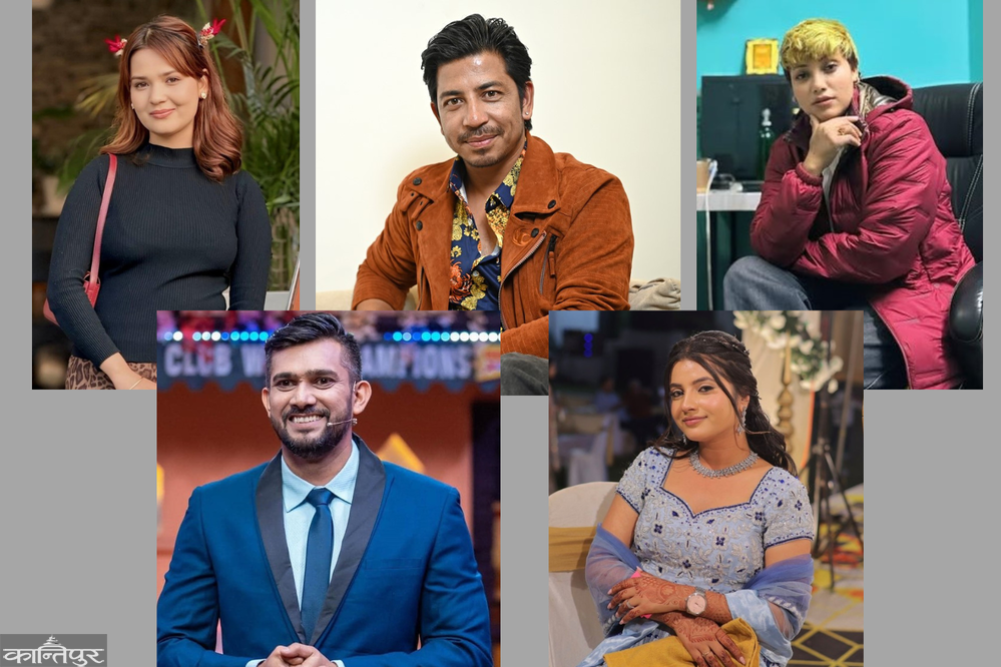
When expressing support or opposition to a party or candidate, men are not only being sold to brokers or for money, and women are being directly questioned about their character, but there has been an increase in the number of sexual harassment in society.
We use Google Cloud Translation Services. Google requires we provide the following disclaimer relating to use of this service:
This service may contain translations powered by Google. Google disclaims all warranties related to the translations, expressed or implied, including any warranties of accuracy, reliability, and any implied warranties of merchantability, fitness for a particular purpose, and noninfringement.
When someone expresses their opinion or comments in favor or against a political party or candidate competing in the election, the other group immediately threatens them on social media and engages in character assassination. When a statement is made in support or opposition of an issue, men are not only sold out for money or money, and women are not only questioned about their character, but also sexually harassed socially. This has contaminated the election environment.
The 47th episode of the television program 'Comedy Nights with Champions' is currently being widely criticized on social media. As soon as UML Secretary Mahesh Basnet appeared in the 'trailer' broadcast on Sunday, the program's host and director Vishal Bhandari began to be abused. After the attacks on social media intensified, Bhandari wrote a status on social media and warned of legal action.
Bhandari 'shared' the 'trailer' on Facebook at 7 pm on Sunday. After that, the abuse began saying 'Rest in peace brother Vishal Bhandari' and 'Jhole'. Some made violent comments saying 'It's time to skin Vishal Bhandari and lie on the road'.
If the program is broadcast, it was warned that they would protest and boycott every work in the coming days. Not only that, Bhandari has also been abused obscenely. Even people with Nepali flag profiles have abused their parents, children, and sisters.
The episode of ‘Comedy Nights with Champions’ aired on Tuesday also featured caricatures of Nepali Communist Party (NCP) coordinator Pushpa Kamal Dahal and former mayor of Bharatpur Metropolitan City Renu Dahal. The NCP-affiliated ‘Gen-G Red Force Nepal’ issued a statement objecting to their caricatures. ‘The video portrays respected leader Renu Dahal, a prominent figure of our Nepali communist movement and the coordinator of the Nepali Communist Party,’ the statement said. The organization has objected to this.
Bhandari says that criticism can be part of democratic practice, but personal insults and threats are unacceptable. ‘After saying that I will take legal action, the threats have started to decrease a bit,’ he says.
Content creator Suruchi Budhathoki has also faced intolerance from some social media users. After RSP President Ravi Lamichhane was released from Nakkhu prison during the Gen-G movement, she made a video saying 'Go back Ravi Lamichhane'. In the video, she said that they did not agitate to release anyone from prison and that it was wrong for someone to be released from prison under the cover of the Gen-G movement. But after her statement was made public, she was abused on platforms including Facebook and Reddit.
The abuse was not limited to Suruchi. Her family's photo was also circulated on social media. A collage of her family's photo, calling it 'Nepo Kid', was made public by a page called 'Troll Tollywood' and became a 'troll'. The same photo was made viral on Facebook and other pages called 'NEB Nepal'. Even now, when she speaks in favor of a good candidate without supporting any party, Suruchi said that she is often asked, 'How much money did that party give?'
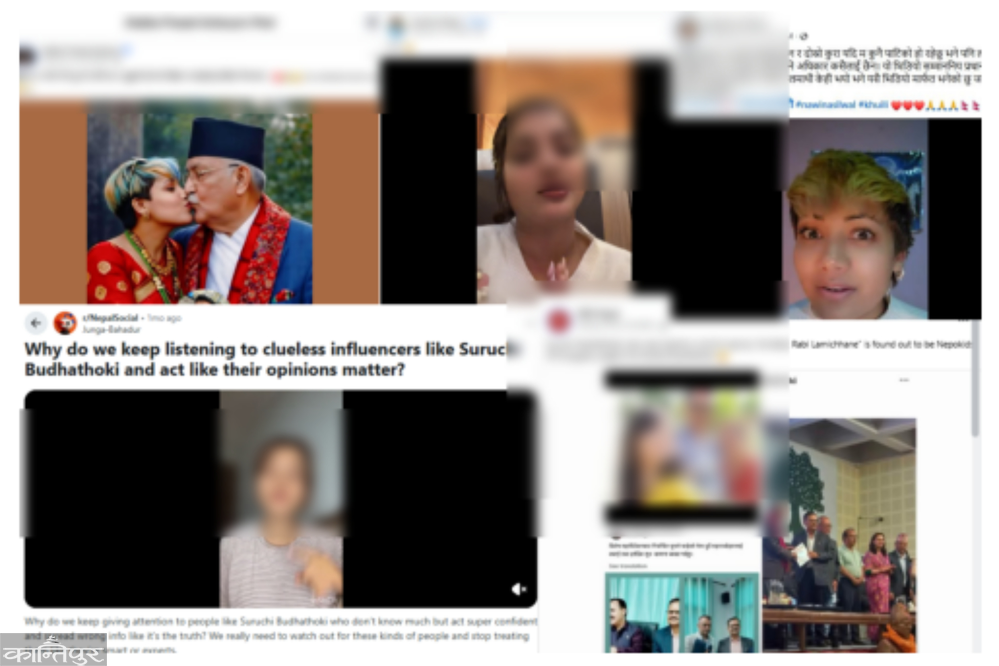
She says that she was deeply affected by the insults she received by posting family photos in the comments section. ‘After seeing the hatred towards me and my family, I have become unable to speak on social media,’ she said. ‘Photos of my parents are uploaded everywhere and written as ‘hanging’. That is why I am afraid to even speak/write anything.’
Navina Silwal is an artist who has been targeted by a mob on social media due to her political comments. Known as ‘Khuili’, she says that she was character assassinated when she spoke about the cooperative fraud case involving Rashtriya Swayamsevak Sangh (RSS) President Lamichhane and the general public being cheated. ‘As soon as political questions are asked or criticized, there is an increasing tendency to use abusive language, character assassination, and create fake photos (deepfake) and spread them on social media,’ she said.
A picture of UML Chairman KP Sharma Oli and Navina has now gone viral on social media with objectionable messages. ‘How many people are there who abuse others by using obscene words! They send messages directly,' she said.
Navina is currently seeking legal redress under cybercrime. 'Before I became an artist, I was a citizen of this country. It is not only my right but also my duty to speak about the country's politics and future,' she says, 'The abuse and mental pressure on social media are forcing many to remain silent. Yesterday, our parents were afraid to speak, they fought and made us able to speak. But today, a situation has arisen where we have to be afraid to speak our minds again,' she said.
Singer Jyoti Magar also once fell victim to a photo created using AI technology. At the 13th general convention of the UML, she was seen eating an orange with Oli. But the same photo was made 'deepfake' and made viral on social media in an offensive way.
During the elections, every party has made message-based songs and music videos. But model and TikTok star Smarika Dhakal apologized before the video was released, fearing that she would be attacked on social media for acting in the same video.
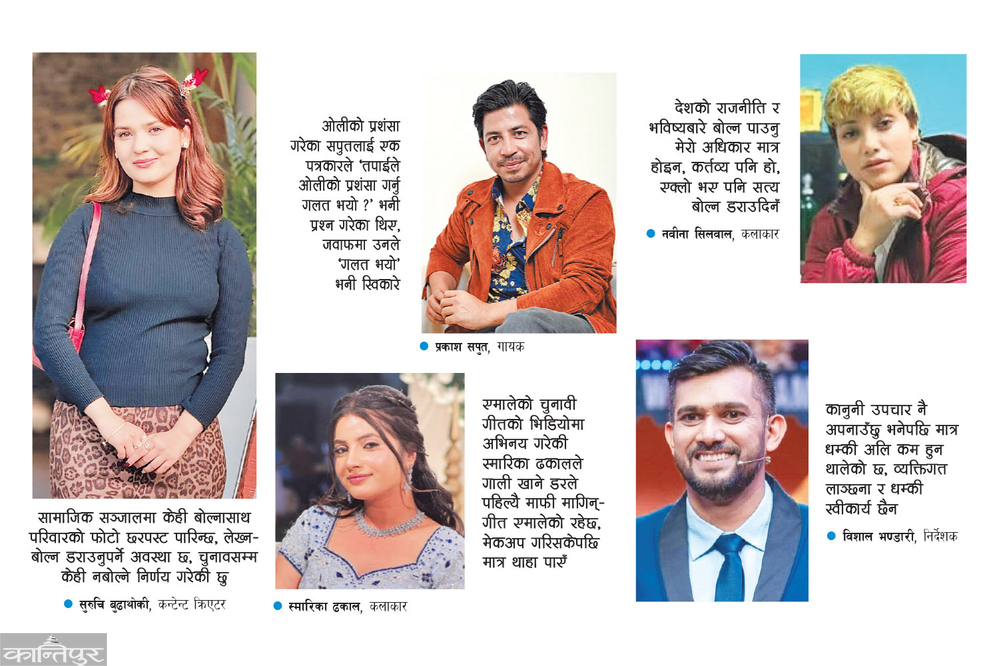
‘I made a huge mistake. I know that you guys will abuse me. I am regretting it now. Sometimes people make mistakes,’ she said, folding her hands, ‘The team I have worked with now is the same team I have worked with before. That is why I went after they called me. The song is from UML. I only found out after I did my makeup.’ Smarika told Kantipur that she apologized after the video was released, fearing that the audience would abuse her.
He said that he and his friends faced hatred and anger on social media when they spoke and wrote about the caste system, women’s rights, and patriarchy. ‘Some people will easily digest it, but some of my friends are afraid to speak out and are depressed because of such practices,’ he said. Singer and actor Prakash Saput had to face trolls and boycotts on social media when he praised UML Chairman KP Sharma Oli. On 19 Falgun 2081, Saput had said at the book launch event ‘KP Sharma Oli: Sapana, Sangharsh Ra Sankalp’ that he should learn to struggle from Oli. ‘KP Oli’s life is inspiring for those who hold back from dreaming, hold back from progress, and hold back from struggling,’ he had said.
After Saput’s statement, there was abuse on social media, including his caste. So much so that a campaign was launched calling for a boycott of his film. The controversy affected the release of his film ‘Basant’. Regarding the same incident, on October 10, at a promotional event for the film ‘Soltini’, a journalist asked Saput, ‘Was it wrong for you to praise Oli?’ In response, he admitted that it was ‘wrong.’ Saput is currently a candidate for the proportional representation seat of the Rashtriya Swayamsevak Sangh (RSS).
Be it the advance apology of Smarika or the abuse of Vishal Bhandari, all these cases convey a common message – there is a competition to express personal frustration and spread hatred by misusing social media.
Satire, criticism and support are natural aspects of democracy. Digital platforms are an easy means of expression. But activities such as personal character assassination and attacks on families, and creating and distributing obscene images through AI are also polluting the socio-political debate. Even though there is a legal remedy against it, the collection of evidence, process and judicial delays in cybercrime make it very difficult for the victims to get immediate relief.
Writer and civic activist Sanjeev Upreti says that ‘bullying’ is being practiced all over the world because no one has control over the digital space and no one knows who is writing what from where.’ He says, ‘This is a problem. It prohibits different ideas.’
He said that he and his friends have faced hatred and anger on social media when speaking and writing about the caste system, women's rights and patriarchy. 'Some people can easily digest it, but some of my friends are afraid to speak up and are depressed because of such practices,' he said.
Santosh Sigdel, Executive Director of Digital Rights Nepal, says that not only political activists but also ordinary citizens are afraid to express their opinions on social media. Although the practice of voters asking questions and candidates answering is common in elections, he analyzes that some parties and candidates have tried to prohibit questions. 'If political parties do not move forward by saying that they are ready to listen to questions and different opinions, an open society and democracy will not be promoted,' he says. 'If parties themselves make it a habit to listen to questions, activists will not attack as soon as they ask questions.'
He says that if people are afraid to speak up on social media, democracy will be in even greater danger. "Right now, it is impossible to openly say whether I support this party or am close to it. Such a practice risks losing dialogue and questions from society, and fostering a leader-oriented system," he says.