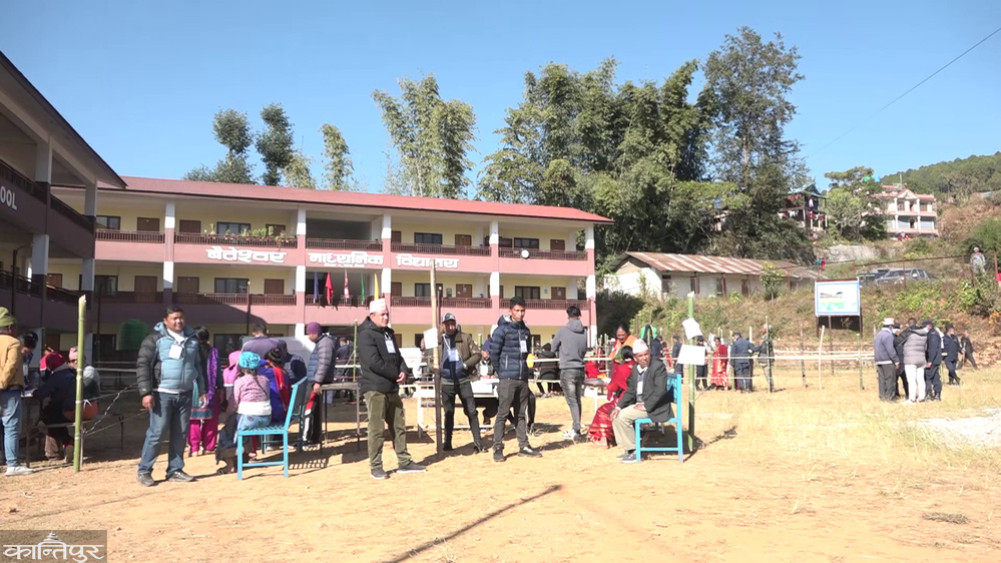
Incidents of booth capture in contested areas, clashes with other parties or security personnel, and injuries and deaths from gunfire have occurred in every election.
We use Google Cloud Translation Services. Google requires we provide the following disclaimer relating to use of this service:
This service may contain translations powered by Google. Google disclaims all warranties related to the translations, expressed or implied, including any warranties of accuracy, reliability, and any implied warranties of merchantability, fitness for a particular purpose, and noninfringement.
Voters are curious about the upcoming House of Representatives elections in Dolakha, which remains turbulent in every election. Shooting and booth capture are common in every election here. Dolakha has always had violent incidents in elections since 2048.
From 2048 to 2056 elections, there was a series of booth capture and clashes between the Congress and the UML. In 2064, the same disease spread to the then Maoists. At that time, the Maoists disrupted the UML assembly and even occupied the booth. In some places, the Maoists even disrupted the Congress assembly. In that election, the Maoists attacked the bus and car carrying UML leaders/activists while they were returning from the assembly, and security personnel opened fire, killing two Maoist activists. Many were injured.
There was a tripartite clash in the 2070 Constituent Assembly elections. Sometimes Maoist-Congress, sometimes Maoist-UML, and sometimes Congress-UML. Security personnel had to fire daily to control the clashes. On the day of the 2070 election, there were clashes at more than a dozen polling stations in the district, and there are records that more than a hundred rounds of bullets were fired by security personnel.
At that time, the Congress and the Maoists had filed a complaint with the Election Commission alleging that UML had occupied booths at more than a dozen polling stations. The counting of votes was stopped for 5 days. Finally, the parties agreed to participate in the counting of votes.
Tensions increased after a UML cadre was killed in a clash between UML and Maoist cadres in Gaurishankar Rural Municipality-2 during the campaign for the 2074 local level elections. In the same election, in Melung Rural Municipality-1, immediately after the voting ended, Congress cadres seized a ballot box, claiming that it was rigged, broke the sealed ballot box and threw the ballot papers, resulting in one person dying due to abuse from the police. More than half a dozen people were shot.
Although the 2074 election was relatively peaceful, clashes broke out at half a dozen polling stations. The police fired dozens of rounds of bullets. In that election, the Congress had filed a complaint alleging that the UML-Maoist alliance had captured booths at dozens of places.
In the 2079 local level elections, Vaityashwar and Tamakoshi Rural Municipality were tense. Booths were captured in four wards of Vaityashwar and up to 98 percent of the votes were cast. This trend did not stop even in the 2079 House of Representatives elections. This year, the UML had alleged that the Congress-Maoist alliance had occupied 11 booths. An elderly voter at the polling station in Vaityashwar-6 had broken the ballot box after being unable to cast his vote. After the Election Commission investigated, it found evidence of booth occupation in four polling stations, and re-election was held in these places.
The general electorate has been feeling unsafe due to the shooting during elections and the violence at polling stations. Voters have been saying that they have not been able to vote at some polling stations for years. As the election time approaches, voters are starting to question whether they can participate in the elections peacefully.
Despite accusations of booth occupation, the parties still do not want to take responsibility for such activities. The parties accept that booth occupation occurs. But none of the parties wants to take responsibility.
Former MP Ananda Prasad Pokharel says that parties should respect the public opinion. "Parties should abandon the practice of using any tactic to win elections by preventing people from casting their votes," he said. "We should learn lessons from past incidents. For this, this time, I am personally trying to reach an agreement to stop such activities by having all candidates and party representatives in the district."
He said that an all-party agreement should be made to send a message to secure the people's votes. He said that the parties have an opportunity in the 2082 elections to erase the stain of booth-capturing that has been happening nationally. Out of 95 polling stations, 52 polling stations have been placed on the highly sensitive list. Similarly, 28 polling stations have been placed on the sensitive list and 15 on the general list.
Former House of Representatives member Ganga Karki said that there should be some kind of understanding between the parties for a fair election. ‘Discussions are underway between the parties and the former members of the House of Representatives for a fair election. I am confident that there will be an agreement to make it fairer than the previous elections,’ he said. ‘The election I contested in was the most peaceful in history. Even though the election was repeated in some places, the results did not change.’ He said that the parties had also learned something from the last election.
The administration has claimed that a special security plan has been made for the election to be held peacefully in Dolakha this time. Chief District Officer Hari Prasad Ghimire said that booth capture and fake votes will not be allowed this time. He said that security basecams including the Nepal Army have been set up in various places in the district for the safety of voters.
‘An all-party agreement has been reached to make the election peaceful and fair,’ he said. ‘We are confident that the parties will implement the agreement we made with them. We have adopted a special security strategy for polling stations in sensitive areas. We will not allow any voters to complain that they were not able to cast their votes.’ He said that a security strategy for voters and polling stations, including ballot boxes, has been made after looking at the situation of past incidents.