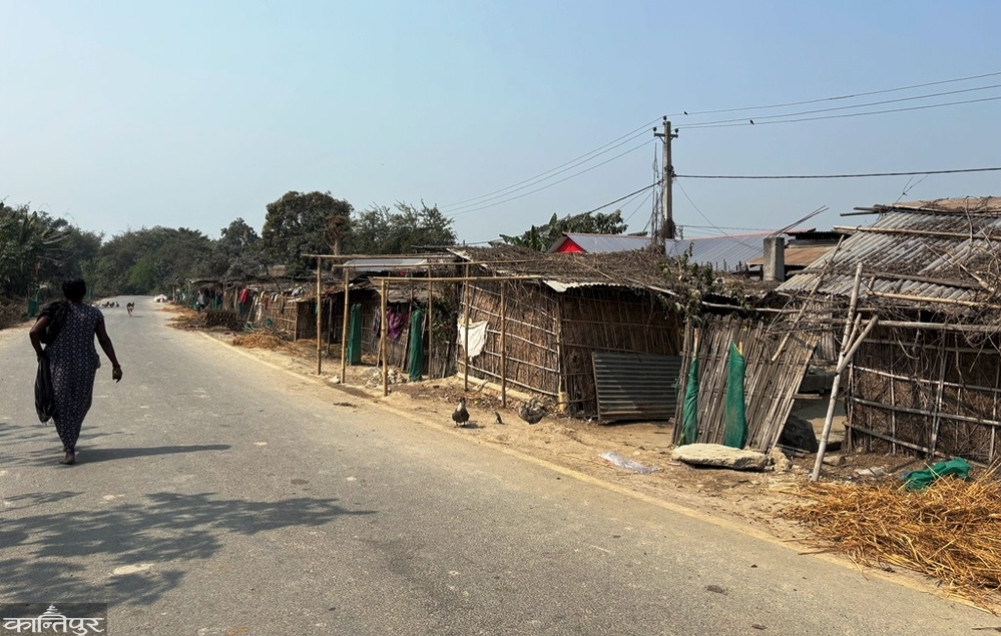
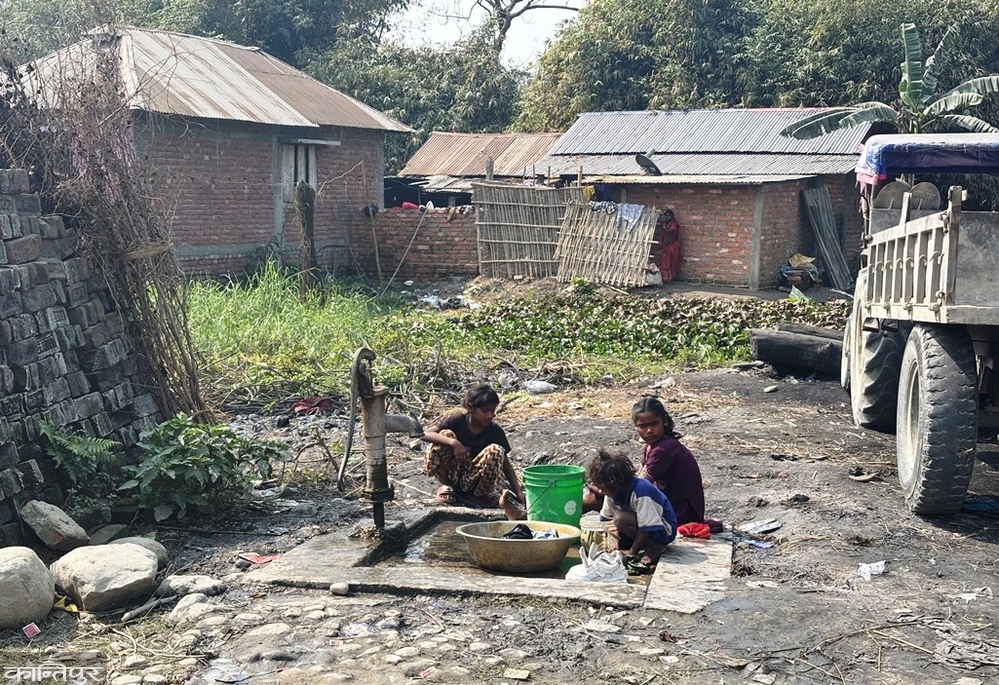
A blacktop road has been built in Karaiya, where about 60 families live in Musahar. However, toilets have not been built. There is also a magnificent temple in the village. However, the entire village has to rely on a tube well.
We use Google Cloud Translation Services. Google requires we provide the following disclaimer relating to use of this service:
This service may contain translations powered by Google. Google disclaims all warranties related to the translations, expressed or implied, including any warranties of accuracy, reliability, and any implied warranties of merchantability, fitness for a particular purpose, and noninfringement.
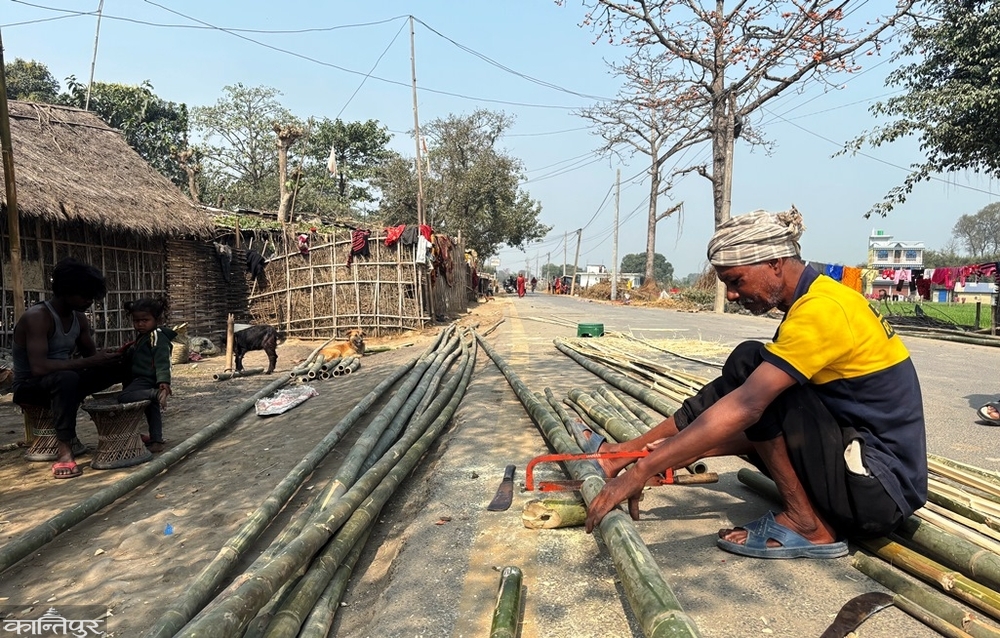
Budhiganga Rural Municipality, which borders Biratnagar Metropolitan City, is in Morang's constituency number 6. Dilcharan Rishidev of Musahar Tol in Budhiganga-1 Karaiya was chopping green bamboo with the help of a saw.
Suresh Rishidev, who was working with him, spoke in his own rhythm, ‘What can you do, sir? You can’t eat without working. Who will look after us poor laborers?’ Until last year, this village was covered with dust in the winter. In the rainy season, it was covered with mud. Everything around was already blacktopped. But, this village’s turn has finally come this time.
Before Kantipur asked what was the benefit of blacktopping the road in front of the house, Shambha Kumari Rishidev, who was sitting on her lap with her child in her arms, said with a laugh, ‘Earlier, the wind used to blow the dust, now cars do.’
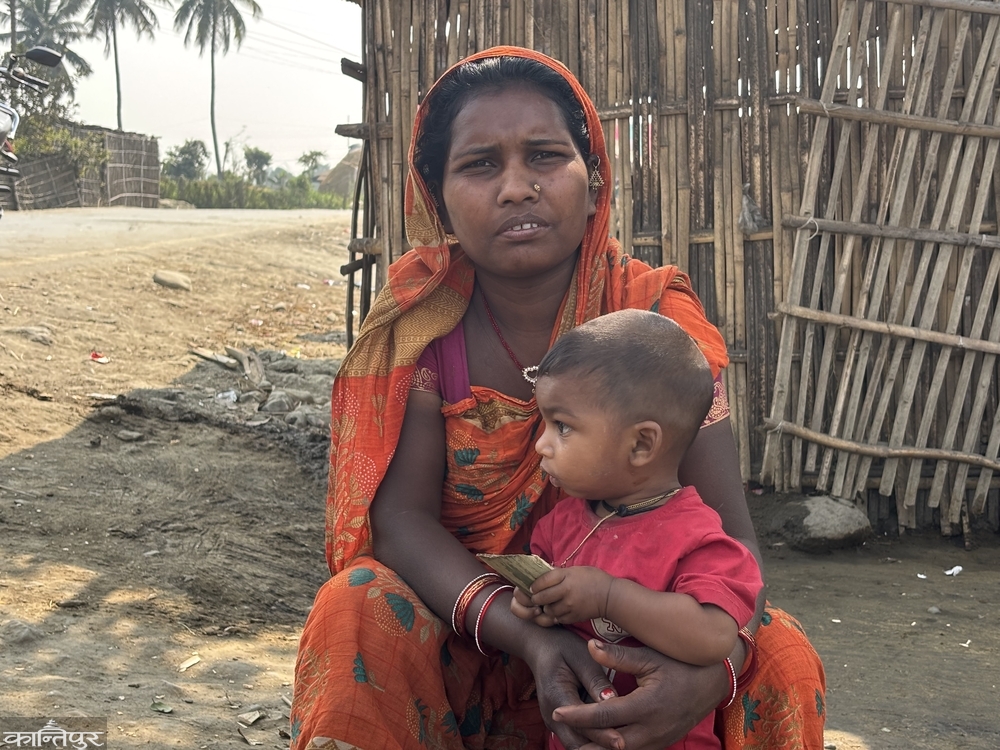
Before the blacktop was made, not many vehicles used to pass through this road. When the blacktop was made, vehicles started passing in droves. From cars to motorcycles. Sometimes, long-distance Indian travelers also drive towards the factory, making this village dusty. This road connects to the eastern highway. From here, the blacktop road reaches Gachhiya in Sundar Haraincha Municipality.
A blacktop road has been built in Karaiya, where about 60 Musahar families live. However, a toilet has not been built. There is also a grand temple in the village. However, the entire village has to rely on a tube well.
The Musahars consider Dina-Bhadri as their ancestral deity. A political party, appreciating their faith, has built a grand concrete temple. However, no leader has seen the lack of toilets and drinking water here so far. ‘We would have preferred to have toilets and running water,’ said Hemantidevi Rishidev, ‘The toilets and water were more important than the temple.’
The land in this village where the Musahars live does not belong to them . They claim that their ancestors acquired this land by clearing the forest . However, landowners including Mohan Koirala from Biratnagar have been claiming this land as theirs . ‘The owner keeps threatening us by saying, “Give us the land today, leave it tomorrow,” complained Patri Rishidev, ‘Where will we go after leaving this land?’
They are also being asked to leave the land immediately and go to India . However, they are staying put . ‘Where will we go after leaving the land where we have been living for years, what will we eat ?’, said 60-year-old Visunya Rishidev, ‘The government should not evict us from here .’
Since the land is not in their name, there is no way to have a title deed . There is no title deed . Most of them do not even have citizenship . Some said that they paid money to get citizenship. 'Our ancestors were born here, they died here, we are not believed to be Nepalis', Bisunya Jungiye, 'How long will we live as stateless people? How long will we live as landless people?'
Party candidates have started coming to this neighborhood seeking votes. This time, their common demand for the candidates is 'Vote for those who prevent us from getting up and living.'
The fate of the Musahars of Budhiganga-4 Gokuwa is also similar. 16 households have been living on the open land on Gachhiya Road for years. However, they have not received the Dhanipura. Local 60-year-old Darshan Rishidev says, 'There is no document, no citizenship.'
The municipality has built a pucca house for poor and needy families. But they did not get it. Because they did not have land in their own name. ‘If we had land, we would have also got a pucca house,’ said 58-year-old Rita Rishidev, ‘We have taken a loan from installments and built a hut.’
According to ward number 4 ward member Chanudevi Rishidev, the Musahar family was deprived of a pucca house because they did not have land in their name. ‘A two-room pucca house was built for the poor and Dalits,’ she says, ‘We did not have land, we did not get a house.’
The municipality closed the school where Musahar studied.
There were two community-based child development centers in Musahar settlement of Khajra, Budhiganga Rural Municipality-1, which is considered remote in Biratnagar. Manokamana was on the banks of the Singhiya River and the ward office was near the Dipajyoti Child Development Center. Around 50 Musahar children aged three and under used to study here. However, the rural municipality has closed the poor Musahar study center.
The rural municipality had been providing Rs 10,000 annually as a subsidy for running the center. The education department used to provide the teachers' salaries. The local Musahar community is the most unhappy after the center was removed. Bimala Rishidev, chairperson of Manokamana Child Development Center, said that due to the lack of the center, young children are deprived of primary education. She says, "After the center was removed, our children's right to learn has been taken away."
There are around 30 households in this settlement. The population is around 100. Most of the parents are illiterate. Their wish is for their children to be able to read and write near their homes. After the then VDC requested the District Education Office, Morang, a child development center was operated under community-based education since December 2065.
Both centers, operated with the aim of increasing access to education, especially for children from the extremely poor and marginalized Musahar community, had been neglected by the government for a long time. In the past, the center located in Khaptol Musahar settlement near Sighinya River did not have its own building. The children were taught at the foot of the Nim.
After learning about the plight of Musahar children who were not able to study, Maiti Nepal constructed a one-room building with a thatched roof in 2073. It also provided fans, drawers, chairs and other goods. That had made learning easier for the students. Jitnarayan Thapa Magar, Chairman of Budhiganga Rural Municipality, said that the center was closed from the previous academic session based on a report from the Education Department that most of the children at the child development center had already started going to school.