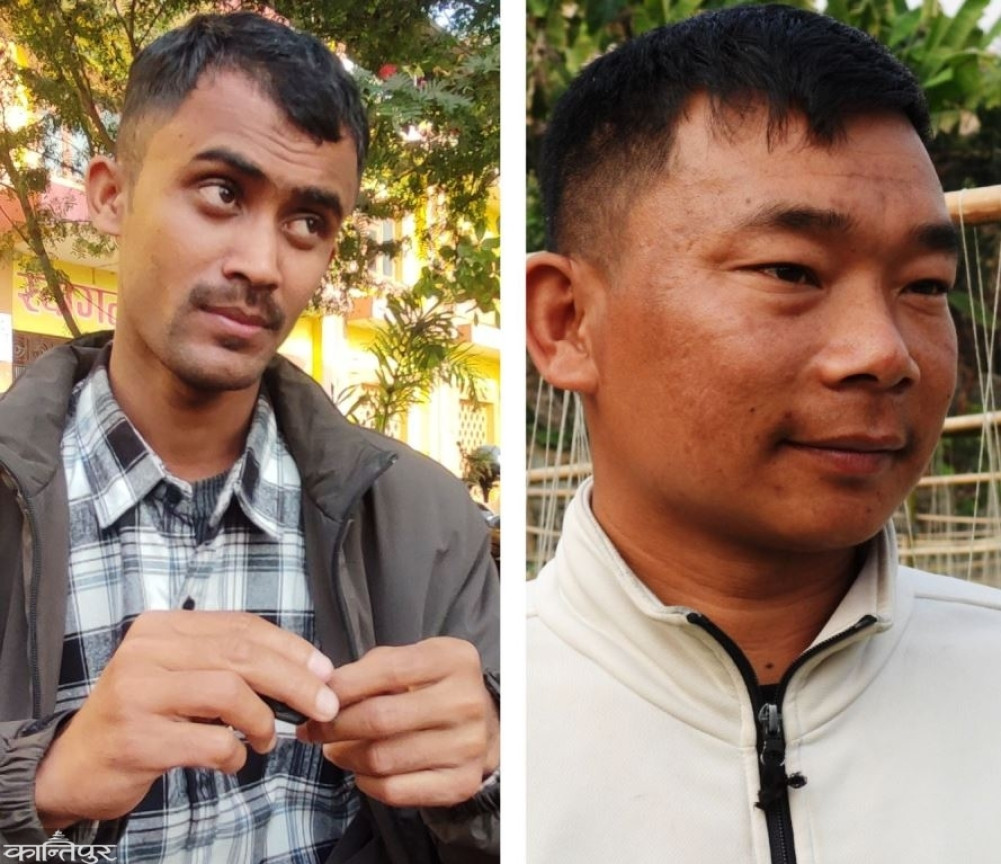
Pralopa's candidate in Chitwan-1, Bikash Kami, 25, and Arjun Chepang, 29, who stood for NEMKIPA, are young people and both of them have not only seen but also experienced social oppression. They say that even after the Genji movement of Bhadai 23, there has not been enough debate on how to make the social, cultural and economic aspects people-oriented.
We use Google Cloud Translation Services. Google requires we provide the following disclaimer relating to use of this service:
This service may contain translations powered by Google. Google disclaims all warranties related to the translations, expressed or implied, including any warranties of accuracy, reliability, and any implied warranties of merchantability, fitness for a particular purpose, and noninfringement.
In Chitwan, which has three constituencies, 64 candidates, both independent and from political parties, are in the fray. In Chitwan-1, Pragatisheel Loktantrik Party (Pralopa) candidate Bikash Kami is the youngest among them. Arjun Chepang Praja, who has contested from the Nepal Workers and Peasants Party (NWP), is the only candidate from the highly marginalized indigenous Chepang community in the district.
There is not much difference in the ages of both of them. Vikas is 25 years old and Arjun is 29 years old. Besides being young, these two have not only seen but also experienced social oppression. Not only do children get scared when a dog barks in the village, but even the faces of the elderly show fear. Why was this the case? ‘We used to be afraid even when a dog barked,’ says Arjun, ‘It used to be like if a dog barked, the army came to the village.’
The eastern part of Chitwan is about 10 kilometers north of Khurkhure or Birendranagar on the East-West Mahendra Highway, in the hilly area of Chitwan, is Chipleti village in Korak. Arjun’s house is in this village. The then Korak VDC was in Ward 9, now it is Rapti Municipality-10.
Chipleti and its adjacent villages like Samitar and Kalikhola in Korak started receiving regular visits from the Chitwan National Park staff along with the army deployed in the park from the late 1950s. This process continued till the late 1960s. Many people from these villages were arrested by the Chitwan National Park on charges of killing rhinos and trading in horns.
Rajkumar Chepang of Kalikhola near Chipleti was charged with killing 20 rhinos by the park. Similarly, Kaziman Praja Chepang of Chipleti was accused of killing nine rhinos. Along with these, many people in the vicinity were charged with rhino cases. The park team would go to look for them. ‘If Chepang here is a rhino killer, then it was time for the state to think like that,’ said Arjun.
Kajiman was arrested in Falgun 2067. The government brought Rajkumar, who had reached Malaysia, to Nepal in Magh 2071 and imprisoned him. After that, the process of coming to the village to catch and search for 'rhino poachers' stopped. Otherwise, Arjun says that the team that came to find the 'poachers' would have gone door to door and told what they were doing. According to him, guests had stopped coming to the village at that time.
Arjun's father is Bijram Chepang and mother is Napimaya. Bijram has passed away. He was also a politician. Bijram won the ward chairmanship of Korak-9 in the 2054 local elections. Bijram had been involved in politics since the Panchayat period. Arjun is the youngest of five brothers and three sisters. He says that his father's political leanings did not pass on to his other children, but they did to him. In the month of Jestha 2071, he was studying in class 9 at Samitar School, located near the village. The leaders of the Nepal Revolutionary Students' Union (NETRAVIS), a student organization of Nepali Congress, had gone there to organize. Arjun listened to them. In the same month of NETRAVIS, there was a district convention at a place called Bhalumara in Dahakhani. Arjun was invited to participate in it. 'We went because we thought it would be fun and there would be dancing and singing. 62/63 Bhalumaras from the Kerak region had arrived,' said Arjun. At the conference venue, the organizer asked Arjun to tell him about Korak. Arjun hesitated a bit. He told his experience of coming from Korak to Bhalumasa.
A bus had gone to Korak to pick them up. They had come in a hurry. The bus had been reserved by the organization. But the same bus was running everywhere to pick up those coming to the conference. So, they were dropped off at Jutpani Club Chowk instead of Bhalumara and the bus took them somewhere else. They walked for about an hour to Bhalumara. Arjun talked about this in detail. He told them what he had to say. Then it was time to listen. Political training began. He heard from the trainer why some people benefit more from the policies taken by the state on issues like education, health and employment, while others lag behind. His father, Bijram, was in the UML. He had never heard such topics when UML leaders came to his house and talked about politics.
He says that after that, he had a flash of understanding what politics was. ‘I actually went there thinking it would be fun, but things turned out differently,’ said Arjun. Then he started engaging in more political training and campaigns. And when he realized that being organized and being aware were different things. He said that his passion for politics increased after realizing that he was in the dark.
He passed his SLC from Samitar School. After receiving a scholarship, he went to Narayangadh Balkumari College and studied till grade 12. Then, he enrolled in Jana Adarsh Multiple Campus in Birendranagar for his graduation, considering it to be closer to his village. He has not been able to pass his graduation. He has been continuously involved in politics and social campaigns. ‘I also cultivate vegetables. I have planted cucumbers. There are tomatoes in the tunnel. It not only supports me financially, but I think our community will also do such work after learning from me,’ said Arjun.
The Chepang community is weaker than others in education, health and economics. ‘What has the state done for this community? Development and campaign focused on cities. We were left behind,' Arjun said.
He says that focusing on politics based on caste and geography is narrow-mindedness. 'Rather than being left behind because Chepang is Chepang, the state's policies and plans were not right and were left behind. If the state had treated everyone equally, made a policy that provided equal opportunities and benefits and implemented it, no one would have been left behind. Therefore, a common people-oriented policy should be made rather than a specific region and community,' he said.
He gives an example from his own village. Here, the state started seeing everyone as rhino poachers. When Chepang said that he had killed a rhino, that started to be the case, he says. 'They also caught Dal Bahadur Chepang of Kalikhola and put him in a rhino cage. After fighting a legal battle for seven years, he was acquitted. He had to stay in jail for seven years,’ Arjun said.
Dal Bahadur is related to his nephew. He told Dal Bahadur, ‘Brother, we should talk about such injustice in different places. Let’s go. Let’s tell the journalists.’ Dal Bahadur sighed. Arjun says that they were just released and were still confused about what would happen next. Arjun said that Dal Bahadur told them not to do anything because they might get into another trouble.
Deep Bahadur Praja is Arjun’s elder brother. Deep Bahadur was also charged with three cases by the National Park Service on charges of killing rhinos and selling horns. He was imprisoned for 15 years in two cases. He was imprisoned for 13 years in one case. When he went to the Supreme Court, Deep Bahadur was acquitted in the 15-year case. The sentence in the 13-year case was upheld. Dip Bahadur was arrested on Magh 1, 2069.
Dip Bahadur is currently in Nuwakot prison after going through Bharatpur, Parasi, Kathmandu. On Magh 1, he went to Arjun to get his sentence. But the Division Forest Office had already sentenced him to seven years in prison in another case of rhinoceros killing. Dip Bahadur would not have been released. ‘After serving 13 years in prison for the same case of the same duration, is it possible to serve additional prison time?’ Arjun said.
The writ was filed by senior advocate Gopal Krishna Ghimire. Senior advocate Ghimire said that he filed the writ based on the Supreme Court’s precedent that no additional prison time is required. He said that an order will be issued soon. ‘When the state said that poachers were the ones who were punished, many here suffered.’ The state came to our village to cause suffering, not to bring happiness. My politics is to make the state responsible,' said Arjun, 'There will be winners and losers in the election. Neither my party nor I have a policy of adopting various tricks to win. Elections are an opportunity to convey our policies to the people.'
He said that the election will also show the level of awareness of the people. 'There should be balanced development in the country, not focusing on any particular region, community and geography. For this, we have to put pressure. We have to adopt measures to protect the sovereignty of the country. We reach the people with this idea. This election is a campaign to make the people aware,' said Arjun.
The indigenous Chepang community, which belongs to the most marginalized category, lives in the hilly areas of Chitwan, Makwanpur, Dhading and Gorkha. According to the 2078 census, there are 84,364 people across the country. Chitwan has the highest number of 35,637 Chepangs. There are three Chepang candidates in proportional representation across the country. Directly, there is Arjun in Chitwan and one candidate in Makawanpur.
The youngest candidate in the district, Bikash Kami, was active in the Gen-G movement in Kathmandu on Bhadau 23 and 24. He had gathered and coordinated 10/12 days in advance to prepare for the movement. He reached Maitighar in the morning on Bhadau 23 and was lucky to escape the bullets fired in front of the Parliament building. The crowd fought him, and those who did not fight were shot in the forehead, says Bikash. ‘What happened was not as we had thought and planned. We have reached a situation where we cannot stop it,’ said Bikash. ‘If there is a movement that will topple the government in 27 hours, how quickly does this generation need development and change?’ It is necessary for politicians to understand and assimilate that now.''
Vikas was born in Lalpur, present-day Rapti Municipality-9, Chitwan in Asoj 2057. He was in grade 8. He was returning home after delivering milk to the dairy. On the way, he smelled the unpleasant smell of rotting rice. He went to the house where the smell came from and looked. The firewood was burning in the stove, the utensils and rice were black. He called out, but no one was home.
Thinking that there might be some disaster, that there was a risk of a fire, he went to the kitchen and extinguished the fire. 'But at that moment, the aunt of that house came. She said, "You entered the stove and touched it, and with words that you cannot hear, you destroyed it." I tried to save it but I heard a bad word that it was destroyed,' he said. Later, a similar incident happened when he was giving SEE. He had taken a coaching class. One day, he took roasted corn. He also shared it with his friends. The female teacher who taught coaching also asked her friend to eat it. She asked why she brought such sweet corn. The friend called Vikas by name. Then the teacher's mouth was squeezed. 'I saw her go outside and spit in the dustbin,' Vikas said.
Such discrimination severely pinched him. After passing SEE, Vikas joined the Saptagandaki Campus in Bharatpur. His political journey began from there. He joined the student organization of the Maoist party close to Mohan Baidya. While he was studying for his graduation, the political campaign intensified, and he became active.
The anti-MCC campaign was intensifying. He was absorbed in it. But the financial situation of the house kept getting worse. He was in his second year of graduation. With the intention of earning money along with his studies, he went to Russia on a student visa. But he did not settle there. Meanwhile, the political campaign was intensifying. He returned before the year was over and became the Madhesh in-charge of the student organization in 2079.
He saw the severe problems of the victims of meter interest in Madhesh. Having seen painful stories like losing their homes, being killed, and being neglected by their children, he felt that the party could do something to save them. 'But what was the problem? The party did not see such classes in the eyes.' After that, I started being active in social issues and campaigns along with politics,' said Vikas.
He did not abandon the progressive line even when he was involved in the movement of meter badge and microfinance victims. His friends were also involved in the progressive campaign. A month before the Gen-G movement, he went to a friend's house in Bhaktapur. When the friend asked him not to give his name at home, he felt cold. Even when he took him inside, when he ate, the other family members did not sit with him, but sat separately. 'When I went to a house that was involved in social campaigns, had progressive ideas, and was more educated, this behavior made me feel that caste discrimination would not go away even if people were educated. This is an issue that can only be resolved by raising awareness at the political level,' Vikas said.
The Gen-G movement took place in this same area. Then elections were held in the country. Those involved in the Gen-G movement were asked not to separate themselves from the elections. 'But there was no party. Among the parties that were formed and active, some had ideological differences with Genji. Some had other limitations. While thinking about how to contest the election, I joined the Progressive Democratic Party,' Vikas said.
He says that the completion of the Gen-G movement of Bhadra 23 and 24 is the election of Falgun 21. That is why he said that he stood for the election. 'Elections are when the people can question the leaders. People listen carefully to the answers to the leaders' questions. That is why for us, elections are also an opportunity for the people to have their say and learn from the people,' Vikas explained his understanding of the election.
But he says this election is not an ordinary election like other times. 'My request is that people vote after the Gen-G movement, considering many things and keeping the country's interests in mind,' Vikas said. He said that he entered politics to change the definition and character of leaders, politics and the state. He says that there is no greater development than if citizens do not feel discriminated against in any way. ‘Social, cultural and economic aspects should be in the interest of the citizens. Citizens are also able to meet their basic expenses. This should be removed. This is what politics is for,’ he said. He says that there has not been enough debate even after the Gen-G movement on how to make the social, cultural and economic aspects people-oriented. ‘I will raise this issue. If I win, I will raise my voice from the parliament and even if I do not, I will never give up the political campaign. I am trying to go to both the streets and the parliament. I will fulfill my responsibility wherever the people put me,’ he said. In Chitwan-1, 18 candidates, including Arjun and Vikas, are in the fray. There are 149,621 voters in Chitwan-1, which includes Rapti, Khairhani and Ratnanagar municipalities. Hari Dhakal of the National Independent Party (NIPP) won this constituency last time. NIPP has fielded Dhakal as its candidate. UML has fielded Dawa Dorje Lama. Congress' Rajendra Burlakoti and Nepali Communist Party's Krishna Pant are the candidates. Rastriya Prajatantra Party (RPP) has fielded Balram Khanal, Janata Samajwadi Party (JSP) Nepal has fielded Ajay Thakur Hajam, Rastriya Janamorcha has fielded Sitadevi constituency, Mongol National Organization has fielded Premlal Chaudhary and CPN (United) has fielded Durga Dutta Aryal.
Similarly, National Republic Nepal has fielded Ishwari Gurung, Shram Sanskriti Party has fielded Anil Tamang, CPN-Maoist has fielded Ganesh Bahadur Shrestha and Ujjal Nepal Party has fielded Dhan Bahadur Gurung. Saurav Kadel, Sanjay Rijal and Hari Prasad Regmi have filed independent candidacies. The area is home to the indigenous Chepang community in the hills and the Rapti River and the surrounding plains.