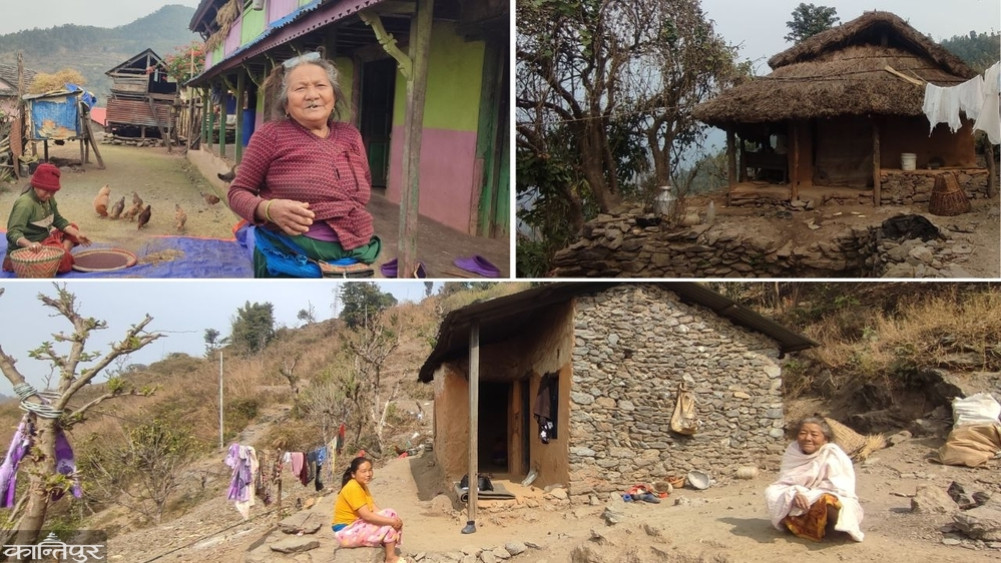
Kamalpur is reached by traveling uphill from 17 kilometers along the Narayangadh-Muglin road section. Kamalpur village is located five kilometers from the highway.
We use Google Cloud Translation Services. Google requires we provide the following disclaimer relating to use of this service:
This service may contain translations powered by Google. Google disclaims all warranties related to the translations, expressed or implied, including any warranties of accuracy, reliability, and any implied warranties of merchantability, fitness for a particular purpose, and noninfringement.
Not many people know about Kamalpur, a hilly village located in Bharatpur-29. Parbati Gurung, 81, who started living here in 2020, said that she chose this settlement because she thought it was safe at the time. “I settled in the hills instead of going to Narayangadh because I was afraid of malaria,” she said. “When I came here, Narayangadh was a mess.”
She said that she stayed in the mountains due to the fear of malaria, cholera and many other diseases. ‘Now Kamalpur is deserted,’ she said, ‘Narayangadh has become a city.’
Kamalpur is reached by traveling uphill from 17 kilometers along the Narayangadh-Muglin road section. The road to the village is not reliable. ‘When it rains, the road is blocked. Work is done in winter,’ she said, ‘It would be good for my children and grandchildren if there was a road that could be used for vehicles even in the rain.’
Kamalpur School is located in Thumko, five kilometers from the highway. This school, which provides education up to grade five, was established in 2028 BS. There are a total of 22 students in the school. Kamalpur village is located next to the school. Since there is no proper accommodation in the village, they have gone to Jugedi Bazaar in the Muglin-Narayangadh section to live. Some are staying in Narayangadh and Bharatpur. Kamalpur Toll Development Committee Chairman Suk Bahadur Gurung said that the market has increased because they can get work even if it is small.
Kamalpur village has 77 houses from top to bottom. ‘But only the elderly live in the house,’ he said, ‘Many families have come to the market to educate their children. That is why there are fewer students in the village school.’
The school’s principal, Badri Prasad Poudel, said that there are 12 Chepangs, three Dalits and other Gurung students. It is not easy to climb the village as it is steep. Motorcycles and auto rickshaws are available. Regular vehicles do not ply. You have to reserve an auto rickshaw and order one. Only if you have to carry a lot of luggage, jeeps and tractors are available. ‘This facility has been provided because of the local government’s budget,’ said Toll Development Chairman Gurung.
Before reaching Kamalpur School, there is a ‘two-house’ village. There are five Chepang houses here and three Gurung houses. Electricity has reached the village. The Chepang family of two-houses does not turn on the electricity. ‘We have to pay for the lights. Where will we pay for the money when we have no income? ,’ said 73-year-old Phulmati Chepang of two-houses. According to her, there are still inconveniences because it is an old village. ‘Earlier, we had to drink water from the river,’ she said, ‘we had to go down the highway to get into the car. It is getting better now than before. The road has reached our house.
Earlier, if someone fell ill, it was a long journey to take them to the hospital. Now, people can reach the hospital from the village by auto. She said that a month ago, when she went to visit a sick relative in Bharatpur, she paid Rs 1,200 for an auto rickshaw. However, due to lack of money, the locals do not even have the courage to take a rickshaw. West of her house is Sukmaya Chepang's house. There is an electricity pole next to the house, but the wires are not connected. Deubahadur Chepang's house is a hundred meters west of Sukmaya's. Although the surrounding houses are covered in thatch, his has a thatched roof.
There is no door in the door. Her house was deserted on Tuesday afternoon. Phulmati said that since Deubahadur had gone to the forest to find grass and firewood, a plastic gate had been hung on the door to prevent animals from entering. ‘Our house has a meter, but they don’t want to bring the wire from here and turn it on,’ said Yamkumari Gurung, who lives in two houses. ‘They say you can’t turn it on by paying money.’ She said that they come to her house to charge their mobile phones.’
‘Information about the election’
Yamkumari said that she got the information about the election when she went to Bharatpur a few days ago to meet her relatives. ‘There is no hustle and bustle in the village,’ she said. ‘You have to go to Jugedi to vote. There are no cars. It takes four hours to walk.’
Local Indrakumari Chepang voted for the first time in 2079. 21-year-old Sharmila Chepang recently became a citizen. ‘I made it last November because I might need citizenship when I give birth,’ Sharmila said, ‘The baby was born in the womb. I don’t know if my name is in the voter list.’ Kamalpur village was under the then Kavilas VDC. Kavilas was included in Bharatpur Metropolitan City in 2073.’
‘Electricity arrived 12/13 years before it became a metropolis.’ The road has been improved for two and a half years,’ said Toll Development Committee Chairman Gurung, ‘I would have been confident if it could be made navigable even in the rainy season.’ He said that due to the lack of drinking water supply, he used to carry water from the river in a jug. After the earthquake, the water supply became even more difficult. ‘It has been a year and a half, now water is coming from the tap in the houses near the school in Kamalpur,’ he said, ‘But the water source is far away.’ I am not sure that I will always be able to drink water like this.’
Candidates arrive after the election in a village with 200 voters. As the village grows, candidates also become familiar with the problems of roads and water. ‘Our demand is that the roads should be good and the drinking water should be reliable,’ said Parbati Gurung of Kamalpur, ‘If there are roads and water, people will not leave the village and migrate.’ At one time, Gurung’s garden used to grow 6 mustard seeds. She said that now, since there are no people in the village, she is only sowing mustard seeds for oil used at home. Parbati has received information that the election will be held in Falgun. She has always voted in the elections so far and feels that she should vote this time too. ‘We used to go to vote together. The old man used to say not to leave us until he breathed,’ she said, ‘It has been five years since the old man passed away. I feel like voting because it is a habit. But now I may not be able to go on foot.’
There are a total of 137,152 voters in Chitwan-2.