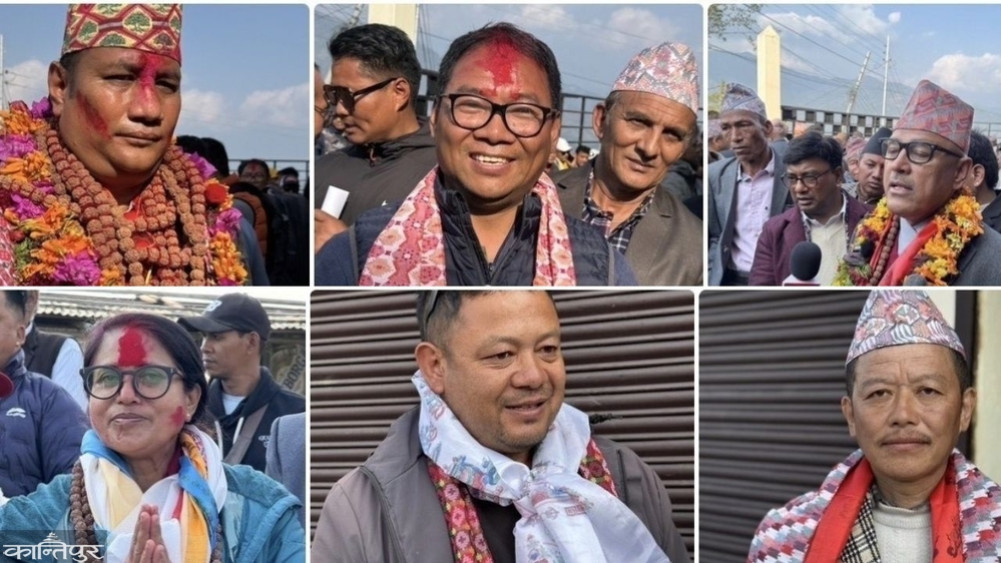
Voters are seen engaging in discussions on how to evaluate the new faces, from street corners and tea shops to social media.
We use Google Cloud Translation Services. Google requires we provide the following disclaimer relating to use of this service:
This service may contain translations powered by Google. Google disclaims all warranties related to the translations, expressed or implied, including any warranties of accuracy, reliability, and any implied warranties of merchantability, fitness for a particular purpose, and noninfringement.
As the upcoming House of Representatives elections to be held on Falgun 21 are approaching, the election campaign in Sankhuwasabha is increasing day by day. In this election, 16 candidates, including 15 political parties and one independent, have registered their candidacies.
As none of the faces who contested in the previous elections are being repeated, this election is being seen as a 'new face election'. This has also added new expectations, curiosity and interest among the voters.
New candidates have entered the election fray with the slogans of change, development and good governance. Candidates from big and small parties have made tourism development, infrastructure construction, job creation and transparent governance as their main election commitments. Although the agendas often look the same, the main concern of the voters is who can win their trust in practice.
Sankhuwasabha, which stretches from the Himalayan region to the mid-hills, is a district full of natural beauty, biodiversity and cultural richness. The lifestyle of the residents here is based on hard work. Most of the citizens depend on agriculture, animal husbandry, herb collection, trade and foreign employment. Rivers like Arun, Tamor and Sabhakhola have great potential for irrigation and hydropower. But due to the lack of adequate infrastructure and long-term planning, the overall development of the district has not gained momentum.
The candidates are promising to improve the lifestyle of Sankhuwasabha. Nepali Congress candidate Deepan Kumar Shrestha is committed to systematically developing Makalu-Barun National Park, religious sites, trekking trails and adventure tourism in the tourism sector. He said that the common commitment of the candidates is to operate hydropower projects in the interest of the locals and create employment, provide opportunities to the youth in the district and prevent foreign migration.
All the candidates have promised to upgrade rural roads, make safe drinking water, quality education and health services accessible in terms of infrastructure. The candidates have also assured to bring sufficient budget from the federal government to ensure basic services to the citizens of remote settlements and to use it transparently. CPN-UML candidate Arjun Karki has promised to make full use of Sankhuwasabha's tourism, religious and water resources. He said that if he wins, he will never back down for the development of Sankhuwasabha.
National Independent Party candidate Mingma Sherpa, who came to politics after climbing 14 of the world's 1,000-meter mountains, says that he will introduce the tourism sector to the world and attract tourists. He said that Sankhuwasabha has so much potential for tourism, but tourists have come to it very little. He said that he will make it the number one district in Koshi Province by using tourism and hydropower.
Sarita Thapa is a female candidate. She has served as an MP from Koshi Province. 'I have experience in the provincial assembly,' she said, 'I will use that experience to introduce Sankhuwasabha to the world.' She said that she will work to establish good governance, transparency and a people-responsive governance system. Candidates are expressing their commitment to control corruption, become representatives who have direct access to the people, and ensure local participation in development plans. The promise of 'respecting the votes given by the people and playing the role of responsible representatives for five years' is heard from the lips of most candidates.
Sankhuwasabha is a district rich in natural resources, says Indrakisan Dahal, a voter from Khandbari, 'The international recognition of the Makalu-Barun region, vast hydropower potential, religious and cultural heritage are the great assets of the district. But ironically, these possibilities have been limited to election speeches for decades,' he said, 'The road network is still weak, citizens of remote settlements are far from basic health and education, and youth are forced to leave the district in search of employment.' According to him, amidst this reality, candidates are once again repeating the promise of 'making good use of the potential'.
There are currently 119,630 voters in Sankhuwasabha. Voters are discussing how to evaluate the new faces from the streets and tea shops to social media. Among the many candidates and similar agendas, the question of who will win the trust of the voters through behavior, credibility and a clear plan has made the election atmosphere of Sankhuwasabha more interesting.