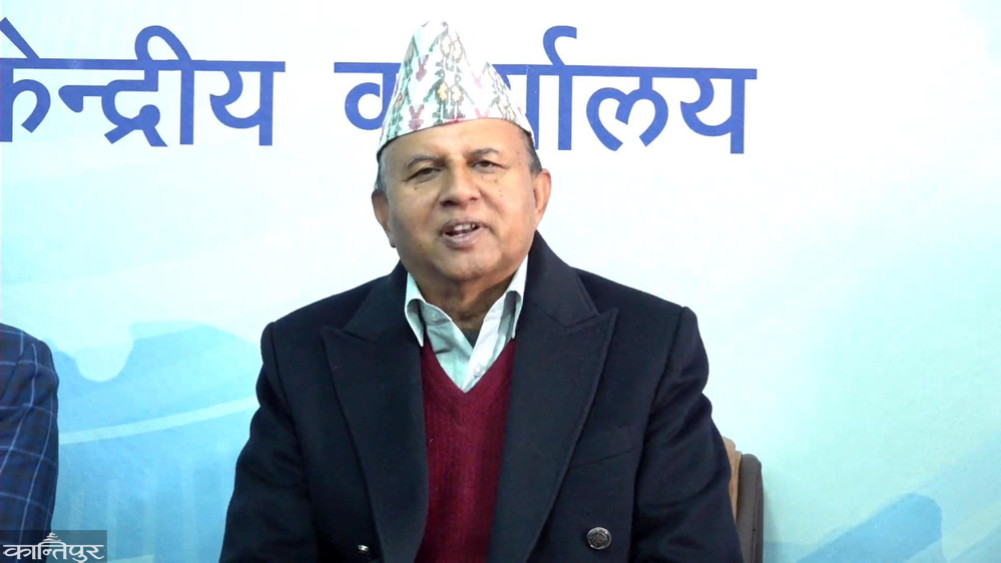
UML General Secretary Shankar Pokharel has made an election analysis of the Rashtriya Swayamsevak Sangh (RSS) and the Nepali Congress (NCP). He has given his analysis of the strengths and limitations of both parties.
We use Google Cloud Translation Services. Google requires we provide the following disclaimer relating to use of this service:
This service may contain translations powered by Google. Google disclaims all warranties related to the translations, expressed or implied, including any warranties of accuracy, reliability, and any implied warranties of merchantability, fitness for a particular purpose, and noninfringement.
UML General Secretary Shankar Pokharel has claimed that the initial enthusiasm of the Rashtriya Swayamsevak Sangh (RSS) in major cities like Kathmandu is now weakening.
At a press conference held in Kathmandu on Friday, he made these comments while explaining the manifesto being prepared by the party, UML's election estimates and the situation of other parties.
General Secretary Pokharel argued that the birth and rise of the Rashtriya Swayamsevak Sangh (RSS) was mainly due to the dissatisfaction of the urban youth, educated and middle class, and said that Balendra Sah's mayoral victory and Ravi Lamichhane's popularity had a major impact. He also predicted that the urban votes of the RSS will decrease due to issues such as cooperative fraud, organizational weaknesses and the possibility of youth votes going in different directions. He also said that an analysis is underway in Kathmandu to see whether the RSS is now weak in the competition or not.
General Secretary Pokharel also analyzed that although the influence of the RSS has decreased in urban areas, it has increased in rural areas. He said that the RSS has expanded its organization in villages, paid attention to youth and local dissatisfaction and spread awareness. He added, "There is a possibility of an improvement in the vote percentage." But this influence has not reached the level of winning the election.'
Regarding the reasons for this, he said that it is difficult for the RSVP to achieve a decisive victory due to organizational weakness, deep roots of old parties, lack of local networks and traditional habits of rural voters.
General Secretary Pokharel also shared his views on the rival party, Congress, in addition to the RSVP. He said that the Congress should not be considered weak due to lack of publicity, and expressed his expectation that the Congress has a strong base in its lower-level committees and a large portion of 'silent voters' (those who vote silently, are not seen in the publicity but are decisive) will be in favor of the Congress. He also pointed out the possibility that the Congress can benefit from the weakness of the RSVP in urban areas.