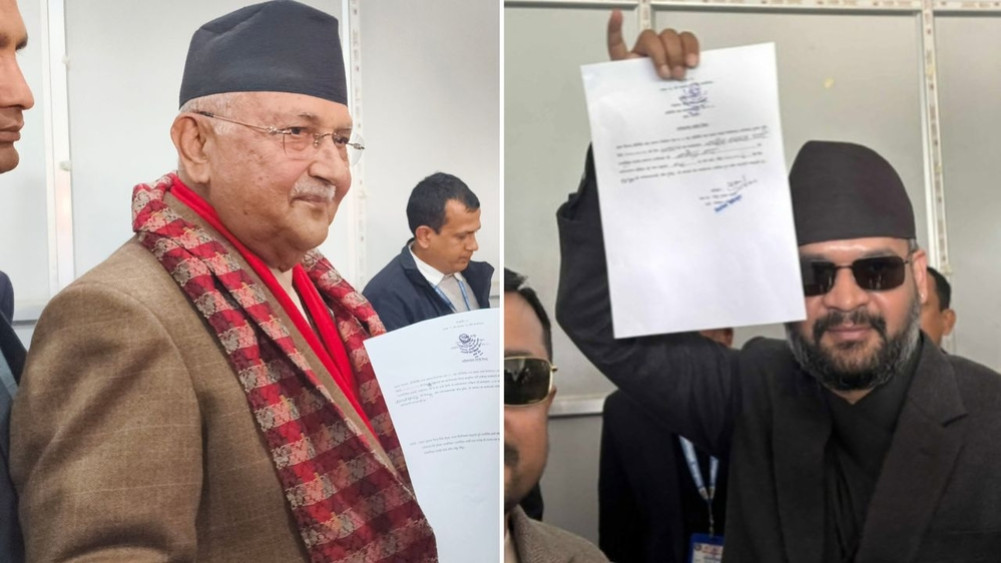
On one side is the Chairman of the Communist Party of Nepal (UML) and KP Sharma Oli, who is carrying the political burden of four decades. On the other side is Balendra Sah, a senior leader of the National Independent Party and former mayor of Kathmandu, representing the aspirations, dissatisfaction, and energy of the new generation.
We use Google Cloud Translation Services. Google requires we provide the following disclaimer relating to use of this service:
This service may contain translations powered by Google. Google disclaims all warranties related to the translations, expressed or implied, including any warranties of accuracy, reliability, and any implied warranties of merchantability, fitness for a particular purpose, and noninfringement.
The open premises of the vegetable market in Damak Municipality-8 were not just the election office of Jhapa-5 on Tuesday, it became a symbolic meeting point of two different political times, two different energies, and two different journeys.
Same place, same process but characters so different that even if they were included in the same frame, their auras could not cover each other . On one side is the Chairman of the Nepal Communist Party (UML) and KP Sharma Oli, who is moving forward carrying the political burden of four decades . On the other side is the senior leader of the National Independent Party and former mayor of Kathmandu, Balendra Sah, representing the desires, dissatisfaction and energy of the new generation.
Oli looked dirty . As if he were a tired traveler after a long journey . Balendaya was radiant, as if ready to climb a new mountain, drinking the energy of the crowd . There was political competition, but beyond that, the contradiction in the time and moods of these two personalities seemed even more intense .
Oli's nomination registration time was fixed at 1 pm . Balendra's at 11 am . However, Oli reached the election office only around 2 pm . The main reason for the delay was the crowd, hustle and bustle spread across the city due to Balendra's presence, and the pressure of security management.
Damak Bazaar had been festive since morning. Songs were playing. The national flag was hoisted. The crowd had created a festive atmosphere. 'Fans' had flocked from far and wide to see, hear, take photos of the former mayor of Kathmandu or to be part of the crowd.
Balendra's nomination, which reached the election office with pomp and show, was delayed by almost an hour. The reason was that the necessary documents were incomplete. After collecting the documents, he came out at 1:45 pm with his certificate. A large crowd of supporters outside. A circle of media personnel inside. However, Balendra refused questions. Once, he even instructed a journalist to 'go out'. Finally, he himself took the steering wheel and walked out among the supporters. The supporters also walked out with him one after another.
The face of the old power that had come slowly
After Balendra, the young candidate of the Nepal Communist Party (NCP) Ranjit Tamang came to register his nomination. Oli arrived at the election office only after Tamang's process was over. However, Balendra had 'faded' his arrival and left.
Oli was neither among many supporters, nor surrounded by many security personnel. His gestures were also not as serious, firm and commanding as before. His voice was soft, his movements were slow, and the clear glow of confidence on his face was less. It was as if he was tired of the burden of time, the fatigue of responsibility and the long journey of politics.
This is Oli's eighth election journey, who has been contesting elections from this constituency since 2048. During this time, he has experienced everything from victory to defeat, support to opposition, government to opposition. But this time, he seemed to be competing not with documents and schedules, but with time and style. With a 'popular figure' who has torn the threads of traditional political coordination.
Two styles of dialogue
Balendra rejected the journalist's question, while Oli turned to the journalist. However, his voice was raspy and low on energy. On top of that, he could not be heard because of the noise.
Oli said, 'What do you want to ask?' His words did not seem to be reflected with the familiar sharpness.
When a journalist asked, ‘Did you just see Balen’s show, how did you feel?’
Oli’s short answer in a light attitude was, ‘I didn’t see it.’
There were many layers of politics in this ‘I didn’t see it.’
There was a new challenge that could not be denied, ignored, defended, or accepted.’
Oli and Balendra, who were seen in the same frame in this same complex, left a common message, ‘This election is not just a competition between candidates, it is also a competition of time, style, and public expectations.’
Oli represents the power of the old political structure, long experience, party machinery, and deep ties with the state.