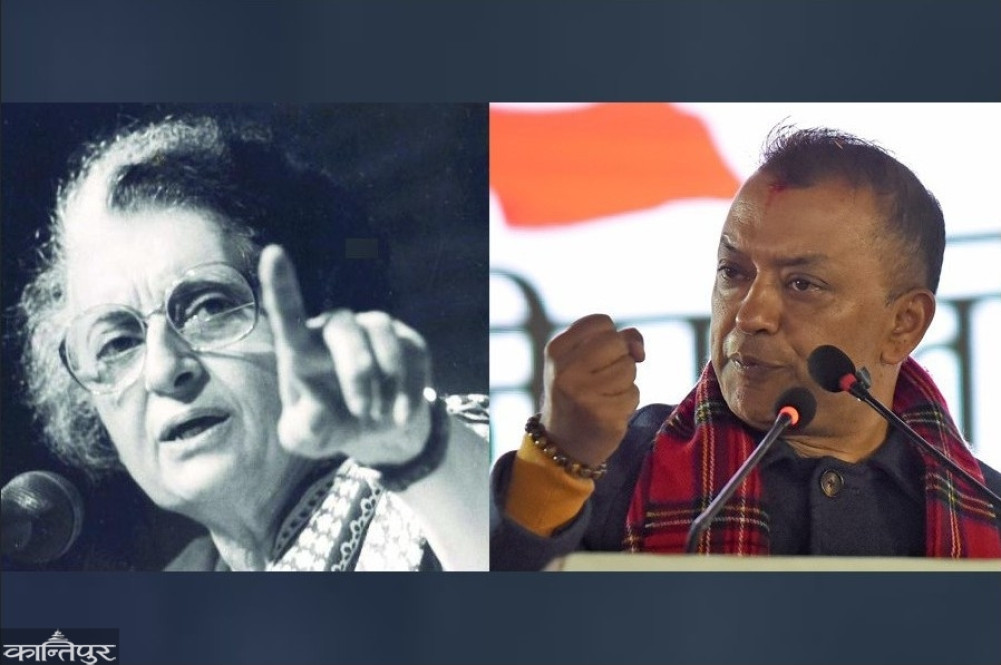
Like Gandhi, Thapa's leadership will have to prove that change is not for gaining power, but for changing political culture.
We use Google Cloud Translation Services. Google requires we provide the following disclaimer relating to use of this service:
This service may contain translations powered by Google. Google disclaims all warranties related to the translations, expressed or implied, including any warranties of accuracy, reliability, and any implied warranties of merchantability, fitness for a particular purpose, and noninfringement.
Some rebellions in history are not just about changing power, they are about changing political culture.
In India, the rebellion against the ‘syndicate’ entrenched within the Congress Party in the 1960s by Indira Gandhi is one such historical example.
When she stood up against the syndicate within the party, she was called ‘Gungi Gudiya’. She was given this nickname because the party syndicate dominated every decision and she was unable to act independently even as the Prime Minister.
But a woman leader led the party and politics in a new direction through strong will, public support and decisive action. Today, almost 6 decades later, the shadow of that history has emerged after the special general convention of the Nepali Congress.
Indira Gandhi stood up against a group of powerful leaders who were arbitrarily ruling within the party. After the sudden death of Prime Minister Lal Bahadur Shastri on 10 January 1966, the reins of power came into her hands on 24 January.
For the first time in the history of the Congress parliamentary party, a vote was held at that time on who would be the Prime Minister. Morarji Desai had presented his claim to the post of Prime Minister against Gandhi. Gandhi received 355 votes, while Desai received less than half, i.e. only 165 votes. Gandhi received immense support within the party when she became the Prime Minister for the first time.
'A storm had come to the country. That storm belonged to Indira Gandhi. She had the ability to not give up until the last moment.' She was 48 years old at that time. Her personality was attractive. She was known within and outside the country as the daughter of Pandit Jawaharlal Nehru. But she lacked administrative experience. The Congress 'syndicate' tried to take advantage of that. This is why the conflict between Gandhi and the party establishment increased. Even though Gandhi was the Prime Minister of the country, some senior leaders dominated the running of the government and decisions. Socialist leader Ram Manohar Lohia had called Prime Minister Indira Gandhi a 'dumb doll'. Political historians have commented that Gandhi's face was used as a vote-gathering machine after giving her the post of Prime Minister.
Senior Indian journalist and political analyst Rashid Kidwai, in his book on Indian prime ministers, has mentioned that the party leadership's proposal of Gandhi as the prime minister after Shastri's death was linked to electoral politics.
Party president K Kamaraj saw the ability to win the 1967 elections in Gandhi. 'A shrewd politician, Kamaraj thought that Indira did not have enough experience at the time. Due to her lack of experience, she could be manipulated,' Kidwai writes, 'Indira was seen as a vote-gathering machine. The strategy was to separate her after the elections and make another person the prime minister.'
But after becoming prime minister, Gandhi started working firmly. Her style of work changed the plans of senior party leaders. They realized that she was a woman who could work in her own way. In the 1967 elections, the Congress barely won the election. Gandhi became the Prime Minister again.
The old leaders' group in the Congress Party of India had transformed into a 'syndicate'. Even though Gandhi was the Prime Minister, the group was not allowing him to work independently. Congress leader and former Foreign Minister K Natwar Singh has mentioned in his autobiography 'One Life is Not Enough' that even though Indira Gandhi was in the Prime Minister's chair from 1966 to 1969, power was not in her hands. During that period, Singh worked in Prime Minister Gandhi's secretariat. He wrote, 'The real power was in the hands of the group of leaders including Atulya Ghosh, K Kamaraj, Morarji Desai, SK Patil, Sanjeev Reddy, led by party president S Nijalingappa, which was called the 'syndicate'.
It was because of this syndicate that Gandhi faced serious challenges in 1969. Gandhi wanted Jagjivan Ram to be the President, but the party syndicate did not accept it. They made Neelam Sanjeeva Reddy the official candidate of the Congress. Then Gandhi put forward Bhavi Giri as an independent candidate instead of Jagjivan Ram.
The presidential election was scheduled for 20 August 1969. Four days before that, Gandhi appealed to the party MPs and MLAs to listen to the 'voice of the soul' and vote. With Gandhi's support, Giri won the election. The party syndicate had to suffer defeat.
This was Gandhi's direct confrontation with the old leaders. The party prepared disciplinary action against him. On 12 November 1969, he was expelled from the Congress. The party from which he was expelled was the party from which his father Jawaharlal Nehru and his family members had raised him. Gandhi was also in a confrontational mood. She rallied her supporters against the party's disciplinary action. On 22 November 1969, a no-confidence motion was passed against party president Nijalingappa in a meeting held in Delhi. Support for Gandhi continued to grow.
The Congress split into two. Both claimed to be the real Congress. In the process, there was a competition between the two sides in the media. The powerful party that had given the country independence and succeeded in keeping it united entered into a struggle with each other.
Senior journalist Kuldeep Nair has written in his book 'Ek Zindagi Kafi Nahin', 'Before the headline was chosen in the newspaper at night, both sides were ready to give some 'dose' to the media. The Statesman newspaper started calling the old leaders 'Old Congress' and the Gandhi faction 'New Congress'. Later, the establishment faction came to be known as Congress (O) and the Gandhi faction Congress (R). The Congress party, which her father had nurtured and succeeded in giving the country independence, split during the time of Indira Gandhi.'
At the same time, Gandhi abolished the privilege (Privy Purse) given to former kings and maharajas to show her power. She also took a historic decision to nationalize 14 private banks. The land quota scheme was implemented strictly. Historian Ramchandra Guha has mentioned in his book 'Bharat: After Nehru' that Gandhi's show of power was successful.
She succeeded in making the Congress stand on the side of the poor. Gandhi received huge support from the landless, workers, Dalits and minority communities. Out of 705 members of the All India Congress Committee, 446 Gandhi supporters participated in the Congress (R) session. Out of 449 members of both houses of Parliament, 310 stood in Gandhi's favor. Out of these, 220 were Lok Sabha members. Gandhi was short of 45 members to prove a majority in the Lok Sabha, which she completed with the support of communist and independent members. Guha wrote, 'A storm had come to the country. That storm belonged to Indira Gandhi. She had the ability not to give up till the last moment.'
A year after the government continued, Gandhi decided to hold Lok Sabha elections. With 14 months left in the government's term, she announced the elections ahead of schedule. Both parties had claims on the party's election symbol. The Supreme Court ordered the 'freezing' of the election symbol of a plough with a yoke, which the Congress had been using since the first election in 1951. The Congress of the Nijlingappa group had received the election symbol of a spinning wheel operated by a woman and the Indira party had received the election symbol of a cow with a calf. She went on the election campaign with the aim of giving a majority to the Congress (R).
According to author Guha, by holding elections ahead of schedule, Gandhi cleverly separated the Lok Sabha and assembly elections. Until then, both elections used to be held simultaneously. The opposition parties formed a grand alliance against Gandhi. The Jana Sangh, Swatantra Party, Congress (O), Samajwadi Party and regional parties participated in it. At this time, Gandhi sarcastically said, 'They say Indira Hatao, we say Garibi Hatao.'
The slogan 'Garibi Hatao' left a deep impression on the people. Gandhi worked day and night to win the election. She traveled 36,000 miles across India and addressed more than 300 election meetings. She succeeded in making the Congress stand on the side of the poor. Gandhi received huge support from the landless, workers, Dalits and minority communities.
Out of 518 seats, the Congress (R) won 352 seats. Only 260 seats were needed to form the government. The CPM, which was in second place, got only 25 seats. The Congress (O) was limited to 16 seats. The elections held in March 1971 completely went in Gandhi's favor. It was accepted as his personal victory. With this victory, the fact that the Congress led by Gandhi was the real Congress was permanently established.
The leaders of Congress (O) joined the Janata Dal. Congress (R) then became Congress (I). And later, the Indian National Congress removed the ‘I’ and has been using the election symbol of the glove.
Meanwhile, the political phenomenon seen after the special general convention of the Nepali Congress is worth comparing with this historical context. Gagan Thapa has intervened strongly against the deteriorating working style within the party, the tendency to consider positions as permanent assets, and the ‘Sindhi Kate’ culture of some leaders. The special general convention held on 27-30 Pus 2082 not only expressed dissatisfaction with the leadership of Sher Bahadur Deuba, but also gave a clear message of generational change. With the intervention of grassroots representatives, 49-year-old Gagan Thapa has become the party president.
This change has created new hope and enthusiasm in Nepali politics. But history is a witness - a change of leadership alone is not enough for a rebellion to succeed. To make it worthwhile, strong political will, continuous struggle and direct dialogue with the people are required, as shown by Indira Gandhi.
The new working committee of the Nepali Congress should now show clarity, not hesitation in decisions. Like Gandhi, it should go all over the country day and night to regain the trust that has been broken with the people. Only by making the organization people-oriented, implementing policies in practice and entering the electoral arena with confidence will this rebellion be recorded as a successful chapter in history.
Like Gandhi, Gagan Thapa's leadership will also have to prove - this change is not for gaining power, but for changing political culture.