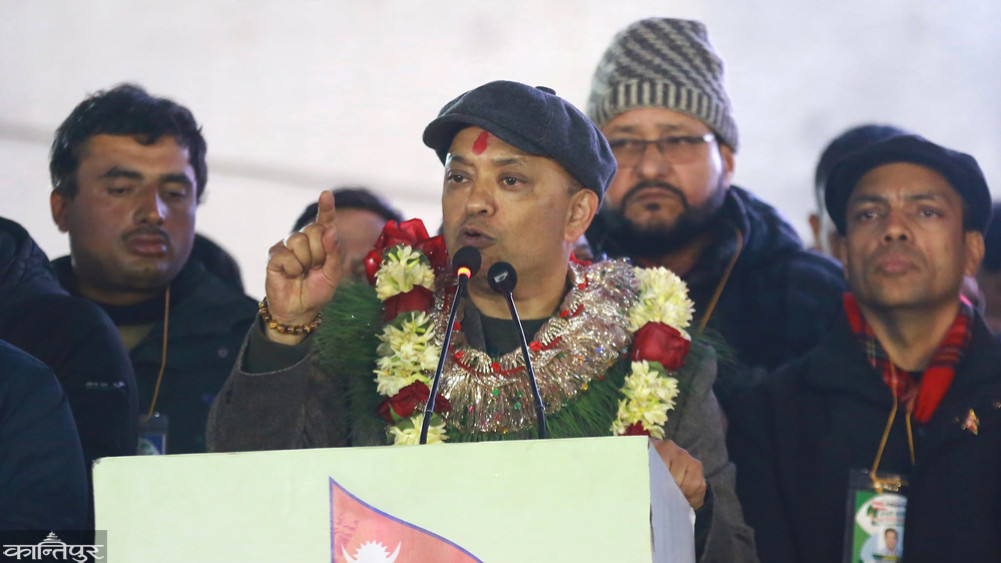
It was announced that he was elected through a special general assembly as his name was the only one listed for the position of chairman.
We use Google Cloud Translation Services. Google requires we provide the following disclaimer relating to use of this service:
This service may contain translations powered by Google. Google disclaims all warranties related to the translations, expressed or implied, including any warranties of accuracy, reliability, and any implied warranties of merchantability, fitness for a particular purpose, and noninfringement.
Gagan Thapa has been elected as the President of the Nepali Congress from the general convention of supporters of the special general convention.
Since his name was the only one included in the post of President, it was announced that he was elected through a special general assembly.
Similarly, Bishwaprakash Sharma and Pushpa Bhusal have been elected as Vice-Presidents, while Pradeep Poudel and Gururaj Ghimire have been elected as General Secretaries.
Gagan's political history
Gagan Thapa's identity in politics began as a leader of the Nepali Students' Union at Trichandra Campus, when he was studying ISC. He was elected as a member of the Independent Students' Union in 2051 and became President two years later. He became Vice-President of the Nepali Students' Union in 2057 and General Secretary in 2059. He was arrested repeatedly on charges of sedition during the student protests that took place while he was General Secretary.
After the then King Gyanendra Shah took power, the then government led by Surya Bahadur Thapa arrested the then president of the Nepali Congress, Gururaj Ghimire, General Secretary Thapa, and leader of the Nepali National Federation of Students Unions (ANFSWU) Purushottam Acharya on charges of treason when they raised slogans during the student movement on 1 Poush 2060 against him.
Gagan had been carrying the issue of republic since 2059. For this, he was intimidated by the party leadership. However, at the general convention held in Bhadra 2062, the Congress withdrew its commitment to accept a 'constitutional monarchy' from its statute. Gagan was at the forefront of the student leaders in the subsequent 2062/063 people's movement. Photos of him throwing stones at the peace park during the people's movement are still occasionally seen on social media.
After the success of the people's movement, Thapa entered parliament from the proportional representation side in the Constituent Assembly elections held in 2064. Gagan was then affiliated with leader Narahari Acharya's republican ideological group. Acharya was a rival of then-President Koirala in the party. While the entire party remained steadfast in favor of the traditional parliamentary system, some leaders like Acharya, Thapa, and Suprabha Ghimire advocated for a form of government with a directly elected executive prime minister. They were openly progressive on issues of inclusiveness, federalism, and civil rights. The entire Congress was included in that line.
The issue of republic established Gagan in national politics.
Thapa was elected as a central member of the party at the 12th general convention held in Asoj 2067. Narahari Acharya had already joined the establishment side at the 13th general convention held in Falgun 2072. Gagan contested for the post of General Secretary from the group of leader Krishna Prasad Sitaula, who was competing with Sushil Koirala. At that time, his father-in-law Arjun Narsingh KC was a competitor from Deuba. When both father-in-law and son-in-law were defeated, BP's son Shashank Koirala won the post of General Secretary. After this, his relationship with Sitaula also weakened and broke.
Gagan stood with leader Shekhar Koirala at the 14th General Convention held in Mangsir 2078. Although Koirala was defeated for the post of President, Gagan was elected General Secretary. After that, his relationship with another General Secretary, Bishwaprakash Sharma, became strong and with Koirala, it became weak.