Two top leaders positive to take the agreement reached when forming the Oli-led government to the elections, but the alliance is uncertain due to the differing views of Shekhar and Gagan within the Congress.
We use Google Cloud Translation Services. Google requires we provide the following disclaimer relating to use of this service:
This service may contain translations powered by Google. Google disclaims all warranties related to the translations, expressed or implied, including any warranties of accuracy, reliability, and any implied warranties of merchantability, fitness for a particular purpose, and noninfringement.
After the merger of the three major alternative political groups, the Rashtriya Swayamsevak Sangh (RSS), Kathmandu Metropolitan City Mayor Balendra Shah, and the Ujjwala Nepal Party, discussions have begun between the two old parties, the Nepali Congress and the UML, about an electoral alliance. Although discussions were initially held between Congress President Sher Bahadur Deuba and UML Chairman KP Sharma Oli, leaders have said that it is not certain that it will take shape.
UML Chairman Oli, who became Prime Minister in an alliance with the Congress on 17 Ashad 2081, has proposed to Deuba to cooperate in the elections, saying that the UML has not backed down from the then seven-point agreement.
Congress leaders say that the proposal to form an alliance for the National Assembly elections to be held on 11 Magh and the House of Representatives elections to be held on 11 Falgun came from the UML. The group that forms an alliance for the National Assembly elections, where local level chiefs/deputy chiefs and provincial assembly members vote, is almost certain to win. On this basis, the leaders have said that discussions are underway between the two top leaders on forming an alliance for the House of Representatives elections as well.
Congress spokesperson Prakash Sharan Mahat says that discussions are underway between the leadership on forming an alliance for the National Assembly elections. According to him, discussions are underway with the UML and the NCP for the National Assembly. ‘In my opinion, the House of Representatives can also be equalized in some places based on needs, but the alliance by sharing seats like before (with the Maoists) is not much preferred in the Congress,’ he says. ‘I also believe that it would be better to go into the election alone without forming an alliance.’
In the Congress, Deuba and a few leaders close to him are not in favor of the alliance. Congress leader Shekhar Koirala claims that local level leaders and cadres are also not in favor of the alliance. ‘I am not aware of any discussions between Sher Bahadurji and KP Oliji on the issue of alliance. But the Congress should contest the election alone. Not only the Congress, but also leaders of other parties are coming up with the idea that it should contest the election alone,’ he told Kantipur. ‘Congress cadres are fed up with not being able to vote on their party’s election symbol. That is why I am not in favor of an alliance before the election.’
UML Secretary Bhanubhakta Dhakal says that when there is a crisis in the political system, it is natural to have dialogue and cooperate. ‘The major parties are in agreement on strengthening the federal democratic republic and bringing the constitution back on track,’ he says. ‘If there is a crisis in this political system, there should be cooperation between the major parties to save it.’ Secretary Dhakal says that UML will go to the elections without forming an alliance with any party in a healthy environment of competition without fear.
UML General Secretary Shankar Pokharel says that it is not meaningful to discuss an electoral alliance as the election is still not certain. He says that the major political parties should now focus on bringing the constitution back on track. ‘The issue of forming an alliance with the Congress or other parties without deciding whether to hold an election is not relevant,’ he says. ‘Political parties are not in a position to organize programs independently.’ However, the UML has already submitted the closed list of proportional candidates to the Election Commission, while the selection process for direct candidates has begun.
According to leaders, Congress President Deuba is in favor of forming an alliance with the UML in the National Assembly. A leader close to Oli says that Deuba is unable to give a clear answer on the issue of forming an alliance for 21 Falgun. ‘The president is positive that the seven-point agreement reached with the UML should be carried through to the elections, but there is no way to say what will happen with the different opinions of Shekhar Koirala and Gagan Thapa within the Congress,’ the leader said.
While the alliance journey with the Maoists was underway, General Secretary Gagan Thapa had proposed in the Congress Mahasamiti meeting held in Godavari on 7-10 Falgun 2080 that no alliance should be formed in any election now.
‘In a situation where no party has secured a majority, it may be natural to coordinate to run the government by formulating certain common policies and programs after the election, but considering that the pre-election alliance culture was not a regular political situation in a democracy but a product of a forced situation, we resolve that the Congress will never create a situation where its voters vote for the election symbol of any other party by forming a pre-election alliance in future periodic elections,’ Thapa proposed.
In order to preserve the ruling coalition, the Congress did not immediately take a decision from the Mahasamiti on General Secretary Thapa’s proposal. But less than two weeks later, on 21 Falgun, the Maoists left the ruling alliance with the Congress and joined with the UML and the Rashtriya Swayamsevak Sangh (RSS). After that, the Congress Central Working Committee decided not to form an alliance by amending the language in the proposal submitted to the Mahasamiti.
The decision stated, ‘We will re-establish the Congress as a party that can bring a majority on its own by making our own organization more energetic and increasing the votes and trust of the general public. We will fight alone in the future periodic elections on our own strength and ensure that our voters can vote on the Congress election symbol tree.’ This is the institutional policy of the Congress on alliances.
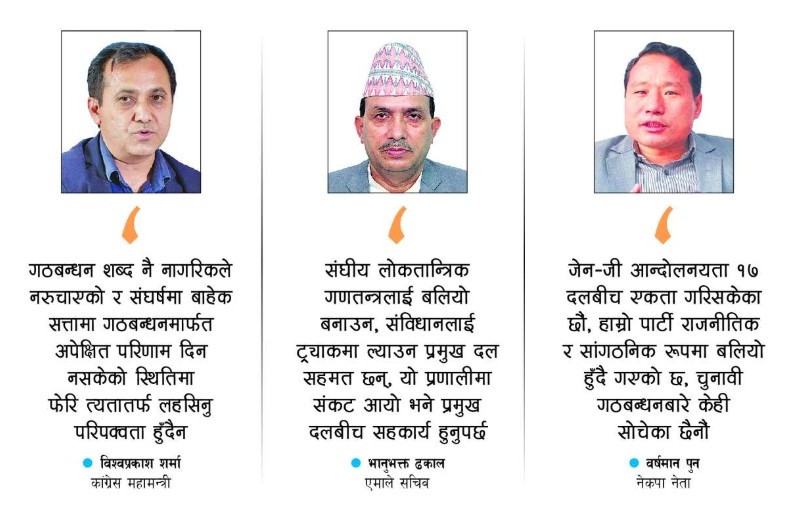
Congress General Secretary Bishwaprakash Sharma says that an electoral alliance would go against the party’s policy and the sentiments of the general leaders and workers. ‘When the word alliance is not liked by the citizens and the coalition in power has not been able to give the expected results except in struggle, it is not mature to move towards it again,’ he says.
Congress leader NP Saud says that there will be an alliance in the National Assembly, but the decision should be made considering the polarization in other parties in the House of Representatives. ‘It is the decision of the Mahasamiti that we should contest the elections on our own strength, but the course of events and the question of whether other parties will form an alliance or not will determine whether we will also form an alliance,’ he says. ‘Whether it is beneficial to fight alone or form an alliance should be decided based on the principle of relativity.’
Saud says that in the National Assembly, we should join forces with some party or the other. ‘It is better to reach an agreement among the parties that are fellow travelers of the constitution. If the big parties give up one or two seats and reach an agreement among all the parties, the National Assembly can be made a place of agreement. That will also strengthen democracy,’ he says.
Elections are being held for 18 of the 19 seats that are going to be vacant in the National Assembly on 11 Magh. One seat is nominated by the President on the recommendation of the Council of Ministers. From 20 Falgun, 8 seats of UML, 8 of Nepali Communist Party, 1 each of Loktantrik Samajwadi Party and Janata Samajwadi Party are becoming vacant in the National Assembly. Nominated Bamdev Gautam is also leaving along with him.
UML is under a lot of pressure to form an alliance in the National Assembly. UML currently has 10 MPs in the National Assembly. If it fails to win the upcoming elections, UML will be reduced to 2 seats. Therefore, leaders say that UML has made an informal proposal to give 10 seats to Congress. According to them, UML Chairman Oli raised the issue of alliance in his meetings with Congress President Deuba on 19 Mangsir and 7 Poush. At that time, there was a discussion in the House of Representatives about keeping the seats won by Congress and UML intact and supporting each other and sharing the remaining constituencies. In the 2079 elections, Congress directly won 57 constituencies and UML 44 constituencies.
Congress leader Koirala says that forming an alliance before the elections will have a negative impact. ‘Due to our electoral system, there is little chance of a single party getting a majority,’ he says, ‘it is natural to have an alliance when forming a government. But an alliance before the election does not benefit anyone, only the president can’t form an alliance.’
There is also concern about the internal dissatisfaction that the alliance will cause in the Congress. Leaders understand that if cooperation with the UML is based on limited decisions at the top level, it will lead to a situation of rebellion among the party’s lower-level cadres and supporters, which will add to the challenge. Due to the alliance in the last election, there was a trend of rebel candidates emerging, abandoning the party and becoming inactive.
The UML side, on the other hand, is arguing that cooperation with the Congress should be viewed in terms of strategic needs and national stability. UML believes that cooperation between major parties will reduce political instability. Leaders close to Oli have started publicizing the idea of forming an alliance. UML Vice President Ram Bahadur Thapa had said at a program at the ‘Madan-Aashrit Pratishthan’ on Tuesday that cooperation between democratic and leftist parties should be considered to win the upcoming election. ‘In the event of an election, the democratic and leftist parties should win half the seats each,’ he had said. ‘Even in proportional representation, the democratic and leftist parties should win half the seats each.’
Political science professor Krishna Pokharel says that an alliance between old parties shows a weak mentality. He analyzes that the old parties are scared after the unity between Rashtriya Swayamsevak Sangh (RSS) President Ravi Lamichhane, Kathmandu Metropolitan City Mayor Balendra Shah and Ujjaya Party patron Kulman Ghising. ‘It seems that the old parties feel challenged after Ravi, Balendra and Kulman come together,’ he says, ‘that is why they have started talking about an alliance.’
Professor Pokharel says that an alliance between any two parties, including the Congress, UML and NCP, sends a negative message to voters. He concludes that the Congress-UML and UML-Maoist alliances in the past have been counterproductive for the country.
Both Congress and UML in talks with NCP
Both Congress and UML are in talks with NCP on forming an alliance for the upcoming National Assembly elections. A NCP leader said that they are holding informal talks with Congress and UML leaders. ‘The talks are more focused on protecting the constitution than forming an electoral alliance,’ he said.
According to the leaders, NCP coordinator Pushpa Kamal Dahal has made up his mind to form an alliance or front until the time he files his candidacy for the House of Representatives directly. He has been saying from public programs that he will collaborate with others besides UML Chairman KP Sharma Oli. Two weeks ago, Dahal had discussed possible collaboration with Congress President Sher Bahadur Deuba.
NCP leader Barshaman Pun, however, says that he is not thinking about an electoral alliance right now. ‘Since the Gen-G movement, we have united 17 parties. Our party is becoming stronger politically and organizationally,’ he says. He says that the unity/alliance between the new forces is making the major parties work hard to expand their organizations.

