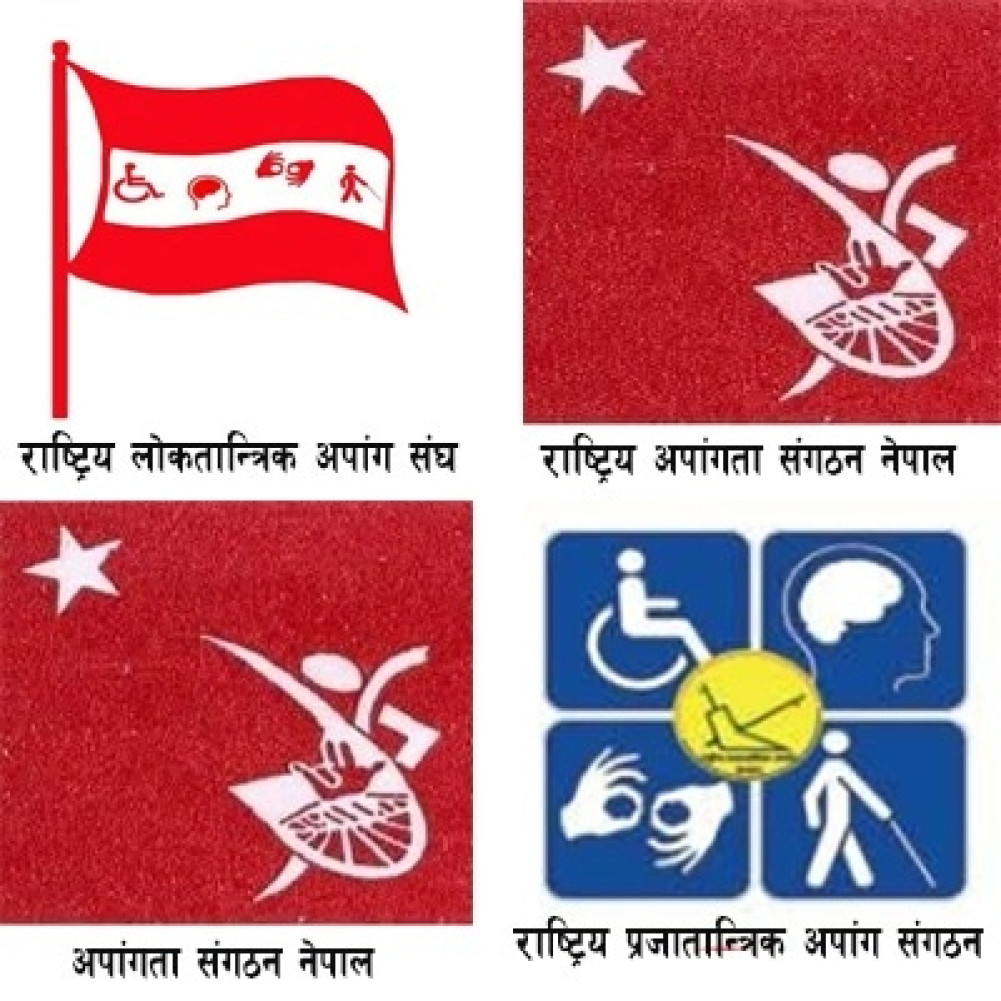
The sister organizations of the Nepali Congress, CPN-UML, CPN-Maoist, and RPP have demanded a correction, saying that the ordinance issued by the government did not include the cluster of people with disabilities.
We use Google Cloud Translation Services. Google requires we provide the following disclaimer relating to use of this service:
This service may contain translations powered by Google. Google disclaims all warranties related to the translations, expressed or implied, including any warranties of accuracy, reliability, and any implied warranties of merchantability, fitness for a particular purpose, and noninfringement.
Fraternal organizations of four political parties have demanded immediate correction, saying that the election ordinance does not include persons with disabilities. The fraternal organizations of Nepali Congress, CPN-UML, CPN-Maoist and RPP have demanded immediate correction, saying that the ordinance is against the constitution.
Madhav Prasad Chamlagain, President of the National Democratic Disabled Association, Jagadish Prasad Adhikari, President of the National Disability Organization Nepal, Tikaram Parajuli, President of the Disability Organization Nepal, and Bharatmani Bhatta, President of the National Democratic Disabled Organization, issued a joint statement and made this demand.
The statement said, 'In the context of the current preparations for the House of Representatives elections, the Government of Nepal has revised Schedule-1 of the House of Representatives Election Act, 2074 BS through an ordinance and re-determined the basis of inclusion (cluster) for the closed list of proportional candidates.'
The four organizations objected to the amendment, saying that persons with disabilities, who constitute about 2.2 percent of Nepal's total population, have been kept out of the clear and mandatory system of proportional representation. 'We are not accepting such an ordinance that deprives persons with disabilities of political rights under any circumstances.'
We have strongly demanded that the ordinance issued by them be amended and reissued with a clear provision for the election of persons with disabilities, stating that they do not accept the ordinance, which was brought in violation of the constitution. The statement said, 'We want to state clearly that inclusive democracy is not a matter of giving or not giving on the basis of any agreement. This is a fundamental constitutional right guaranteed by Articles 42 (1) and 84 (3) of the Constitution of Nepal. If this constitutional demand of ours is ignored, we want to give a clear warning that we will be forced to resort to legal remedies, peaceful protests through democratic methods and all other constitutional options.'
The statement, examining the articles of the constitution, said, 'Article 42 (1) of the Constitution of Nepal has ensured the right to proportional inclusive participation in all state bodies, specifically including persons with disabilities among socially backward communities under the right to social justice. Article 29 of the Convention on the Rights of Persons with Disabilities, to which Nepal is a party and ratified by the Parliament, also mentions the participation of persons with disabilities at all levels of the state. Similarly, Article 84(2) of the Constitution clearly stipulates that political parties should ensure representation of different classes, genders and communities on the basis of population when fielding candidates under the proportional representation system. More importantly, Article 84(3) imposes a constitutional obligation on the state and political parties to elect persons with disabilities to the House of Representatives, with mandatory inclusion of persons with disabilities, it said. The statement, discussing the contribution made by
to democracy, said, 'We would also like to recall that in the historic people's movement of 062/63 BS, persons with disabilities played an important role for democracy, inclusion and social justice by standing at the forefront. The principles of inclusive democracy and proportional representation are the result of our struggle. Therefore, persons with disabilities are not only beneficiaries of this constitution, but also important stakeholders in its creation.'
Urging the concerned bodies, the statement said, 'The organizations of persons with disabilities sincerely urge the Honorable President, the Government of Nepal, the Election Commission and all the concerned bodies to make clear, binding and assured arrangements for the election of persons with disabilities under the proportional system by political parties in the upcoming elections to the House of Representatives. The rights granted by the Constitution should be fully implemented by ensuring the representation of persons with disabilities in the House of Representatives as per Article 84 (3) of the Constitution.'