There is a legal provision that the closed list should be based on the population of the inclusive group. Since the 2078 census report has been published, there is a possibility that the election process will face legal challenges if the old population percentage is used.
We use Google Cloud Translation Services. Google requires we provide the following disclaimer relating to use of this service:
This service may contain translations powered by Google. Google disclaims all warranties related to the translations, expressed or implied, including any warranties of accuracy, reliability, and any implied warranties of merchantability, fitness for a particular purpose, and noninfringement.
According to the 2078 census, it is necessary to amend the existing law to prepare a closed list of candidates for the proportional electoral system in accordance with the principle of inclusion. The Election Commission has given political parties until December 13 and 14 to submit the closed list of proportional candidates. Before that, the House of Representatives Election Act, 2074, needs to be amended.
There is a legal provision that parties must prepare a closed list of candidates in accordance with the principle of inclusion, representing Dalits, indigenous peoples, Khas Aryas, Madhesis, Tharu and Muslims on the basis of population. Section 28(5) of the House of Representatives Election Act mentions the provision regarding proportional closed list.
Schedule-1 of the Act specifies the inclusion basis for the closed list of candidates as per the 2068 census. It mentions the percentage of population of Dalits, indigenous peoples, Khas Aryas, Madhesis, Tharu and Muslim communities as per the old census. The parties had prepared closed lists in the House of Representatives elections held in 2074 and 2079 according to the census percentage of the inclusive groups mentioned in the Act. The elections and results were declared on that basis.
The law has not been amended even after 3 years since the report of the census held in 2078 was made public. The new census has seen a general change in the population of inclusive groups. Election Commission spokesperson Narayan Prasad Bhattarai says that there is a situation where inclusive groups need to be represented in the closed list according to the new census. For that, he informed that the inclusive basis in Schedule-1 of the House of Representatives Election Act should be amended according to the new census.
‘There is pressure of time. Parties should submit closed lists by 13-14 Poush. It is necessary to reach a decision before that,’ he said, ‘The government has been informed in this regard.’ Last Thursday, Home Minister Om Prakash Aryal, Acting Chief Election Commissioner Ram Prasad Bhandari, and officials from the Commission, the Ministry of Home Affairs, the Ministry of Law, and the National Statistics Office held discussions.
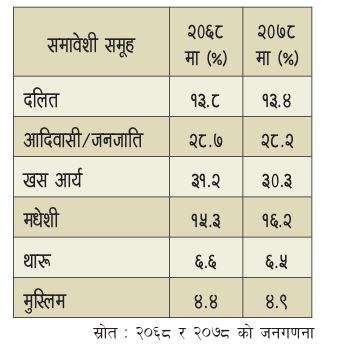 It has also been seen that a single law amendment will not be enough to amend the percentage of inclusive clusters in the House of Representatives Election Act according to the new census. 17 new castes have been identified in the census. The government should also decide on which cluster of inclusive groups to place those castes in. Statistics Office spokesperson Dhundiraj Lamichhane says that a small number of new castes have been identified.
The Indigenous Peoples Foundation Act mentions 60 castes as part of the indigenous peoples group. The names of those castes are written in the schedule. It seems that the act also needs to be amended to include the newly identified castes in the indigenous peoples group. Spokesperson Lamichhane said that they have been included in various clusters based on the newly discovered castes, locals and experts.
The Statistics Office has already sent the details of the ethnic population to the Ministry of Home Affairs. Now, the government should classify them into inclusive groups and include them in the law, he mentioned. The commission, however, has said that the law should be amended to reveal the percentage of inclusive groups according to the 2078 census or the government should decide whether to go according to the 2068 census. Since the law states based on population and the new population has been published, there is a possibility that the election process will face legal challenges if the old population percentage is used.
Commission spokesperson Bhattarai said that a committee has been formed under the coordination of Subhash Kumar Bhattarai, Joint Secretary of the Ministry of Law, to determine the inclusive percentage based on the census. The commission needs the population percentage of six inclusive groups: Dalit, Adivasi Janajati, Khas Arya, Madhesi, Tharu and Muslim. The Statistics Office has classified all castes and communities into eight groups. It will have to be reduced to six groups. The committee will also prepare a report to include it in the Election Act.

