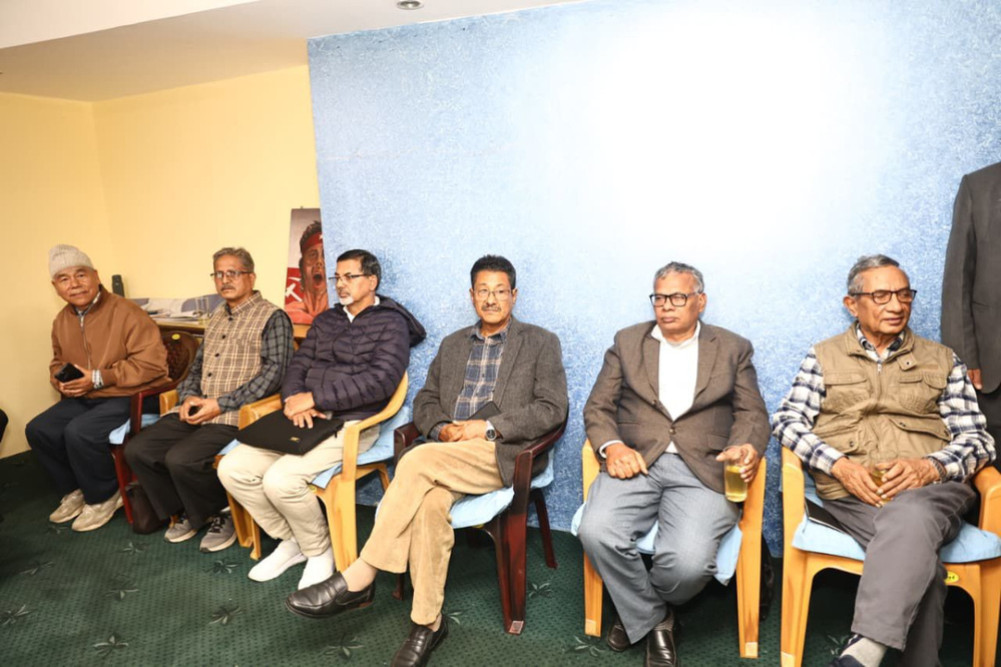
He walked out of the meeting held on Saturday to take a final decision on party unification, stating that the matter was unacceptable.
We use Google Cloud Translation Services. Google requires we provide the following disclaimer relating to use of this service:
This service may contain translations powered by Google. Google disclaims all warranties related to the translations, expressed or implied, including any warranties of accuracy, reliability, and any implied warranties of merchantability, fitness for a particular purpose, and noninfringement.
The Maoist Center has decided to unite with the CPN Unified Socialist (CPN-S), CPN Socialist, Jana Samajwadi, Nepal Socialist Party and Communist Party of Nepal (Chiran Pun) groups.
After the Unified Socialist Party made a policy decision to unite with the Maoists on Friday, the Maoists' central secretariat meeting held on Saturday decided to unite with the CPN-S and other parties. Deputy General Secretary Janardan Sharma has expressed a different opinion against this decision, saying that unity should not be achieved without a broad left unity. He has said that he will not unite with the CPN-S and other parties.
After the central secretariat meeting, Vice President and Spokesperson Agni Prasad Sapkota informed that the decision to unite with the CPN-S and other parties has been made as agreement has been reached on political, ideological and theoretical issues. 'It has been decided to unite with the CPN-S and the Unified Socialist Party, the CPN-S (Raj Karki), the Jana Samajwadi Party (Subhash Raj Kafle), the Nepal Samajwadi Party (Mahindra Ray Yadav) and the CPN (Chiran Pun),' he said, 'Agreement has been reached on political and theoretical issues. The unity will happen soon.'
He said that the party unity is going to create an environment to hold elections on time. ‘If unity is delayed, the nation will be in even more trouble. We should unite and take the initiative to create an environment for elections on time.’
He commented on the statement of Deputy General Secretary Sharma, who was opposed to unity, as apolitical and chaotic. ‘Janardhanji’s style is not democratic, not political. Let everyone, including the chairman, sit down and discuss. Let’s reach a conclusion.’ He said that he did not accept it,’ he said, ‘His style is not democratic, not democratic. It is chaotic.’
Deputy General Secretary Sharma said that unity that is not based on political and ideological grounds cannot be supported.’
‘Unity that does not strengthen the party, does not create factions at the bottom and goes against the spirit of the movement cannot be accepted,’ he told Ikantipur, ‘We should go ahead with a broad left unity.’ Leaving this idea and uniting is a deviation. This unity is going to happen without leaving the Maoist identity.'
Sharma's statement is as follows:
I have come to the secretariat meeting now to present my statements. Especially the unity that is being talked about now, our party had decided to hold the general convention in the central committee meeting of the previous year in November. An attempt was made to circumvent that general convention. The central committee that met after the last Gen-JD movement had decided to hold the general convention again. This unity discussion was held to circumvent that decision, prevent the ideological debate from moving forward and prevent the new generation of leaders from being elected through competition. This current unity cannot solve the problems of current politics. This unity is not possible even by dividing various parties and joining them piece by piece.
What I meant was that I believe that we can achieve this by launching a massive campaign to unify the communist movement as a whole, by holding massive debates, and by taking a long time. Contrary to that belief, by using people from below to break, split, and create factions in our own party, not protecting our own cadres, and by bringing in and uniting broken groups from outside, that too by forming committees of thousands—I have stated that the communist party cannot move forward in this way.
The second thing is that the ideology of the Maoist party is Maoism. We cannot surrender to the fundamentals of multi-party democracy by abandoning Mao ideology and Maoism. This is ideological surrender, which is unacceptable to us.
The third thing is that the Gen-JD movement has raised the issue of good governance and the issue of ending corruption. But when we unite, we are not understanding its sensitivity, but rather trying to create a unity that promotes it. The Maoist Party cannot carry that burden, and I do not accept that it should carry that burden. I left this meeting with the view that the attempt to create a security circle by nominating again, while completely rejecting the idea of handing over leadership, cannot move the party forward.