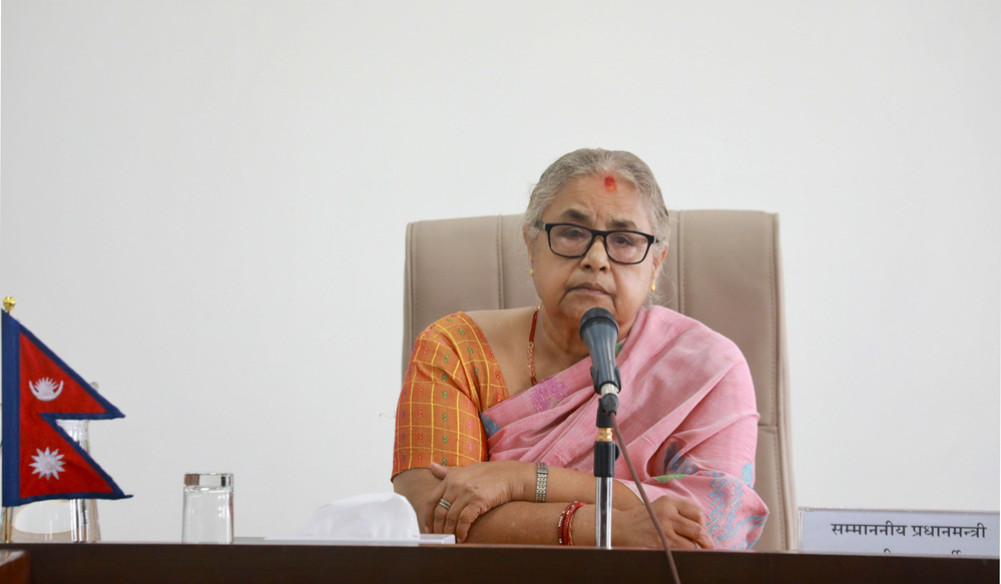
There was no discussion that Sushila Karki became the first Prime Minister. Because Karki, who has made history by being the first woman Chief Justice, was not even discussed closely with any political party.
We use Google Cloud Translation Services. Google requires we provide the following disclaimer relating to use of this service:
This service may contain translations powered by Google. Google disclaims all warranties related to the translations, expressed or implied, including any warranties of accuracy, reliability, and any implied warranties of merchantability, fitness for a particular purpose, and noninfringement.
Writer CK Lal wrote in an article in Baisakh 2067 - 'Difficult situations call for tough decisions. Now is the time to test whether the leadership of the three major parties is capable of taking such a decision. Perhaps it is time for Nepal to accept its first female Prime Minister.
The time when Lal's article was published was a difficult situation. The Maoists made the general strike and agitation organized against the government led by Madhav Kumar Nepal very strict. Even the ministers were not allowed to enter the Singha Darbar . Some ministers used to enter the Singha Darbar in the early hours of the morning. Even though the constitution was supposed to be promulgated on June 14th of the same year, the tension between the Congress-UML government and the Maoists was extremely high.
Lal took the name of Congress leader Suprabha Ghimire at that time. He said, "President Pushpa Kamal Dahal and President Jhalnath Khanal (the then President of UML), do you two 'leftists' accept the leadership of Nepali Congress' intellectual personality and Kathmandu assembly member Suprabha Ghimire?" If not, the delay in searching for an alternative personality may not be acceptable to the Nepali people.'
Ghimire was a member of the Constituent Assembly at that time. Congress member, she decided to travel to the Constituent Assembly by defeating UML candidate Bidya Devi Bhandari in Kathmandu-4. She was .
The sentence that Lal wrote saying that difficult situations seek bold decisions, has been implemented after 15 years . The complexity of the situation is more than that. 73 people have died in the Gen-G movement on 23 August and the demonstration on 24 August. The injured are in the hospital. The parliament building, several ministries at Singha Durbar, the President's residence, and the Supreme Court have been burnt by protesters. Government offices across the country have been set on fire. The damage suffered by the state in a single day is enormous .
The political fluidity is the same . Going beyond the traditional process of government formation, the President has appointed Sushila Karki as the Prime Minister. The House of Representatives has been dissolved and the election date has been announced as 21 February. The parties that fought for democracy and were at the center of political chaos for decades have been pushed to the sidelines . Gen-jis have become the mainstream and decisive of politics without political philosophy and broad ideological similarity. Political confusion will remain until the popular constitutional practice of government formation and the chain of representative institutions are re-connected.
The current difficult situation has made a bold decision . As a result, a woman has been appointed Prime Minister for the first time in the political history of Nepal.
However, the discussion of a female prime minister used to be discussed in different times in the politics of Nepal . The then Prime Minister Pushpa Kamal Dahal on 27 November 2080 Addressing the groundbreaking ceremony of Green Industrial Park, a female entrepreneur in Panchkhaal, Kavre, said, 'After the declaration of the Federal Democratic Republic, good work has started in this country with a woman President, a woman Speaker, and a woman Chief Justice . Now there is only one left - Prime Minister Woman . I wish to have a woman prime minister soon.'
His wish was fulfilled within two years .
While answering the questions of the participants in the Youth Conclave held in Kathmandu on August 8 last year, the then Prime Minister KP Sharma Oli said that he wanted to make the first woman Prime Minister saying that he had made the first President, Chief Justice, Speaker and Chief Secretary. But you have to prepare a little for that. In reality, it may be a little difficult to say that I will make a woman prime minister in two months, three months, next year, but I am thinking about preparing to make it soon.'
must be a coincidence, even though she did not make it, she left it as 'next year' as a woman prime minister . Oli had to resign from the post after the Gen-G movement on 23 August and the demonstration on 24 August. Then President Ramchandra Paudel appointed former Chief Justice Sushila Karki as Prime Minister on the recommendation of Gen-G.
There was no discussion that Karki became the first Prime Minister. Because, Karki, who has made history by being the first woman Chief Justice, was not even discussed closely with any political party. She was not even a member of the House of Representatives. But the responsibility to overcome the difficult time has come on his shoulders.
Outgoing foreign minister Arju Rana was once discussed as the future prime minister.
In June 2081, UML President Oli became the Prime Minister after the power sharing between Congress and UML. Before agreeing on power sharing, Oli and Congress President Deuba also agreed to become prime minister in turn. According to which, Oli kept repeating in his speech that Deuba would leave power after June 2083.
After Oli became the prime minister, Arju Rana, who was also Deuba's wife, visited Delhi in August 2081, and she was also discussed as the future prime minister. The respect that Arju received from the Prime Minister in Delhi caused such a discussion . The comment was made in Nepal that the honor given by Delhi, which is said to have an influence on Nepal's power politics, has a special meaning. But when he reached Delhi again in January, he did not receive the same honor as the previous time, so there was a lot of discussion.
Similarly, after the former President Bidyadevi Bhandari insisted that UMA return to politics, the political society had drawn some possible scenarios. Bhandari made a public statement linking her being active in the UML with her desire to become its leader. In an interview given to a television last June, she said that she had no doubts about returning to active politics to take the leadership of UML. It was not difficult to become the Prime Minister after reaching the leadership of UML due to the circumstances and the size of the party at that time. Therefore, he was seen as a strong character of the future prime minister . Bhandari, who has become the president, was thought to be able to carry the burden of the post of prime minister.
But UML not only revoked his membership, the former president also decided not to return to active politics . After the Gen-G movement, questions have been raised on the top leaders of all parties, including the UML. Public pressure to leave the leadership has increased. In such a situation, it is being assessed that UML will bring Bhandari into party politics and deal with the crisis of the party by giving him the responsibility of the president. In such a situation, Bhandari may become the prime minister in time, but she will not be the first woman prime minister.
UML Vice President Ashtalakshmi Shakya was seen as the future Chief Minister of Bagmati Province after becoming a candidate for the Provincial Assembly in the 2074 election. She also expressed that she can lead the country by leading the state (becoming the prime minister). But the UML's power struggle at that time took place in the parliamentary party elections. Dormani Poudel became the Chief Minister after defeating Shakya and became the leader of the parliamentary party. During the UML split in 2078, she became the Chief Minister for a while but since then she has been out of the political role . Since he did not become a candidate in the 2079 election, he is not in a position to be the Prime Minister, let alone a minister.
is not only discussed by others, some female leaders present themselves as the future prime minister. Shailaja Acharya belongs to such a leader.
Shanta Ghimire of Biratnagar, who went to meet Shailaja Acharya, who was jailed for showing the black flag to King Mahendra, recalls, "Sheilaja would never stay till the end of the meeting". He would go from the center waving his hand like a leader. She used to wave her hand saying 'First Lady Prime Minister of Nepal' instead of what A. Shailaja did,' she says . At that time, she started preparing herself for the future prime minister. Shailaja's five decades of active politics show that it was not just the prison thrill of a political prisoner. (Anvika Giri/February 15, 2072/Kantipur Koseli)
After the Congress became the second largest party in the 2051 general elections, Girija Prasad Koirala expressed disinterest in becoming the leader of the parliamentary party, and eight leaders including Acharya, Sher Bahadur Deuba, Khum Bahadur Khadka, Ramchandra Paudel moved forward. Acharya was stopped by Koirala. Finally, Deuba became the leader of the parliamentary party and also the prime minister.