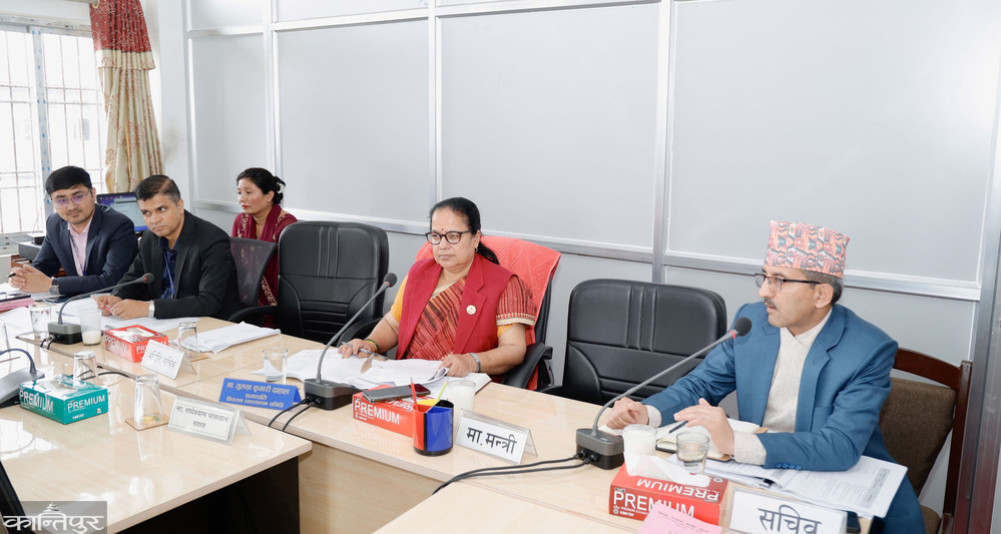
The provisions passed by the Legislation Management Committee remain in place and the Chief Secretary, Secretary and Joint Secretary of the Civil Service will not be able to take appointments in non-governmental organizations for two years after retirement due to conflicts of interest with the Constitutional Commission, ambassadors, and the government.
We use Google Cloud Translation Services. Google requires we provide the following disclaimer relating to use of this service:
This service may contain translations powered by Google. Google disclaims all warranties related to the translations, expressed or implied, including any warranties of accuracy, reliability, and any implied warranties of merchantability, fitness for a particular purpose, and noninfringement.
The Legislation Management Committee of the National Assembly has corrected the evasion by the House of Representatives in the provisions related to 'cooling off period' of the Federal Civil Service Civil Bill.
The committee has made a clear provision that high-ranking civil servants cannot take constitutional commission, diplomatic and government appointments for two years after they retire from service due to age or resignation. For a long time, high-ranking employees supported by the UML, which is leading the government, have been pressing for the removal of the provision of 'cooling off period' from the bill. During the monthly discussion in the Legislation Management Committee, apart from UML and nominated members, MPs from Congress, Maoist, United Socialists, and JSP Nepal took the position that there should be a provision of 'cooling off period' for at least two years.
Gopal Bhattarai, who is also the chief whip of UML, proposed that if there is a system of 'cooling off period', it should be less than two years. But after Congress, Maoist and other party MPs said that it is not possible to arrange a time less than what was passed by the House of Representatives, UML expressed its silent support. After the discussion, Federal Affairs and General Administration Minister Bhagwati Neupane said, "It has been established that the provision of 'cooling off period' should be kept in the Civil Bill itself." Let's go with the opinion of the most honorable on this.'
Legislation Management Committee Chairman Tulsa Dahal informed that the provision of a two-year 'cooling off period' has been passed for gazetted special category employees. "We have corrected the error made by the House of Representatives in the provisions related to the 'cooling off period' in the civil service bill, and there has also been an agreement to keep the 'cooling off period' for two years," she said. The provision passed by the Legislation Management Committee was approved by the National Assembly and implemented as a law by the House of Representatives. The Chief Secretary, Secretary and Joint Secretary of the Civil Service will not be allowed to be appointed to non-governmental organizations in conflict of interest with the Constitutional Commission, Ambassadors, and Government for two years after retirement. In the meeting of the
committee, after Ravilal Panth, Secretary of the Ministry of General Administration, argued that the House of Representatives had arranged for a 'cooling off period' for office assistants to the Chief Secretary, the parliamentarians agreed to keep the arrangement applicable only to Joint Secretary, Secretary and Chief Secretary level officers.
Secretary Panth had also claimed that the Constitution itself indicated that political persons would be appointed to constitutional, diplomatic and government positions. He argued that if the post-retirement appointment of civil servants is stopped, the morale of the employees in the service will be weakened. Prohibiting only civil servants is discrimination. Laws should be made to apply to everyone," he said.
Chief Secretary Ek Narayan Aryal and the secretaries of the Parliament along with the General Secretary Padma Prasad Pandey actively put pressure on the political leadership to remove the 'cooling off period' provision from the bill. Chief Secretary Aryal has expressed in the parliamentary committee that this provision should be removed until the bill is implemented as a law.
UML's chief whip Bhattarai said that his party raised the question of the chief secretary and secretaries but was not accepted by other parties. Anjan Shakya, a member of parliament nominated by the President, maintained her stand till the end that there should be no provision of 'cooling off period' in the Civil Bill.
Maoist MP Jhakkuprasad Subedi said that the chief secretaries and secretaries who want to take constitutional, diplomatic and government appointments after retirement should retire at the age of 57, but the system of 'cooling off period' is inevitable in the civil service. Joint secretary, secretary and chief secretary will go for constitutional, government and diplomatic appointments. If he wanted to go there, he would have resigned at the age of 57. After attaining the age of 59, he will be appointed and retire in 6 years, he said.
In the National Assembly, Congress Parliamentary Party leader Krishna Prasad Sitaula asked civil servants not to be taken into account in the sense of the provision of 'cooling off period' in the Bill. This arrangement is going to be made so that you can stay for some time after the vacation. Let him write a book about his experience, give ideas for reforming the country,' said Sitaula, 'in the context of Nepal, he will influence the party leader in the government and take his own work soon. No one gets anything, no one gets what they get. Sitaula also mentioned that Chairman of the State Affairs Committee of the House of Representatives, Ramhari Khatiwada, who played a role in maintaining the system of 'cooling off period', resigned due to errors in the report of the bill.
During the passage of the Civil Bill by the State Order Committee under the House of Representatives, the system of 'cooling off period' was tampered with. The committee unanimously passed the report with the provision that in Section 82 (4) "Civil servants or employees who have resigned or retired from service shall not be appointed to any constitutional or government post before the completion of a period of two years from the date of retirement".
After that, the provision that was already placed in the bill that 'not to be appointed to posts other than constitutional or diplomatic appointments and any other appointments made by the Government of Nepal' had to be removed. But it was retained in section 82 (5A). A special investigation committee was formed in the House of Representatives regarding the fraud in the
bill. The committee suggested that the provision of 'cooling off period' should be removed from the National Assembly. The bill was passed by the House of Representatives and came to the National Assembly. The bill must be passed by the National Assembly and returned to the House of Representatives by August 17. After that, the Speaker will have to verify it and send it to the President for verification. Then it will be implemented as a law. Legislation Management Committee Chairman Dahal informed that the report of the Civil Bill is ready to be presented in the meeting of the National Assembly on Monday.