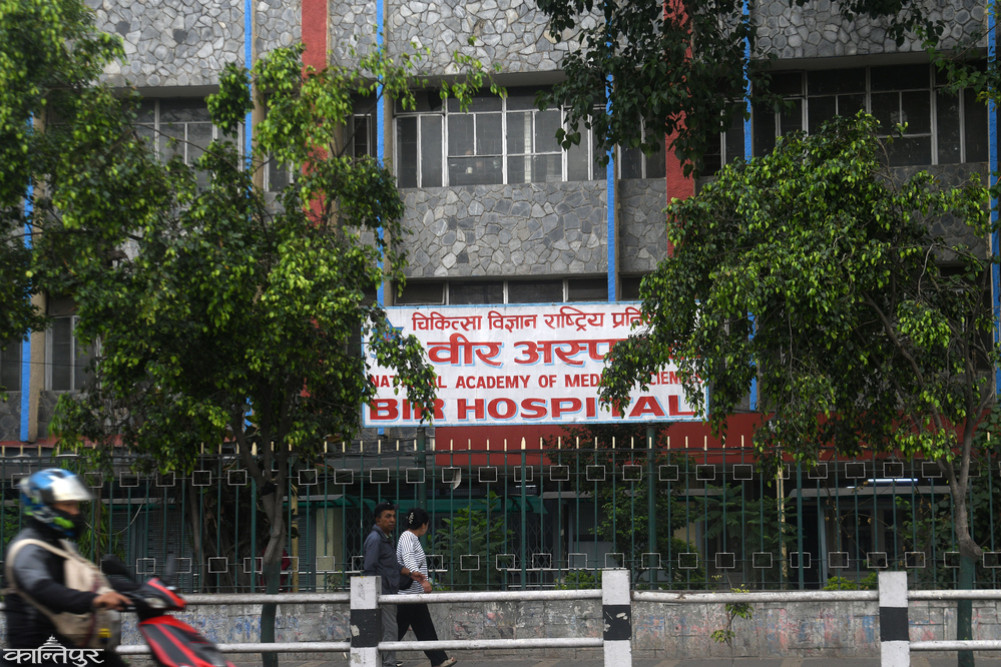
To address the increasing number, types, and treatment of patients, awareness programs should be implemented at Bir Hospital. The hospital, which has about 2,500 staff, should be made technology-friendly and smart.
We use Google Cloud Translation Services. Google requires we provide the following disclaimer relating to use of this service:
This service may contain translations powered by Google. Google disclaims all warranties related to the translations, expressed or implied, including any warranties of accuracy, reliability, and any implied warranties of merchantability, fitness for a particular purpose, and noninfringement.
Due to its trustworthy and reliable services, the number of patients at Bir Hospital is increasing day by day. In this fiscal year, there have been 1.4 million diagnostic cases, 750,000 outpatients, 37,000 emergency cases, 25,000 inpatients, and more than 25,000 surgeries, among which over NPR 60 million worth of treatment has been provided free of charge. Bir Hospital is not just a building of trust; it is a confluence of the suffering of Nepalis.
Health insurance has raised the expectations of the general public, and over time, service recipients have sought efficiency. Even when there are prolonged issues with insurance payments, Bir Hospital faces the compulsion of not being able to halt services. There has not been any significant increase or expansion in budget, human resources, infrastructure, or technology at Bir Hospital. However, statistics show that when insurance services are halted at other hospitals and there are two weekly holidays, the number of service recipients at Bir Hospital has doubled, with daily outpatient numbers reaching 5,000. Bir Hospital is striving to adopt the latest international technology and treatment methods, embracing the concept of evidence-based medicine.
The artistic building of Bir Hospital, which Bir Shumsher constructed with 15 beds on the 12th of Shrawan, 1946 BS, was destroyed by the earthquake of 1990 BS. Later, during King Birendra’s reign, India built the OPD building and USAID constructed the 360-bed surgical (old NAMS) building. JICA built a new 100-bed building behind the surgical building, which now houses the hemodialysis, cardio, and gastro wards. The Government of Nepal has built a new 500-bed surgical building. With the expansion of ICU and HDU, there are now 72 multi-specialty ICU beds and 38 HDU beds, totaling 110. Currently, Bir Hospital has only one 60-year-old building, but it has operational approval for 960 beds. Through 22 clinical departments, 3 clinical units, and 52 other units, it provides basic to specialized and highly specialized services. Bir Shumsher established Bir Hospital after seeing the suffering of the common people in accessing medical treatment, and even today, Bir Hospital remains the hope for treatment for the underprivileged and general public.
Bir Shumsher acquired land in five locations outside the valley for Bir Hospital’s income, and the provision was that the income from these lands would fund free services at the hospital. However, in 2053 BS, a committee led by Dhruvalal Joshi was formed to investigate the land and agriculture. To this day, there is no trace of the investigation or accounting.
To make health services more patient-friendly and accessible, the hospital has arranged for additional allowances to incentivize staff. However, despite countless complaints, grievances, and issues from not only patients and their relatives but also those in management, there have been no results. Even in such circumstances, Bir Hospital distributes up to 90 percent of its income in various salaries and allowances.
Carrying the history of the Rana era and being the face of the country’s health sector, this hospital holds many aspirations for ordinary people. However, there are daily dozens of complaints and grievances about busyness in corridors and meetings, internal disputes, lack of services in the laboratory and pharmacy, malfunctioning equipment, unavailability of consultants, long waits and queues for outpatient and surgical services, politicization, and issues with snacks and meals provided to patients. Problems such as medicine procurement, tenders, equipment maintenance, crowd management, and referral systems have been exposed one after another, and after repeated disruptions in some services, people have started saying: “First, perform surgery and diagnosis at Bir Hospital, and then the patient will be treated automatically.”
To address the increasing number, types, and diseases of patients, programs with awareness must be implemented. With about 2,500 staff, Bir Hospital needs to be made technology-friendly and smart with detailed planning. Various crowd management measures must be implemented. Service facilities and budget management should be ensured by rules, not by precedent.
The distribution, management, and deputation of human resources, which is excessive in some areas and lacking in others, must be resolved. The hospital must be made technology-friendly and scientific, including waste management. The Duwakot project should be realized, making Bir Hospital a center of excellence as a central referral hospital. It is already late to adopt new technology in the hospital. If the current situation persists, Bir Hospital will lose public trust, and its impact will fall on the lower classes of society—the underprivileged.
It is challenging, but not impossible, to maintain the increased public trust in Bir Hospital, the geometrically rising number of service recipients, the upgrades and expansion in specialized services, the expectations of policymakers and civic leaders, its proud history, and its reputation to date. To develop Bir Hospital as the country’s leading, internationally exemplary, and reliable hospital, support and suggestions from all sectors are necessary.