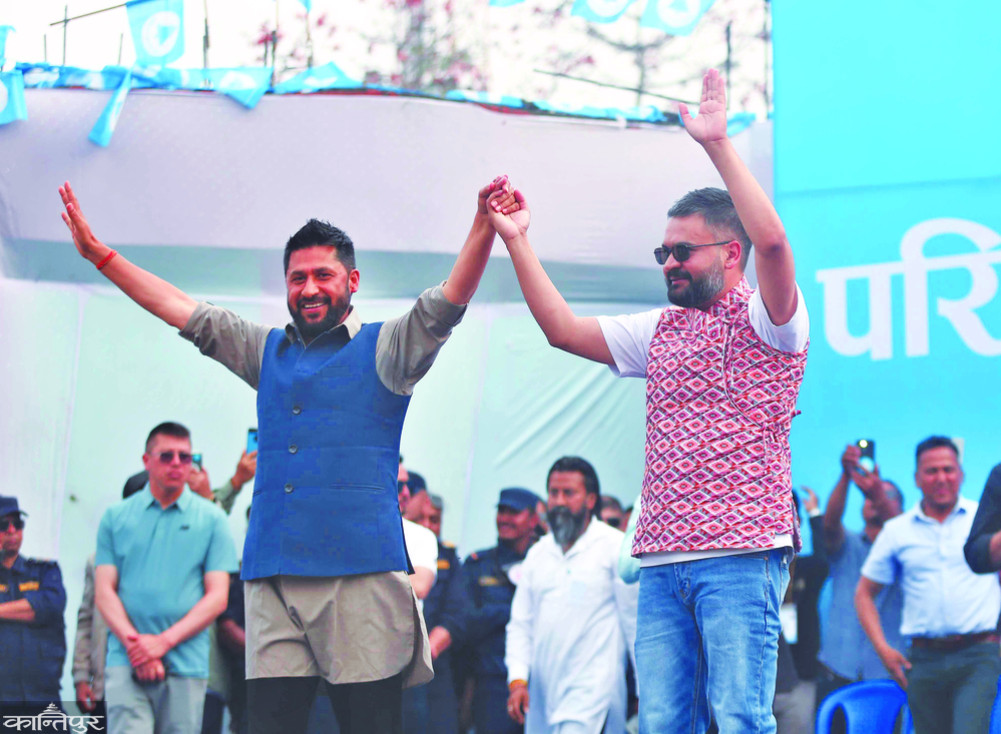
Personality-centered disputes and internal conflicts have disrupted Nepali politics. Will Rabi and Balen bring about a more resolved form of politics, or will they, the closer they get, just as quickly drift apart and set a precedent as new players in the exercise of power and authority? This remains a matter of anticipation.
We use Google Cloud Translation Services. Google requires we provide the following disclaimer relating to use of this service:
This service may contain translations powered by Google. Google disclaims all warranties related to the translations, expressed or implied, including any warranties of accuracy, reliability, and any implied warranties of merchantability, fitness for a particular purpose, and noninfringement.
Does Rastriya Swatantra Party President Rabi Lamichhane still converse with the photograph of his late mother these days, or not? And even if he does, does he have the courage to look that photograph in the eye?
The reason Rabi is now in the dock with these questions is that six months ago, he made a political promise while remembering his mother from a public stage. At an election rally in Janakpur, with his wife Nikita as witness, he recounted a conversation he had with his mother’s photograph, saying, “Mother, Balen will build the country. Balen will fulfill our dream.”
In just six months, Rabi’s “Janakpur promise” has fallen apart.
At that time, he also said, “It took only five minutes to reach the conclusion to walk together with Balen. For the selfish, it would take hours. We have come together for the sake of the country. We shared our individual dreams of building the nation and decided to walk together.”
Rabi did reach the conclusion to walk with Balen, but are they still traveling together now? Is Rabi still on board Balen’s express car, speeding down the highway with no brakes? Or is he waiting somewhere by the roadside for the Balen Express to crash? The gulf between the shared dreams and the reality of Rabi and Balen is deepening. And is the “nation-building team” under Balen’s leadership actually building the country, or further destroying it? Doubts and questions are mounting.
The public, fed up with a handful of worn-out leaders who have become the bearers of political distortions, believed in Rabi’s magical promises. They endorsed Balendra Shah’s “heroism” at the ballot box. As a result, Rastriya Swatantra Party emerged as a powerful party with a historic victory. Balendra Shah was elected Prime Minister with nearly two-thirds support.
Is Rabi still on board Balen’s express car, speeding down the highway with no brakes? Or is he waiting somewhere by the roadside for the Balen Express to crash?The old guard was sidelined, and a wave of new faces began to sweep through the corridors of power. However, in the first four months, the public has not felt even a hint of the “spirit” of cooperation between the two leaders who once shared the dream of building the nation. Instead, cracks have begun to appear in their relationship and trust, and the power-centric games and interests hidden within their dreams are starting to dominate.
Along with this, a flood of questions has begun: Has the political trust built in five minutes started to falter in six months? Was the Rabi–Balen equation merely a product of their immediate and strategic needs? And, the biggest question of all: What is the lifespan of the political relationship and trust between these two? This analysis revolves around these questions.
Let’s begin this discussion from the background of their alliance.
The Rabi–Balen alliance was formed after the Gen-Z uprising and as the general election approached. It was not a unity based on any political ideology or doctrine. At that time, there was a strong narrative building that new alternative political figures and forces should join together for the election. Anger against the old parties and figures was intensifying.
As corruption became institutionalized and the narrative that new leadership was needed for good governance grew stronger, Balen’s popularity graph was rising. He was an “icon” for the Gen-Z activists. The Gen-Zs had asked him to become Prime Minister from the streets after the movement. But he did not accept that “offer.” Instead, he played a role in making former Chief Justice Sushila Karki the Prime Minister of an election government.
Having emerged as an independent candidate for Mayor of Kathmandu Metropolitan City, Balen had by then established himself as a figure capable of exerting deep influence on national politics.
As for Rastriya Swatantra Party President Rabi, he found himself in a somewhat defensive position after the Gen-Z movement. In fact, his rise was not much different from Balen’s. He too emerged from the groundswell of dissatisfaction with the old and so-called establishment parties and figures.
Within just six months of the Rastriya Swatantra Party’s founding, Rabi’s entry into politics as the leader of the fourth largest party after participating in the election was both surprising and promising. Rabi’s appeal, having repeatedly won popular votes to enter parliament, began to wane when he rushed to power and became Home Minister. He became embroiled in one controversy after another—ethical, financial, legal, all kinds. He has not yet been fully freed from these. On top of that, his release from jail during the Gen-Z movement through illegal means proved counterproductive for his political career.
Rabi had adopted a strategy to seize “leadership” by emerging from jail during the vacuum, crisis, and serious times created by the Gen-Z uprising. But the Gen-Zs themselves painted him as a “villain.” After facing harsh criticism and boycott from the Gen-Zs, he returned to jail.
Rabi’s image became controversial. Even though it was a new party, Rastriya Swatantra Party leaders had already tasted power. As a result, the party was on the defensive on the eve of the election. However, the alliance with Balen injected new energy into the party. There are those who are suspicious of the dramatic rise in the activity of figures like Sudhan Gurung during the Rabi–Balen alliance. Nevertheless, the main essence of the unity was that Rastriya Swatantra Party got a popular Gen-Z figure as its electoral face, while Balen got the shelter of a party. Moreover, after Rabi put forward Balen as the party’s candidate for Prime Minister, a nationwide wave swept in favor of Rastriya Swatantra Party.
The electoral wave established Rastriya Swatantra Party as the most powerful party in the country. Balen has been at the helm of the country’s government for four months. Rabi is running the party. On the surface, it may seem that the two leaders, who agreed that one would run the party and the other the government, are doing just that. But at a deeper level, both the party and the government are becoming increasingly problematic. Although they claim not to engage in factionalism, the party has already begun to suffer from internal strife.
At the party’s first general convention, which concluded recently, there were numerous examples of mismanagement, immaturity, and factionalism. Dozens of question marks have already been raised about Balen’s governing style and his political character. As a result, the party’s internal disputes are smoldering like a fire beneath the surface. Meanwhile, the conflict between Balen and his Finance Minister Swarnim Waglé has come out into the open. In interactions with people from the finance/business sector, Balen did not include Waglé at all. Instead, he tried to remove him.
Incidents of cars being parked in front of private media gates under government protection have also increased conflict and dissatisfaction within the party. The conflict is still dormant and has only surfaced slightly. Only a few leaders have commented on Balen’s working style. Nevertheless, these are enough to raise questions about the future of Rabi–Balen cooperation.
How will the alliance between the two leaders move forward? Its future will be determined mainly by three factors.
First, internal reasons within Rastriya Swatantra Party. How long can Rabi ignore Balen’s apolitical, impulsive, and immature governing style? And how long will he keep compromising to defend him? The future of the alliance will be largely determined by this question. This is the fourth month that the country has been experiencing Balen’s rule. Balen, under pressure to do something new, certainly has the urge to act. However, the way he is moving forward with an authoritarian and controlled approach to governance will be the main challenge in the relationship between the two leaders.
There are those who are suspicious of the dramatic rise in the activity of figures like Sudhan Gurung during the Rabi–Balen alliance.Balen does not like to operate within the party framework. But he wants his group to have a proper place within the party. He blatantly disregards democratic procedures and practices. He wants to reshuffle ministers without consulting the party leadership. His express car with no brakes has displaced squatter settlements. He wants to expand political influence within the courts. Recently, his interactions with businesspeople and others have been positive. However, most of his governing behavior is subject to criticism and increases suspicion.
In their recent four-hour-long meeting, it has been reported that Rabi raised questions about Balen’s governing weaknesses. It is said that Rabi questioned Balen about the unresolved squatter problem, the conflict with the Finance Minister, and other geopolitical issues. In other words, the process of expressing disagreement has begun. At the same time, there is discussion in the media about the revised statute of Rastriya Swatantra Party. The revised statute includes a provision to remove the parliamentary party leader if they disobey the party president’s directives. The implication and message of all this is: how much will Rabi compromise regarding Balen’s governing style? The future of the alliance will be determined by this.
Second, external reasons. Another external factor could also bring complexity to the alliance. Of course, if you tighten your own purse, you don’t need to blame outsiders for stealing. Once you give them the field, it’s not unusual for outsiders to play. There are many examples in the past where Nepal’s political forces have been strongly influenced by external interests. Now, geopolitical maneuvering is also increasing within Rastriya Swatantra Party, which is at the center of power.
Recently, Nepali politics heated up over unconfirmed reports that the Prime Minister’s chief advisor Kumar Ben secretly visited Delhi and met Indian National Security Advisor Ajit Doval. This has also raised suspicions within the Rastriya Swatantra Party leadership. Rabi’s planned visit to China after his trip to India is also being closely watched.
Amid geopolitical concerns and complexities, the main challenge for Nepali diplomacy is to maintain its strategic autonomy. The role of Rastriya Swatantra Party, which is now at the helm of government, is important in this. At the very least, parallel and conflicting activities between party leaders and the government leadership in foreign affairs constitute a “diplomatic blunder.” Looking at past examples, it is evident that when there is internal power struggle within Nepali parties, there is a tendency to seek external support and goodwill.
Therefore, high-level meetings and diplomatic contacts that create mutual suspicion are not beneficial for Rastriya Swatantra Party’s politics. If the government ignores the party president’s formal and important visits, if the president does not consider it necessary to formally inform the Prime Minister about his visits, and if the Prime Minister deploys his advisors to secretly meet foreign officials, such activities centered on external power centers not only weaken the nation’s diplomatic strength, but also further undermine the mutual relationship and trust between the two leaders.
Third, their own reasons—that is, the different characters of the two leaders. Both Rabi and Balen are leaders who emerged from the groundswell of dissatisfaction and frustration in recent Nepali politics. However, there are fundamental differences in their political character. Rabi is someone who wants to become a leader by building a party through parliamentary politics. He wanted to use the “fame” from journalism in politics. That’s why he formed Rastriya Swatantra Party. He emerged directly as a national political figure.
Balen is someone who emerged from local politics. He entered politics as a brand of independent leader rather than as a party figure. He does not seem particularly interested in parliamentary practice. He wants to remain in power relying on the popularity he has gained from social media. He speaks little, and when he does, it is often controversial. Rabi is skilled in oratory. In a way, his main political height is also based on his speaking skills, which connected him to the people.
In summary, both leaders emerged as representatives of political change. They developed an anti-establishment image. However, one wants to bring administrative reform through a controlled style of governance, while the other wants to strengthen the party through parliamentary political practice. One wants to use social media as a political weapon, while the other is obsessed with building and expanding the organization. In other words, their different political styles and characters could also be obstacles to their political alliance.
Personal disputes and internal conflicts have long disrupted Nepali politics. Even though they are coated with the veneer of ideology and politics, there are many examples from the past where conflicts among top leaders have arisen over the division of power and authority. Especially, the inability to manage the egos of Communist and Congress leaders has made our politics directionless and unstable. Will Rabi and Balen internalize this bitter reality of history and practice reconciled politics, or will they, the closer they get, drift apart just as quickly and set a new precedent as power players? That remains to be seen.
@Rajaramgautam