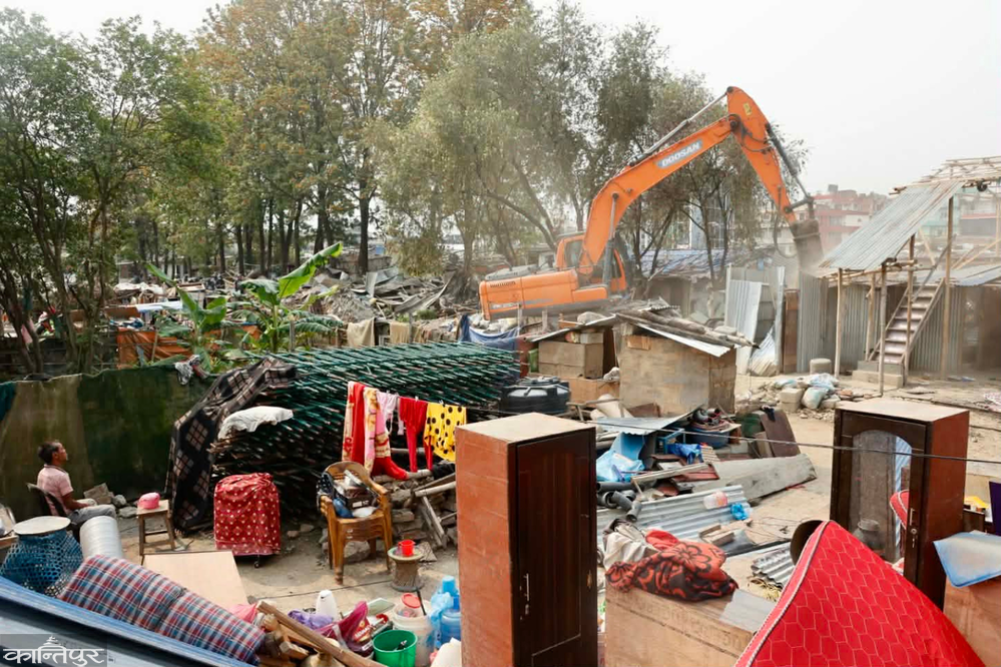
Resettlement is not merely relocation; it is a process of rebuilding lives. Unfortunately, Nepal's practice is not only weak in this regard, but also inhumane.
We use Google Cloud Translation Services. Google requires we provide the following disclaimer relating to use of this service:
This service may contain translations powered by Google. Google disclaims all warranties related to the translations, expressed or implied, including any warranties of accuracy, reliability, and any implied warranties of merchantability, fitness for a particular purpose, and noninfringement.
Are people also ‘disposable’ objects to be discarded after use? Author Kevin Bales, in his book ‘Disposable People’, analyzes modern slavery and writes, “When people are seen only as tools for labor, when the value of a person’s life is tied solely to their utility, when victims are regarded as consumable objects to be controlled through violence, then they become ‘disposable’—that is, to be thrown away after use.” The book focuses on modern slavery, but the ethical question it raises is much broader.
Whom does a society or state consider a valuable citizen? Whom does it regard as easily displaced, replaced, or ignored? This very question reveals the true character of a society or state. What is the character of today’s world and of our own country and society? Are all citizens able to live with equal self-respect? Or why and how have citizens been used and discarded as ‘disposable people’? This article is written around these very issues.
The Global Economy and ‘Disposable’ Workers
Today’s global economy stands on cheap labor. Millions of citizens from poor countries are compelled to seek employment in wealthy nations. They pick fruits in fields, produce goods in multinational company factories, do risky work in construction, serve in hotels and restaurants, work as domestic workers inside homes, catch fish from the sea, or exchange their labor in coal factories. In addition, millions of girls and young women are sold into the sex trade. It is their labor that keeps the economies of developed countries running. However, these workers work for low wages, with uncertain working hours, unsafe conditions, limited or negligible labor rights, and a lack of social security. If such workers fall ill, have an accident, or become unable to work for any reason, they are immediately replaced by another worker.
Bales connects this situation to the concept of ‘disposable people’. There is a need for labor, but the life or dignity of the worker is not valued; rather, one person can be instantly replaced by another. Millions of workers within Nepal and in the global market are part of such a labor market. There, more than security, employment, or respect, there is risk, fear, discrimination, displacement, and replacement. The irony is that the economy of rich countries depends on the labor of workers from poor countries, but the lives of those workers are so cheap that they can be replaced at any moment.
Development for Whom?
No one opposes development. We need roads, bridges, public infrastructure, the highest technologies and communications of the modern world, parks, and playgrounds. Protection of public land and state property is also necessary—these are both the duty and right of the state. Implementation of the law and protection of public property are fundamental responsibilities of democratic governance. But above all these, there is another responsibility—the protection of citizens’ lives and dignity. The value of a democratic state is not measured only by its ability to complete development projects, but by how justly it treats citizens affected in the name of development. If hundreds of families are displaced for the construction of a road, park, or other structure, the question is not limited to whether the structure is built or not. The question focuses on how the lives of those displaced families will continue—where will they live? How will their children continue their education? How will their employment, security, livelihood, health, and social relationships be protected?
If there arises a situation where riversides or public land must be cleared, the state’s responsibility cannot be fulfilled by forcibly evicting people, running bulldozers overnight. Rather, in such cases, the responsibility increases to provide alternative housing, trauma care and psychosocial counseling, ensure livelihoods, and bring forward plans for organized and dignified resettlement. What the state must not forget is that resettlement is not just relocation, but a process of rebuilding lives. Unfortunately, our practice is not only weak at this point, but also inhumane.
It is wrong to view development and human rights as two separate aspects. Real development is that which works by giving the highest priority to the interests of the most vulnerable groups in society. If development makes the weakest citizens even weaker, that is not a sign of development’s success, but of governance’s failure. Some time ago, bulldozers ran along the riversides of Kathmandu, sending thousands of people onto the streets overnight. Before running the bulldozers, did the state consider where those families would live, how their children’s education would continue? Did the state have answers to how daily wage laborers would survive, how the elderly, disabled, chronically ill, and single parents would start anew after their lives were completely shattered? Does it have those answers today? If not, the problem is not just with the unorganized settlements along the riverside, but with the state’s very concept and perspective on development.
The Experience of Resettlement: Houses Were Built, but Lives Were Not
For Nepal, the issues of landlessness and resettlement are not new. The issue of millions of squatters exists, and the challenges and failures seen in the resettlement process after the liberation of bonded laborers, such as Kamaiya and Haliya, who lived for generations as agricultural laborers, can be taken as examples. After years of struggle, they were legally freed. The government also created resettlement packages. In some places, the government itself even built houses. On paper, the resettlement work was successful, all freed Kamaiya and Haliya were successfully established in society, and became landowners. But did that really happen?
No. Because it took the government nearly ten years just to bring resettlement packages for thousands of families freed from landlords. When the data of those communities was collected, many families were left out. For example, all Haliya families from the then fifteen Village Development Committees of Baitadi were excluded from the records. The reason for this was incorrect reporting by the then VDC secretary, which was never corrected, and those families were never included in the records. These facts are also mentioned in the report of the Freed Haliya, Harwa, Charwa, and Freed Kamaiya Study Committee (2022) formed by the government. According to the same report, even excluding Banke district, more than 12,000 freed Kamaiya families were left out in the remaining four districts—Dang, Bardiya, Kailali, and Kanchanpur.
The government took neither responsibility nor accountability for these excluded families. Freed families were given a piece of land—often on riverbanks or in remote, infertile areas, without ensuring access to employment, drinking water, electricity, schools, or health services. Those who had worked for decades in landlords’ agriculture were not given any opportunity to pursue agriculture on arable land. As a result, many families did not stay there. They went to towns or to India in search of work. Some, left with no options, returned to servitude under their former landlords.
This shows that the state’s concept of resettlement itself has failed. Resettlement was implemented as a land distribution project, whereas resettlement is actually a process of rebuilding lives with dignity. Even today, many freed Kamaiya and Haliya families are still searching for secure housing, land, sustainable livelihoods, and respect for their labor. The Harwa and Charwa communities of Madhesh, who were declared free only in 2079 BS, are still waiting for data collection. Although there are no government statistics, according to claims by non-governmental organizations, there are nearly 79,000 Harwa and Charwa families in eight districts of Madhesh and Sunsari.
Even taking this experience as a basis, it is essential for the state to be extremely sensitive in the process of collecting data for protection, prioritization, and secure and dignified resettlement. However, the majority government, which stands on the vision of good governance and a just society, has evicted the riverside residents of Kathmandu without any study, without verified evidence of whether they are genuine squatters, and without any prior plan for resettlement. This has created confusion about the state’s good governance and sensitivity towards the poor, marginalized, and landless communities. This action is contrary to the constitutional right to housing, Nepal’s international obligations—especially the right to adequate housing—and human rights standards regarding forced displacement.
Why Are the Poor Repeatedly Displaced?
One question always nags—why is it almost always the poor who are displaced in the name of development? Why do bulldozers easily reach informal settlements, but the state’s intervention does not seem as strong when powerful and influential people misuse public resources or commit other illegal acts? Why are millions of workers in the informal sector still outside the scope of social security? Why, even decades later, are the freed Kamaiya, Haliya, and Harwa, Charwa communities still waiting for dignified resettlement and lives?
Perhaps the answer lies in their political status? Is it because poor communities have limited power to speak for themselves? Or is it because they lack access to power, authority, and political parties? Why are these communities, who are showered with promises during elections and become vote banks, always used like chess pieces? Why do they occasionally become headlines, but never a priority in policymaking? The pain of these communities becomes a topic of debate for a few days or months according to interests, but why is it forgotten just as quickly?
The reason for all this seems to be that the state does not regard these communities as citizens with equal rights, but as populations to be ‘managed’, settlements to be removed, or groups to be given relief. Their poverty and helplessness become their identity rather than their status as citizens. When, in any society, a person’s value is determined by their economic status and political access, inequality is not just economic or social, but also moral and political.
The destruction of a house is not just the destruction of a structure. It is the destruction of a family’s shelter, livelihood, social capital and relationships, children’s education, access to health services, and a life built over years. Yet, such issues are rarely discussed in development debates. When the state does not place poor, marginalized, and landless citizens at the center of policymaking, does not take responsibility for dignified resettlement, and always imposes the costs of development on the weakest communities, then those citizens become ‘disposable’ for the state.
The state has the opportunity to address all these issues, to correct past mistakes, and to move development forward from a human rights-based perspective. If, in the name of development, citizens lose their lives and the foundations for living, if resettlement remains incomplete for years, if the security of workers’ lives is not considered necessary, then we must ask ourselves an uncomfortable question—does our state value all citizens equally? Or does it consider some as citizens and others as ‘disposable’ objects to be discarded? The answer to this question will measure not the level of development, but the level of our democracy.