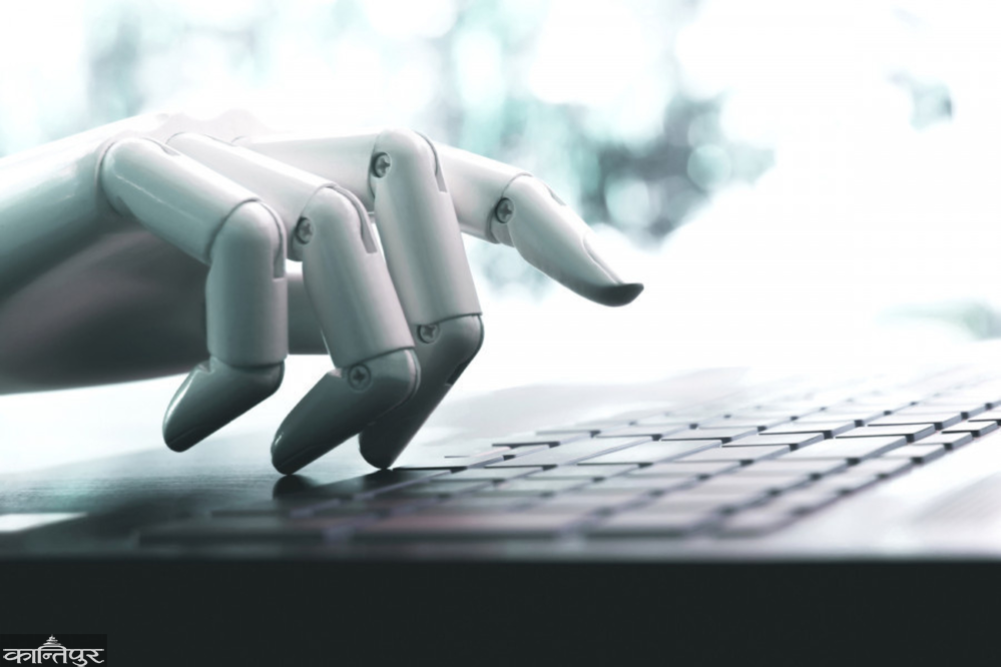
Even after a century and a half, the fundamental question remains unchanged—who holds the power in the world today? Rather, the sources and forms of power have changed. Today, power is not limited to factories alone—it is also dispersed in data, artificial intelligence, algorithms, semiconductor chips, cloud computing, and digital platforms.
We use Google Cloud Translation Services. Google requires we provide the following disclaimer relating to use of this service:
This service may contain translations powered by Google. Google disclaims all warranties related to the translations, expressed or implied, including any warranties of accuracy, reliability, and any implied warranties of merchantability, fitness for a particular purpose, and noninfringement.
Where does global power lie today? Yesterday, the answer was clear: wherever the factories are, there lies power. After the Industrial Revolution, iron, coal, steam, machines, and factories determined the power of the world’s political economy.
Control over the means of production formed the basis of economic power, political influence, and social relations. In the 1867 ‘Das Kapital,’ Marx analyzed the political economy of this industrial world. The argument of ‘Capital’ was that ownership of the means of production determines class relations, the character of the state, and the future of capitalism.
Even after nearly a century and a half, the fundamental question has not changed; the question remains: in whose hands is power? Rather, the nature of the source of power has changed. Today, power is not limited to factories—it is also scattered across data, artificial intelligence, algorithms, semiconductor chips, cloud computing, and digital platforms.
Yesterday, industries bought the labor of workers; today, digital platforms are selling users’ time, attention, and digital presence in the market.The geography of power has changed today. The world economy is moving from industrial capitalism, through financial capitalism, toward algorithmic and platform capitalism. Today, the world’s most influential companies are investing not in industries that produce goods, but in industries that increase data, artificial intelligence, algorithms, computing, and digital capabilities. In today’s transformed capitalism, they do not just produce goods—they produce information, control people’s attention, and, by analyzing human behavior, even predict the decisions people will make in the future. Therefore, to understand the political economy of the 21st century, it is necessary to understand data centers rather than factories, algorithms rather than machines, and chips rather than oil.
If the source of capitalist power in the nineteenth century was the factory, today it is the data center. If the main means of production yesterday were machines and labor, today algorithms, chips, computing power, and digital platforms have become the new means of production. These means of production today are not just technologies—they are also the structural basis for creating economic power, political influence, and cultural dominance. This does not mean that ‘Marx failed to explain the present era.’ But if his analysis of political economy is not brought into dialogue with the digital age, Marx remains incomplete and unfinished.
The history of political economy tells us: in feudalism, power was concentrated in land. In industrial capitalism, that power shifted to factories. In financial capitalism, banks and financial markets became centers of power. Today, in algorithmic capitalism, power is increasingly concentrated in data, artificial intelligence, chips, computing infrastructure, and digital platforms. To understand today’s world, it is necessary to understand not only the geography visible on the map, but also the new geography of power being constructed in the digital world.
The most valuable resource in today’s economy is data. In the industrial age, iron, coal, and oil were necessary to run industries. Today, data is needed to run artificial intelligence. Just as refineries were essential to extract oil yesterday, today computing power, chips, and algorithms are needed to create and operate data.
The center of the world’s political economy has shifted today. The competition between America and China is not just a trade war—it is also a competition for control over artificial intelligence, semiconductor chips, cloud computing, and advanced technology. If petro-dollars determined global power yesterday, in the twenty-first century, computing power, data, and chips are creating a new balance of world power.
This visible and experienced transformation is creating a new geography of power in political economy. For Marx, relations of production meant ownership of the means of production and the class relations arising from it. That fundamental truth still holds today. However, the changed means of production and their evolving relations—that is, the capitalist journey from factories to digital networks—demand further analysis in today’s political economy.
Today, people are not just workers or consumers—they are also producers. When using social media, operating mobile apps, shopping online, making digital payments, or searching for information on the internet, we are constantly producing data. This data is used to inform artificial intelligence, refine advertising systems, predict consumption, and generate new profits. In this sense, the production process is no longer limited to factories; it has expanded into our daily lives.
This transformation also demands further debate on Marx’s theory of surplus value. Marx said, ‘Surplus value is created from the unpaid labor of workers.’ Today, labor is still important, but along with it, data, human attention, behavior, and predictions of the future have become new sources of surplus value. The better a digital platform can understand and predict user behavior, the more profit it can make. Today’s capitalist competition is not only about production, but also about predictive capability. Capitalism today is transforming into algorithmic capitalism, platform capitalism, and surveillance capitalism. Now, profit can be earned not only by selling goods, but also by converting people’s time, attention, data, and behavior into economic assets. Yesterday, industries bought the labor of workers; today, digital platforms are selling users’ time, attention, and digital presence in the market.
In this sense, the smartphone is the small factory of today’s era. Without our knowledge, every click, like, share, comment, time spent watching videos, places we travel, and online behavior become the raw materials of the digital economy. Although social media appears free, we are paying for it not with money, but with our own data and attention. Therefore, in today’s political economy, data is the new raw material, algorithms are the new machines, chips are the new energy, and digital platforms are the new factories.
The geography of the means of production has changed today. As this geography changes, so does the geography of democracy. The foundation of democracy is independent citizens, free information, and prudent public debate. But if the news citizens read, the videos they watch, the advertisements they receive, and the political messages they encounter are all selected by algorithms, then the nature of public debate also changes. The world we see may become more a result of algorithmic selection than of reality.
Today, the purpose of recommended content on social media is not to seek truth or strengthen democratic debate, but to keep users on the platform as long as possible. This encourages the spread of sensational, emotional, divisive, and inflammatory content. When citizens’ attention becomes an economic asset, public debate also begins to operate according to market logic. Therefore, today’s digital economy is also called the ‘attention economy.’
The rapid development of artificial intelligence has made this challenge even more complex. In just a few seconds, deepfake videos that look real, artificial voices, and automated propaganda materials can create different psychologies among voters during elections based on age, interests, language, and location. Such micro-targeted content weakens public debate and divides citizens into different digital realities, thereby creating confusion among citizens.
This has weakened our traditional democratic values and changed the nature of the challenges democracy faces. Yesterday, the threat to democracy came from military intervention, direct censorship, or an authoritarian state; today’s challenge comes from private digital infrastructure. As the flow of information, search systems, advertising markets, video recommendations, artificial intelligence, and digital communication structures become concentrated under the control of a few global companies, a new crisis has emerged in democracy.
The fundamental question of today’s political economy is not only who owns the means of production, but also: who owns the data? Who writes the algorithms? Who makes the chips? Who controls the computing power? In whose interest is the digital infrastructure that shapes citizens’ thinking and the psychology of democratic decision-making being operated? Seeking answers to these questions is to understand and search for the new geography of power today. Nepal is not untouched by this changed geography of power. With the expansion of the digital economy, we too are under the influence of algorithmic political economy. In Nepal, the use of digital technology is rapidly increasing in banking, education, health, trade, government services, social media, and even election campaigns.
We have not yet become producers of the digital economy. This is Nepal’s real challenge. We are using digital services, but we do not own them. We are constantly producing data, but we are not receiving the economic value generated from it. We have started using artificial intelligence, but we do not have the capacity to produce the advanced chips and high-capacity computing infrastructure needed to operate it. In this way, we are importing not only goods, but also digital dependency.
Today’s inequality is not limited to industry, capital, and technology—inequality is also seen in data, computing power, artificial intelligence, and digital infrastructure. In the colonial era, raw materials were taken from southern countries to the north, and still are. In today’s digital age, data produced by billions of people around the world is being accumulated in the systems of a few limited digital companies. The form of raw materials has changed, but the process of power concentration remains the same. This is today’s digital colonialism.
For Nepal, the challenge of today’s political economy is not the use of Facebook, TikTok, or other digital platforms. The real challenge is: where is the data of Nepali citizens being collected? Who owns it? Who is receiving the economic value generated from it? When the Nepali language provides information to artificial intelligence, who is reaping the intellectual benefits? These questions must be linked not only to information technology, but also to the national economy, national security, and democratic sovereignty. We must also connect them to the question of whether we will become only consumers of the digital market in the future, or producers of the digital economy.
Today’s political economy seeks not whose hands capital is in, but where power is being concentrated. The search for this question teaches us to look for the new geography of power. It shows us that the power once concentrated in factories, mines, and oil wells is now increasingly concentrated in data centers, algorithms, semiconductor chips, cloud computing, and artificial intelligence infrastructure.
It reveals that competition among nations is now based more on computing capacity, digital infrastructure, and the ability to produce knowledge than on territorial expansion. Therefore, to understand the world of the future, it is no longer enough to look only at the borders visible on the map. If we do not seek answers to the questions of where power is produced, who controls it, who creates value from it, and in whose interest it is used, we will understand neither the new geography of power nor the changed nature of political economy.