Good governance is measured not by viral videos, but by strong national institutions and the rule of law. This government must remember that impressive visuals and effective governance are two different things.
We use Google Cloud Translation Services. Google requires we provide the following disclaimer relating to use of this service:
This service may contain translations powered by Google. Google disclaims all warranties related to the translations, expressed or implied, including any warranties of accuracy, reliability, and any implied warranties of merchantability, fitness for a particular purpose, and noninfringement.
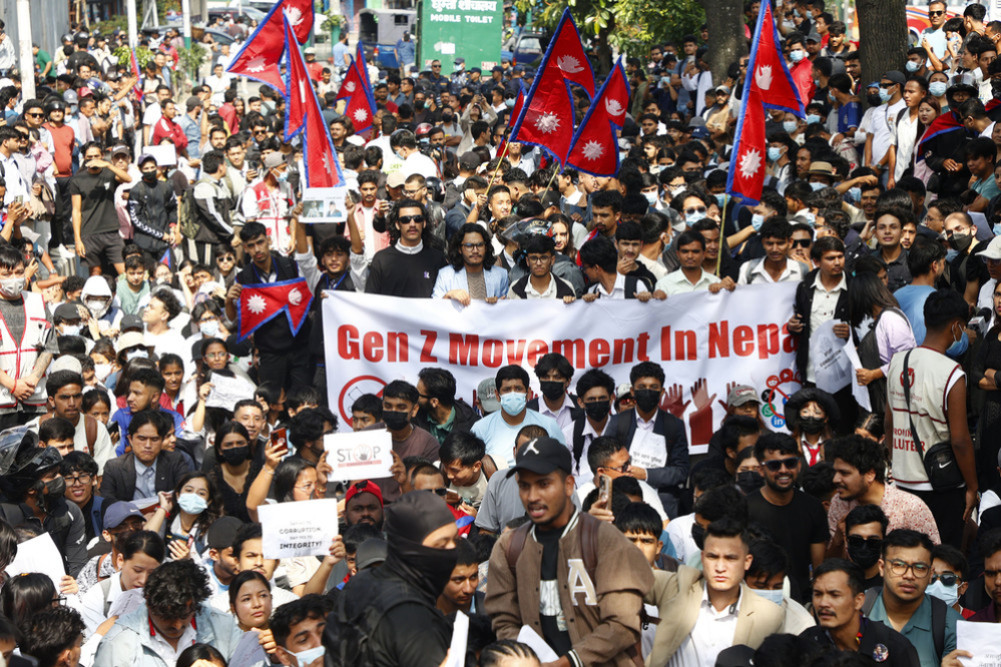
I myself stood on the streets during the Gen-Z movement. At that time, when I took to the streets, my expectation was not just for a particular person to become prime minister or for a change of government. My main hope was for a transformation in the country’s system of governance and political culture.
In the movement, I and others raised our voices against corruption, lack of transparency, political protectionism, weak institutional accountability, and the same old bad political culture and malpractices. That’s why it was natural for us to be optimistic after a new government was formed. However, even now, a new style of governance is not being felt in practice.
We were neither looking for a hero nor expecting a miracle. Rather, we wanted the so-called new government to break old traditions and focus on strengthening institutions. I repeatedly ask myself—was this the change we sought? Was this the system of governance our generation demanded while facing bullets on the streets back then? Was this what the blood of 76 people was shed for? It feels as if the days gone by are still questioning us.
The protesters’ expectations were that a power-centric mindset like that of the Rana regime would not be repeated, that the democratic process would be strengthened, that institutions would become robust, that the tendency for individuals to dominate institutions would end, that corruption would be eradicated, and that state operations would be transparent. But the government, which talks big about transparency, does not appear accountable or responsible to citizens and parliament now.
When the public asked for the ‘sources of gold’ mentioned in ministers’ asset declarations, no satisfactory answer was given. The report of the investigation into Home Minister Sudhan Gurung was not made public. A change of government should not mean a change in the level of transparency. The institutional system should be the same for everyone, regardless of which government is in power. Strong institutions, not individuals, should be firmly in place to get things done.
There are suspicions that the state apparatus is being used to create pressure on individuals or voices critical of the government. If citizens start to feel afraid that criticizing the country’s prime minister could result in legal or administrative action against them, that is not just an individual’s problem. It is an issue tied to the very health of democracy. The government must understand that in a democracy, the government does not become weak because of criticism. Rather, it appears weaker when it cannot tolerate criticism.
In a democracy, the power of the government does not lie in suppressing the voices of citizens. No one becomes stronger by silencing criticism. If criticism can be answered with facts, accountability, and results, only then can it truly become a government of the people. Only in such a situation can we say that there has been a change in the culture of governance, as sought by Gen-Z. Because a change of power is not enough to just change faces; the culture of governance must also change.
The evaluation of a government should not be based solely on popularity, speeches, social media reach, or ‘views’. The real test of a government is how transparently it governs, how it accepts criticism, and what kind of changes it brings that citizens can feel in their daily lives. At first glance, it may seem that the style of presentation in politics has changed, but the underlying culture has not changed much. For example, a few years ago, leaders’ speeches were full of proverbs and quips. Today, those have been replaced by Facebook statuses, viral soundbites, and catchy slogans.
I notice another clear difference between the government of some time ago and the current one. Then-Home Minister Rabi Lamichhane had established the practice of publicly sharing updates on the progress of investigations into high-profile cases, who had been arrested, and what actions were being taken. But now, such regular information flow seems to have greatly diminished. Transparency is not just about conducting investigations behind closed doors; it is also about building trust by regularly informing citizens about the progress of investigations.
The less the government speaks, the more it seems to be telling citizens to speak less against it as well. That is why today, the greatest concern is linked to freedom of expression.
On the other hand, most recent decisions are presented in a very ‘filmy style’. Videos of surprise inspections, sudden raids, strict directives, and public punishments are everywhere on social media. But good governance is measured not by viral videos, but by strong institutions and the rule of law. The government must remember that impressive visuals and effective governance are different things.
Sometimes, I even see a hint of indirect authoritarianism in our current style of governance. This is not an outright autocratic regime. But the tendency for power to be concentrated in a few individuals, to react uncomfortably to criticism, to prioritize directives over dialogue, and to focus more on managing the government’s image seems to be increasing. This is very wrong.
Narrative-building has also become extremely powerful in today’s politics. Governments in this digital age seem more focused on how to present their work attractively on social media than on the work itself. Digital platforms have further spread this trend. But such artificial narratives may sway public opinion for a while, but cannot sustain it. History shows this as well.
In commenting on the current government in this way, it is not as if I expect it to have a magic wand. Problems accumulated over decades cannot be solved overnight. Economic challenges, a corrupt administrative apparatus, and weak institutional structures cannot be changed in a single night.
But this reality should not be used as an excuse to hide weak performance and sluggishness. No impossible demands have been made of the new government. At the very least, there was an expectation of a responsible political culture with transparency, accountability, and tolerance for criticism, which should have been evident from the start. A government that dreams of a thousand miles should at least be able to take the path that leads there from the very first mile.
My generation does not wish for any government to fail. We want a successful government in the country, because that has a direct impact on our future and the nation’s progress. In saying this, there should not be excessive bias or prejudice in support or criticism. If the new government is also limited to the same old political culture, the same lack of transparency, the same power-centric tendencies, and the same unfulfilled commitments, how will citizens feel any change?