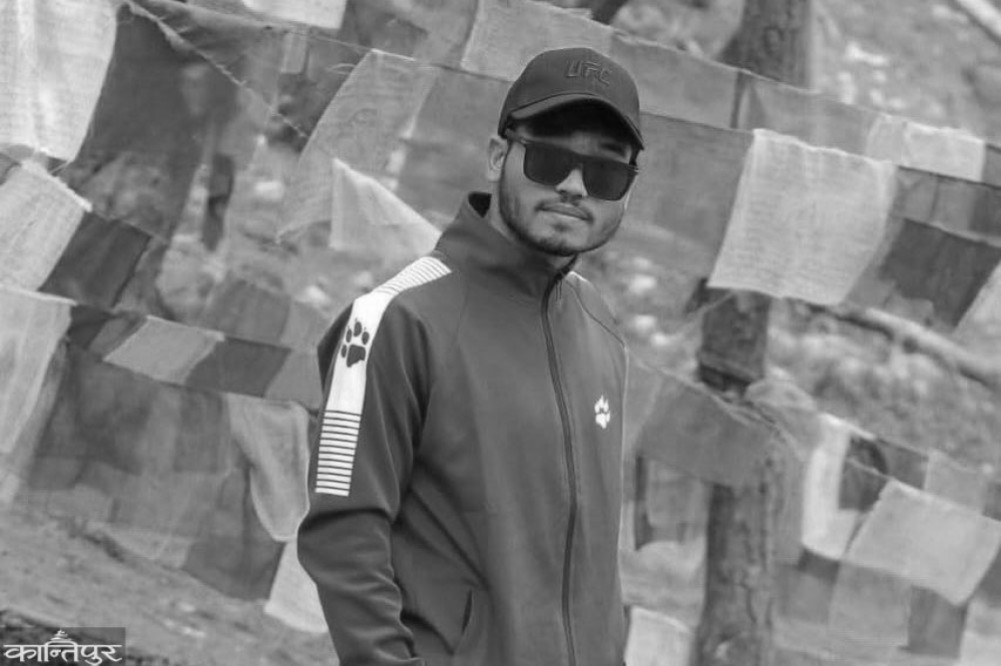
Ganesh's self-immolation shows that the impoverished twenty percent need immediate and concrete relief.
We use Google Cloud Translation Services. Google requires we provide the following disclaimer relating to use of this service:
This service may contain translations powered by Google. Google disclaims all warranties related to the translations, expressed or implied, including any warranties of accuracy, reliability, and any implied warranties of merchantability, fitness for a particular purpose, and noninfringement.
Kathmandu city! Crowds and noise. A few scattered pillars of deprivation and dissatisfaction. And those terrifying volcanoes of helplessness, separation, and restlessness. Why is it that sometimes, in this capital city, it becomes so difficult for someone to even breathe?
The 25th of Asar. A 25-year-old youth went to park his bike in a place in front of the Passport Office that was labeled ‘unauthorized’. Around 11 o’clock, he had an argument with the municipal police. After that, the municipal police wheel-locked his bike. Some time later, he took petrol from his bike and poured it over himself. Around 2 o’clock, he set himself on fire. The next day, on the 26th of Asar, at 11:18 in the morning, doctors declared that youth, Ganesh Nepali, dead.
Is the cause of Ganesh’s death only the failure of the state, or is it also the humanity that is disappearing from our society? There may have been some shortcomings on the part of the state towards Ganesh. But from the time he argued with the police in the morning until he set himself on fire in the afternoon, why did no one say to him, ‘Brother, the municipal police gave you a lot of trouble, I understand your pain. Some police officers sometimes behave harshly with everyone. Let it go, forget about it. Come, I’ll take you for a nice cup of tea.’
These days, have we become so busy that even when someone is taking petrol from their motorcycle and setting themselves on fire in broad daylight, we cannot stop them?
These days, have we become so insensitive that even when someone is writhing in pain and about to die in the middle of the day, we cannot recognize the signs of their wounded heart?
A death that cannot be understood?
When I heard the news that a healthy, robust young man died prematurely at an age meant for laughing and playing, and for no particularly convincing reason, I, like all Nepalis, was saddened. But as a researcher in social science, I also tried to find the cause of this self-immolation through the theories of political science.
Is the cause of Ganesh’s death only the failure of the state, or is it also the humanity that is disappearing from our society?All the theories of violence and rebellion I have read so far say that when young people are dissatisfied and angry, they engage in small or large acts of violence. Even looking at Nepal’s own examples, the frustrated youth Dipendra wiped out the entire royal family. The distressed Maoist youths were also not short on violence. Similarly, the violent destruction carried out by the angry Gen-Z youths a few months ago is also unforgettable and terrifying. In theory, dissatisfied youths commit violence against others. Nepal’s example also shows the same. But why did Ganesh commit violence against himself?
If he was extremely angry at the harsh words and behavior of the municipal police who wheel-locked his bike, he could have pushed them, even thrown a punch or two. Young people sometimes do such unexpected things in a fit of rage.
If he was fed up with the state’s attitude of not providing easy parking, imposing fines, and burdening him with taxes without providing employment, and had become disillusioned with life, he could have gone to a nearby bar or tavern, gotten drunk on five or six pegs, and forgotten the world for a while. Many young people do this when they are frustrated. If he didn’t drink or didn’t have money for it, he could have entertained himself for a while by watching his favorite reels.
If the wheel lock made him anxious about what to eat in the evening, he could have cheated someone, stolen without getting caught, or even robbed others. If a young person in extreme financial hardship had done this, it would not have been as surprising as a youth unexpectedly setting himself on fire.
According to some books I have read about self-immolation, its main cause is mental health problems. In Ganesh’s case, there is no background of mental health issues or any prior thought or preparation for suicide. Another cause of self-immolation is sacrifice for a greater cause, as seen in the example of Tibetan refugees. But the sequence of events that day shows that Ganesh did not self-immolate out of such sacrificial feelings.
Another cause of self-immolation is symbolic protest. In 1965, an American citizen, Norman Morrison, self-immolated to protest the Vietnam War. Influenced by photos of Vietnamese children burned by American bombs, he went to the military headquarters carrying his one-year-old daughter. After handing his daughter to someone, he self-immolated there. But Ganesh’s act does not appear to be a symbolic protest either.
If his self-immolation was not suicide due to mental health problems, nor sacrifice, nor symbolic protest, then what was it? Even after reading theories from Durkheim to Galtung, I could not find a satisfactory answer.
A world where there is no difference between living and dying
To understand Ganesh’s self-immolation, perhaps one needs to travel 700–800 kilometers west of Kathmandu, to Mugu. I had gone there nearly 20 years ago, when Ganesh was probably five years old. Oh, that mountainous remoteness, that poverty, and the countless tangled complexities there, which words fail to describe. Of course, the beauty of Rara Lake in Mugu is equally indescribable and enchanting.
The people of Mugu openly shared the pain of years of exploitation and oppression by the state. Listening to their stories, it seemed the state had created a world there where many people, though alive, did not seem to be truly living. That is why the state did not know the value of the lives of the poor in Mugu. It seemed that by turning them into living corpses, the state had placed most of the people of Mugu on the list of citizens whose death made no difference.
Coincidentally, when I reached Mugu, the peace process had just begun. So it seemed that such a painful situation was starting to change. Like Ganesh’s family, other Dalits in the villages of Mugu (who belonged to the most oppressed group among the oppressed in Mugu) appeared hopeful. They believed that the state’s indifference towards them would now end completely. The state would now do something for them.
Perhaps it was this arrival of hope that led Ganesh’s father to work hard to educate his son instead of making him do traditional tailoring work. Ganesh must have thought—my father has fed me on half a stomach to educate me. I will study hard, get a job, and give my parents a comfortable life. Before dying, he told his brother in a weak voice, ‘Take good care of father and mother,’ which suggests that Ganesh’s dream was to provide happiness to his aging parents. To fulfill this dream, he took the civil service exams repeatedly.
Perhaps he wanted to get a job and gift his mother a new sari and his father a new watch or a new mobile phone? But despite many attempts, Ganesh could not pass the civil service exams. Then, leaving the warmth of his home, he came to the distant city of Kathmandu and, despite tireless efforts, not only was he unable to afford gifts for his parents, but he also had to drown in debt just to manage daily life. Perhaps that is why Ganesh’s dream was shattered.
When a dream breaks, the heart also shatters. If someone gives even a slight blow to that broken heart, a wave comes that can turn the whole life to ashes. Perhaps that is why the routine action by the municipal police, which they do to everyone, provoked Ganesh to self-immolate—a tragic incident that could have been prevented.
Some relief for those who find it hard to live
Like Ganesh, our Prime Minister also has a young daughter, whom he has publicly shown great affection for. At many events, he is seen happily carrying his young daughter. That is why I thought, after Ganesh’s death, he would take this incident extremely seriously, at least out of love for Ganesh’s daughter, who, at a young age, lost her father.
I thought he would give utmost priority to solving the root of the problem behind Ganesh’s self-immolation, so that no other young daughter would have to lose her young father. But so far, he has not been seen to do so.
If we dig into the root cause of Ganesh’s death, it appears that one main reason for such incidents is the state’s misplaced priorities. This analysis is based on research I conducted a few years ago.
My research on the last two decades in Nepal showed that the government’s programs to improve the lives of the most vulnerable groups—those below the poverty line (mostly Dalits and indigenous peoples from the Far/Mid-West and Madhesh)—were not a priority. Yet, looking after the most vulnerable should be the state’s foremost responsibility. For example, in India, there is a scheme to provide food grains to the poorest citizens. In Sri Lanka, there is a provision to give packages worth up to 15,000 rupees to the very poor.
In our country, however, the government has not introduced any concrete program to improve the lives of people below the poverty line (who can spend only 6,075 rupees or less per month). Although this number has now dropped to 20.27 percent, for simplicity, this article refers to people below the poverty line as the ‘poorest twenty percent’.
Even though a few scattered relief programs have been introduced for them, their implementation does not appear to be effective. A few years ago, there was a provision for concessional loans for poverty alleviation, but it did not continue. According to a Chamar from Rautahat whom I interviewed during my research, almost all government relief was distributed to party workers, while people like him just watched helplessly.
According to a Dom widow, her brothers in India sent her some of the food grains provided by the Modi government as relief, and that was how she survived. She was never informed about the social security allowance for single women for years. When she finally learned about it and went to claim it, the government employees took the old allowance, and she only received the allowance from the date she applied.
The ineffectiveness of our government’s relief programs is also evident from the example of the old-age allowance. Instead of targeting those who need it most, it is distributed to everyone. What is astonishing is that the government uses the faces of poor people to obtain billions of dollars in foreign aid. But the benefits do not seem to reach those who need them most.
Surely, our engineer Prime Minister must understand this situation. That is why I thought Ganesh’s self-immolation would compel him to prioritize the most vulnerable poorest twenty percent, even if it meant putting other matters aside. I thought he would understand that his responsibility does not end with providing relief to just one family of Ganesh.
Perhaps he will soon introduce some relief program for the poorest twenty percent in the name of Ganesh Nepali. Because what Ganesh’s self-immolation shows is that the poorest twenty percent do not have the patience to wait for the results of the Prime Minister’s current priorities—economic growth and governance reforms. The poorest twenty percent need some immediate, concrete relief, which can be mobilized in various ways if the government makes it a priority.
This incident also shows that, for various reasons, it has become not only difficult for the poorest twenty percent to live, but they are being forced into situations where they have no choice but to die. If effective relief is not arranged for them immediately, Nepal’s problem will not just be that young people are forced to go abroad, but that they may openly take their own lives in broad daylight, as indicated by other self-immolation incidents following Ganesh’s. In the end, what our honorable Prime Minister needs to understand is that, as Buddha said, sometimes it is more important to be kind than to be right.