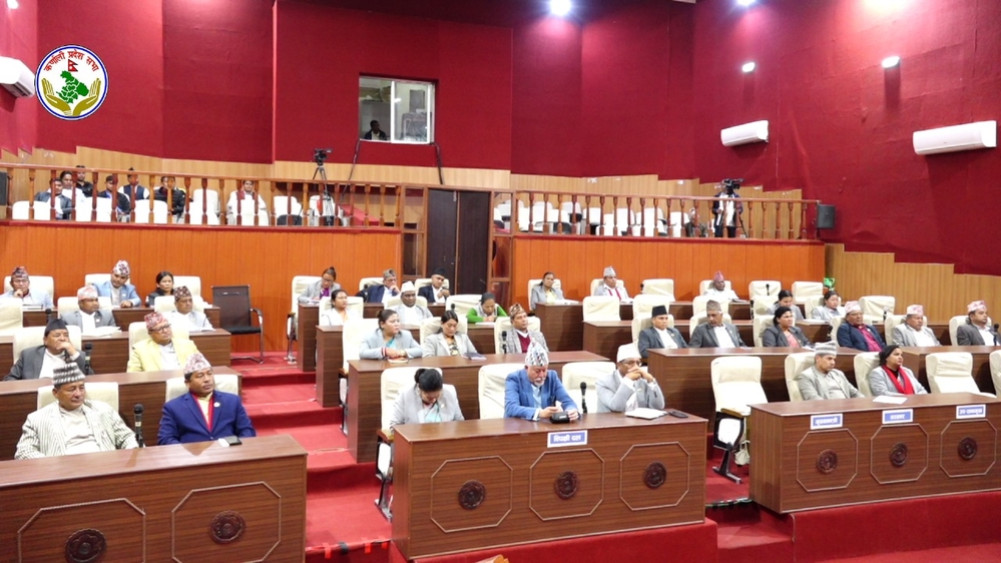
In Canada, provincial spending accounts for 45.30 percent of the total expenditure of the three tiers of government. In the United States, it is 45.49 percent, and in Switzerland, it is 38.17 percent. However, it is unfortunate that in Nepal, provincial spending does not even reach 10 percent.
We use Google Cloud Translation Services. Google requires we provide the following disclaimer relating to use of this service:
This service may contain translations powered by Google. Google disclaims all warranties related to the translations, expressed or implied, including any warranties of accuracy, reliability, and any implied warranties of merchantability, fitness for a particular purpose, and noninfringement.
Constitutionally, federalism is the distribution of powers among federal units. There is a tendency to view provincial structures as synonymous with federalism. At the citizen level, there are various kinds of commentary about the provinces. For example: it has become expensive, it has remained a place for leaders to manage themselves. Some say that having a federal government at the center and local governments at the local level is enough, and that provinces are unnecessary.
Rastriya Swatantra Party Vice President and Finance Minister Dr. Swarnim Wagle’s proposal to abolish the provincial assembly at the Chitwan General Convention has angered Madhesi and other leaders. They are suspicious of Rastriya Swatantra Party’s stance on federalism.
Provincial Expenditure
According to the consolidated financial statement of the Office of the Auditor General for fiscal year 2081/82, a total of Rs. 758,188,000 was spent under the heading of remuneration for provincial officials (provincial government, provincial assembly members, etc.). This is only 0.042 percent of the total expenditure of Rs. 1,816,000,000,000 (excluding financial management) across all three tiers. In other words, only 42 paisa is spent per thousand rupees. This fact confirms that it is baseless to claim that provincial assembly members and provincial government officials have spent excessively, squandered, or misused funds.
Even when looking at the overall expenditure of all three tiers, the provincial structure does not appear expensive. According to the Economic Survey 2082/83, provincial expenditure accounts for 9.22 percent of the total spending of the federal, provincial, and local levels. Out of every 100 rupees, the province’s share is not even 10 rupees. The budget of a single ministry in Singha Durbar is larger than the combined budget of all seven provinces. So how can provincial financial expenditure be considered high? For example, in the budget for fiscal year 2083/84, the Ministry of Infrastructure Development alone has a budget of Rs. 302,830,000,000.
Meanwhile, the combined budget of all seven provinces is only Rs. 300,000,000,000. According to the Office of the Auditor General, the total expenditure of all seven provinces over seven years (from fiscal year 2075/76 to 2081/82) is Rs. 1,232,000,000,000. In contrast, the Government of Nepal’s expenditure for a single year (2081/82) is Rs. 1,523,000,000,000. These figures also show that there is no basis for the claim that the provincial structure is costly. However, this is not the spirit of the constitution. The constitution regards provinces as agents of development, but those who enjoy power in Singha Durbar do not accept this. On the contrary, they block the sources of financial transfers that provinces should receive. They halt them under various pretexts. They make cuts.
For the country’s rapid and balanced development, provincial-level expenditure should be significant. For example, according to January 2026 data from the OECD (Organisation for Economic Co-operation and Development), in Canada, provincial expenditure accounts for 45.30 percent of total government spending across three tiers. Including local governments, it is 65 percent. The federal share is only 35 percent. In the United States, it is 45.49 percent. In Switzerland, it is 38.17 percent, and 58 percent including local governments. It is unfortunate that in Nepal, provincial expenditure does not even reach 10 percent of total spending across the three tiers.
Province Without Provincial Assembly
The (provincial) assembly is a legislative body. That is, it is a place where laws are made. There should be a sufficient number of officials in a law-making body. Every citizen should be able to see and read their own representation in the law. Citizens should feel a sense of ownership. If this fact is taken as a basis, imagining a province without a provincial assembly would be meaningless.
No country that has adopted federalism has a provincial structure without a provincial assembly. The provincial assembly is indispensable for the adoption of the principle of balance and control of power. Debating something that does not exist and will not exist is pointless. Moreover, the provincial assembly is an integral part of federalism. Not understanding its relevance and necessity is to not understand the essence of federalism.
Symbol of Federalism
Those who say that only local governments are sufficient need to understand: Nepal had local governments (local bodies) before as well. Why, when there were local bodies, did the country experience major conflicts? Why were local body elections not held for 20 years at a time? Why did local bodies function only on the basis of staff? Why did citizens have to wander to the district headquarters searching for VDC secretaries? Those who say only local and federal governments are enough must answer these questions.
The provincial structure is a symbol of federalism. It is linked to the distribution of state power. To claim that local governments can fill the void of provinces is to misunderstand the essence of federalism. It is to not recognize Nepal’s geography. The Nepal Tarai Congress Party was formed as early as 2008, demanding federalism and provinces. Not understanding the movements led by this party until 2017, and more recently by Madhesi, indigenous nationalities, and other marginalized citizens, is to ignore their sentiments. It is to devalue the achievements gained through the blood and sweat of the Madhesi people.
Contraction of Powers
The federal (central) government is always powerful. If local governments are directly connected to the center, the center can easily suppress, control, or take away their powers. Gradually, under various pretexts, it contracts their powers. The province, by standing between the center and local levels, acts as a protective shield (buffer state). This prevents the center from becoming authoritarian. The province has the capacity to bargain politically and legally with the center. As a result, there is a balance of power among federal units.
The scientific basis for service delivery in federalism is provided by the principle of proximity and economist Charles Tiebout’s theory of ‘local public goods’. According to this, only those tasks that cannot be performed by the government closest to the citizens should be done by the higher government. Local levels should handle local matters, and the federal level should handle broader tasks. Similarly, provinces should handle intermediate responsibilities. The absence of provinces means encouraging centralized governance. It means pushing services further away from citizens.
Municipalities cannot fulfill the role of provinces. For the center to claim it will coordinate directly with municipalities is to promote authoritarianism. However, in Nepal’s context, when discussing federalism, especially the provincial structure, it is also necessary to address its political, social, and cultural aspects.
The Essence of Federalism
Federalism is not just a system of governance based on the constitutional distribution of state power. It is also a system for the just management of a diverse society. It constitutionally recognizes ethnic, linguistic, cultural, and regional diversity, and builds a foundation for identity, rights, equitable access to resources, and coexistence.
The core philosophy of federalism is the constitutional balance between self-rule and shared rule. That is, federalism grants provinces the right to govern autonomously within their jurisdiction. Likewise, it ensures the right to participate equally in processes such as national policy-making. According to this principle, federalism maintains a balance between national unity and regional diversity.
Federalism scholar Daniel Elazar has described federalism as a system of agreement, partnership, and shared governance, where diversity is respected and national unity is strengthened. Similarly, another scholar, Ronald Watts, has defined federalism as a system of governance in which powers are constitutionally distributed among two or more levels of government to ensure self-rule and shared rule. According to him, the objective of federalism is not merely to transfer powers downward from the center. It is also to make provinces constitutional stakeholders in the national decision-making process.
From this perspective, provinces are not merely administrative levels. They are distinct geographic, historical, cultural, and political units. They maintain a balance between national unity and regional autonomy in federal governance. Moreover, they play an important role in preventing excessive centralization of power at the center and in ensuring checks and balances. Suppose, for a moment, that the provincial level is removed from the federal structure. In such a situation, local governments would not be able to effectively negotiate or communicate with the federal government on matters of policy, resources, or rights on an equal footing. In such a scenario, the foundation of shared governance in federal rule would weaken, and the state structure would gradually risk reverting to a unitary system.
The Example of ‘Quebec’ and Others
In world history, there is no evidence that federalism was born merely for administrative convenience. It is linked to the constitutional recognition of diversity by the state. For example, in Canada, granting special recognition and autonomy to the ‘Quebec province’, which carries French linguistic identity and culture, is the secret to the success of its federalism.
There have been two referendums (in 1980 and 1995) on whether Quebec should separate from Canada. According to scholars Will Kymlicka and Alfred Stepan, if Canada had a unitary system or if Quebec had been treated like any other province without recognizing its distinctiveness, Quebec would have already separated from Canada. The vote would have been in favor of separation.
Belgium created a federal structure based on three regions and three communities to constitutionally protect the identity and rights of the Flemish, Walloon, and German-speaking communities. This played an important role in peacefully managing linguistic conflict and saving the country from potentially serious internal strife.
Similarly, Switzerland has also successfully managed linguistic and cultural diversity through federalism. In Switzerland, German, French, Italian, and Romansh are recognized as national languages. Cantons have the constitutional right to determine the language in their own province. This is the greatest success of Switzerland’s federal model. There has never been any serious internal conflict on linguistic grounds, and its diversity has become the basis of its national identity. In Switzerland, which is slightly larger than Karnali Province, there are 26 cantons (provinces) and more than 2,100 communes (local governments).
In India, states were reorganized on a linguistic basis in 1956. According to the book ‘The Success of India’s Democracy’ edited by Princeton University Professor Atul Kohli, although India is a centralized state, the main reason for the strength of its democracy is the center’s response to the demands of regional and cultural groups and the balance of power.
If India had not granted linguistic and other autonomy to states like Andhra Pradesh, Tamil Nadu, or Punjab, the integrity of India itself could have ended. The acceptance of cultural diversity has preserved Indian democracy and unity. Nepal should learn from the experiences of these federal countries.
Nepali Context
Nepal has more than 100 ethnicities and languages. In the east, there is Kirat (Rai, Limbu, and Koch) culture; in the Madhes, Mithila, Bhojpuri, and Bajjika cultures; and in and around the Kathmandu Valley, the grandeur of Newar and Tamang cultures. Similarly, the western hills are adorned with Gurung, Magar, and Tharu cultures; the mid-west with Khas-Karnali and Tharu civilization; and the far-western region with Doteli and Rana Tharu cultures.
This regional diversity and unique cultural partnership are the true identity of Nepali national unity. Provinces were/are necessary for the protection and promotion of this unique culture. Therefore, Nepal’s federal movement was not an imported agenda. It was a revolt against the exclusion created by decades of centralized governance.
After the end of apartheid in 1994, South Africa adopted a federal model with nine provinces. According to African scholar and legal expert Nicholas Haysom, if provincial governments had not been formed to address South Africa’s regional inequality and ethnic diversity, local governments would have become paralyzed due to extreme central intervention.
According to him, provinces have acted as a security wall to prevent central monopoly. Provinces have contributed to controlling excessive centralization and making multi-level governance effective by taking responsibility for regional planning, service delivery, and coordination. In Germany’s upper house, the Bundesrat, representatives of provincial governments sit directly, ensuring that every law made by the federation serves the interests of the provinces.
Nepal’s journey to federalism is a historic achievement born from the decentralized foundation of the ancient village panchayat, the initial voice raised by the Tarai Congress in 2008, the Maoist armed movement, the Madhes movement, and the struggles of indigenous nationalities, Tharus, and others.
The constitution regards the allocation of powers among federal units as the core principle of federalism and the principles of cooperation, coexistence, and coordination as the basis for inter-tier relations. The debate now is not about whether provinces are needed. Rather, it should focus on how to make provinces more capable, efficient, and empowered.
The constitutionally granted powers of the provinces must be implemented. The problem is not with the existence of provinces. The issue lies in the tendency to prevent provinces from exercising the powers granted by the constitution and to keep them weak. Weakening provinces does not strengthen federalism. Only by making them capable and empowered will the foundation of federalism be strong. Finally, the Prime Minister’s statement that one should not have to go to Kathmandu to demand rights must be implemented.