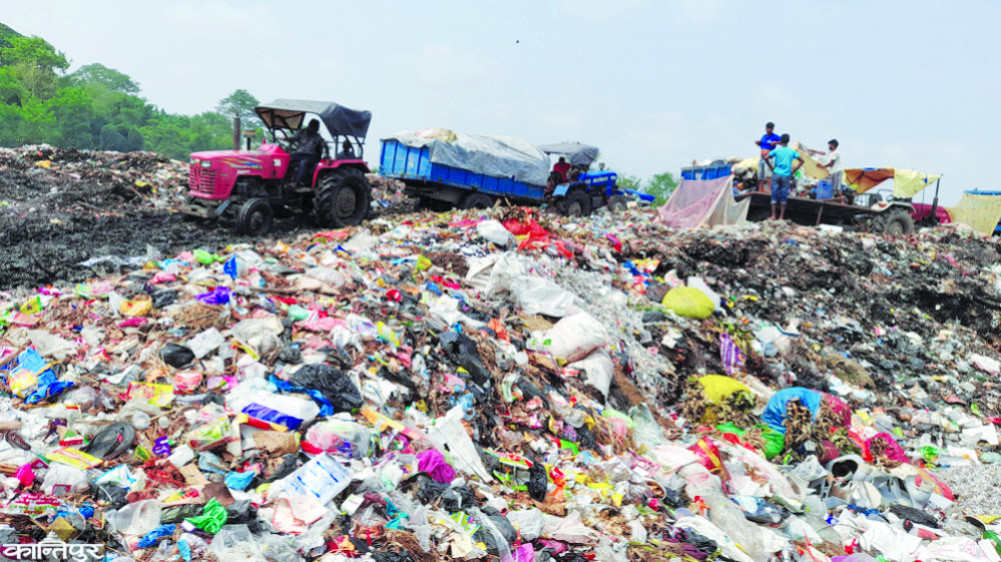
The issue of managing organic and inorganic, hospital, construction, electronic, and mining waste is becoming increasingly complex. Waste management is not only an environmental concern, but also a matter of governance and the basis for the interrelationship between different levels of government.
We use Google Cloud Translation Services. Google requires we provide the following disclaimer relating to use of this service:
This service may contain translations powered by Google. Google disclaims all warranties related to the translations, expressed or implied, including any warranties of accuracy, reliability, and any implied warranties of merchantability, fitness for a particular purpose, and noninfringement.
Waste management is a subject of concern and priority worldwide. As another aspect of human development and advancement, this issue has emerged on the surface with different dimensions and trends. All nations are active in waste management—some are successful, others are striving.
Developing countries like Nepal are trying to turn this challenge into an opportunity. With the implementation of federalism, the issue of waste management has taken on a new dimension. Rather than just the theoretical concepts of waste management, let us discuss the new governance dimension—namely, the ‘roadmap for practical solutions to waste management through public–private partnership based on existing international practices and their application in Nepal’.
The concept of public–private partnership has recently been put into practice in Nepal as well. Globally, the use of public–private partnerships is increasing to implement innovation practically, alongside financial and intellectual capital from the private sector, instead of relying solely on government regulation, restriction, and traditional development management.
Population growth, rapid urban expansion, qualitative and quantitative increases in consumption, and shrinking land have recently made waste management a complex issue. The management of organic and inorganic, hospital, construction, electronic, and mining waste is becoming increasingly challenging. Waste management is not only an environmental issue but is also becoming a basis for governance and the interrelationship among different levels of government.
Internationally, the concept of public–private partnership is being effectively implemented in waste management. In neighboring India, which has waste composition similar to Nepal, the public–private partnership model has played a significant role in modernizing urban waste management.In particular, the long-standing conflict between local governments and federal agencies over waste management in the federal capital during the monsoon season is clear to us. Although the issue of waste management in the Kathmandu Valley receives priority in the media, all local levels in Nepal are, in some way, connected to or affected by this issue. According to the ‘National Policy on Waste Management 2079’ issued by the Government of Nepal, only 12 percent of local levels have an institutional structure for a waste management branch/sub-branch/unit. This indicates the need for even greater seriousness from local governments regarding waste management. Nowadays, openly dumped waste has severely affected urban areas. This bitter reality has become commonplace, making urban beauty and the multidimensional aspects of human development seem like a bad joke.
The inability to develop a sustainable waste management system with citizen participation, and the expectation of a permanent solution through temporary support from development partners, have created a situation where locals in waste disposal areas are always dissatisfied.
Waste management is not specifically mentioned in the list of powers of any level of government in the current constitution. However, environmental management at the national and international levels is included in the federal list of powers, and environmental management within the province is included in the provincial list. This subject is also listed in the concurrent powers of the federation and provinces. Since basic health and sanitation, local market management, environmental protection, and biodiversity are included in the list of local powers, it can be analyzed that waste management is related to the government closest to the people. The Solid Waste Management Act 2068 is in force ‘to reduce, reuse, process, or dispose of waste at the source in an organized and effective manner, to minimize adverse effects on public health and the environment, and to maintain a clean and healthy environment’. This Act assigns all responsibilities and duties for waste management to the local level. The Act’s Section 17 stipulates that waste must be separated at the source into at least organic and inorganic categories, the time, place, and method of waste disposal must be determined by the local level, and the local level may designate waste collection centers. The Act also mentions that waste management can be done through public–private partnership, indicating an effort to incorporate new concepts into its management.
In Nepal’s context, waste management has the potential to become a standard for practical success in coordination and partnership among different levels of government. Section 8(5) of the Intergovernmental Relations Act 2077 states, ‘Infrastructure construction or other projects related to any subject under the exclusive or shared authority of local levels may be jointly implemented or operated by two or more local levels by making laws.’ With such provisions, local levels can proceed with integrated waste management activities accordingly. Furthermore, Section 26, Clause (gha) of the Local Government Operation Act 2074 states, ‘While operating their functions, rural municipalities and municipalities may enter into partnerships, agreements, or joint management with other rural municipalities or municipalities for the development and operation of waste disposal sites or processing systems, among other matters, to reduce costs, maximize resource utilization, or provide effective services.’ This seeks to further clarify the partnership of local levels in waste management. Currently, some local levels are struggling with waste management problems and seeking clarity in the practical application of concepts such as public–private partnership. Although laws related to public–private partnership exist in local levels such as Kathmandu, Pokhara, and Birgunj Metropolitan Cities, almost all local levels in Nepal are striving for the effective implementation of this concept in waste management.
The Public–Private Partnership and Investment Act 2075 and its Regulations 2077 also allow for the use of public–private partnerships in waste management. Local levels themselves can also make policy and legal arrangements regarding public–private partnerships. According to these provisions, local levels can conduct pre-feasibility studies of waste management projects, include such projects in the project list, and select qualified developers through competition.
The local level must reach an agreement with the selected developer for detailed study, development, and implementation of the project. After such an agreement, the local level must provide necessary coordination and facilitation to the developer. Upon receiving the detailed project report from the developer and after its multidimensional evaluation, the report can be approved, a project development agreement can be concluded with the developer, and the project can be implemented. Since this phase is very complex, in-depth discussions and negotiations are essential on topics such as benefit–cost analysis of the project, expected benefits to the local level, the modality of fee payment to the developer (through the local level or households), and per-household waste fees. In fact, the main issue of public–private partnership is successful and effective negotiation and agreement. After project implementation, the local level must also consider the provision of transferring the project in its operational state, as project transfer is the essence of public–private partnership.
Some local levels have approved waste management procedures in accordance with the Local Government Operation Act 2074 and are promoting public–private partnerships in waste management through these procedures. For this, cooperation and partnership from the federal and provincial governments may also be necessary. If two or more local levels wish to jointly operate a waste management project, the provincial and federal governments must provide sufficient support to the local levels in stages such as drafting necessary model laws, conducting environmental studies of the project, and securing land use rights in national forest areas.
For facilitation regarding public–private partnership, the Investment Board and its office, identified under the Public–Private Partnership and Investment Act 2075, can also provide their experience to governments at different levels.
Currently, many local levels in Nepal are striving for the practical implementation of public–private partnership in waste management. There may be problems such as identifying a reliable private sector, ensuring adequate coordination and collaboration, equitable sharing of benefits and risks, weaknesses in estimating the amount of waste, and difficulties in using appropriate technology. Policy and legal changes have also affected waste management in Nepal, the latest example being the legal complications in the Integrated Waste Management Project of the Kathmandu Valley.
Internationally, the concept of public–private partnership is being effectively implemented in waste management. In neighboring India, which has waste composition similar to Nepal, the public–private partnership model has played a significant role in modernizing urban waste management. Its market value is estimated at $12.21 billion in 2024. The waste management system of Indore city in India is the country’s first public–private partnership model, in which green waste was converted into environmentally friendly fuel and other products. In addition, cities such as Greater Noida and Visakhapatnam have implemented waste management through various public–private partnership models. Another neighboring country, China, relies on public–private partnership for waste management. During China’s 14th Five-Year Plan, the goal was to make about 200 cities ‘zero waste cities’, in which the private sector played a significant role.
The currently prevalent models of waste management are based on informality and ad hocism. Instead of traditional methods of collection, transfer, and disposal, the implementation of new technologies is essential.
Many countries around the world are searching for advanced methods, technologies, and strategies for effective waste management. Some have succeeded in this. Nepal, which has already entered a phase of rapid urbanization, can also implement waste management as a standard for urban beauty management and successful intergovernmental relations. For this, management by the private sector, technological advancement, regulation by the public sector, and responsibility towards citizens are important aspects.