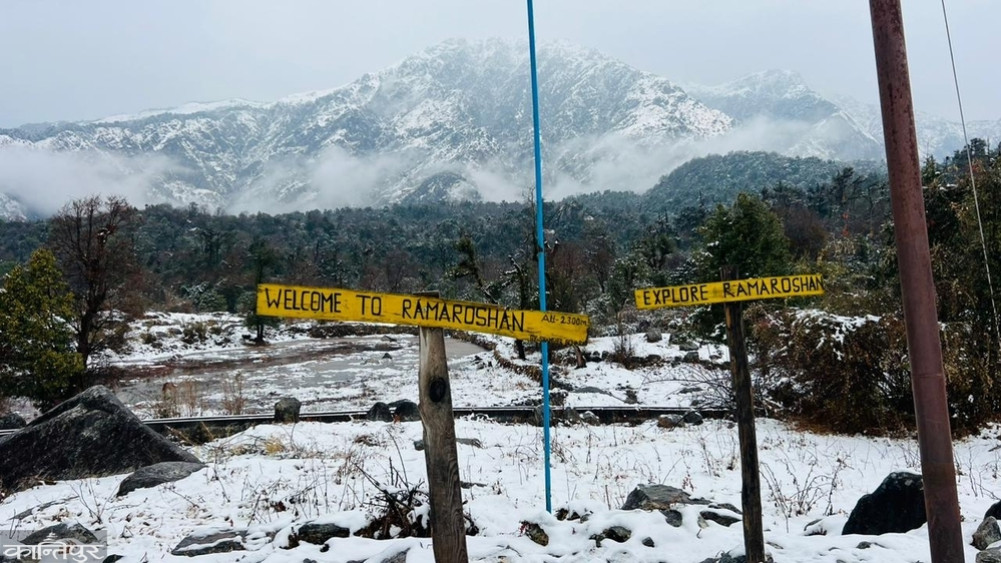
The tourist destinations of Sudurpaschim Province are filled with religious significance, unparalleled natural beauty, and biological diversity. For example, Prime Minister Balendra Shah referred to Badimalika, which holds religious importance, as the 'father of Switzerland' during a pre-election rally on March 4.
We use Google Cloud Translation Services. Google requires we provide the following disclaimer relating to use of this service:
This service may contain translations powered by Google. Google disclaims all warranties related to the translations, expressed or implied, including any warranties of accuracy, reliability, and any implied warranties of merchantability, fitness for a particular purpose, and noninfringement.
Tourism is also at the forefront among the sectors with the greatest potential to contribute to Nepal’s economic development. From east to west, and north to south, there is immense potential for religious, cultural, natural, and adventure tourism. Sudurpaschim Province is one such region, home to renowned destinations such as Badimalika, Ramaroshan, Khaptad, Saipal, and Api Himal. Due to posts on social media and public discussions, the attraction of tourists to these destinations has been increasing.
However, due to insufficient infrastructure, tourists have had to undertake risky and difficult journeys. Some have had to end their trips midway. Even though these are famous destinations and there is visible attraction to reach them, the compulsion to return with a bad experience prevents the tourism industry from flourishing. Therefore, all three levels of government must provide basic and additional facilities for tourists. Since sufficient investment in a sector like tourism yields ample and regular returns, they should also prioritize increasing investment in tourist facilities.
The tourist destinations of Sudurpaschim Province are filled with religious significance, unique natural beauty, and biodiversity. For example, Prime Minister Balen Shah referred to Badimalika, which holds religious significance, as the ‘father of Switzerland’ during a pre-election rally on 21 Falgun. Ramaroshan is known as ‘12 Bund, 18 Khand’, featuring 12 lakes and 18 vast meadows. Khaptad is informally known as Nepal’s ‘earthly paradise’.
The tourist destinations of Sudurpaschim Province are filled with religious significance, unique natural beauty, and biodiversity. For example, Prime Minister Balen Shah referred to Badimalika, which holds religious significance, as the ‘father of Switzerland’ during a pre-election rally on 21 Falgun.In Saipal, one can enjoy unique natural beauty and biodiversity. The highest peak in Sudurpaschim, Api Himal, and its base area are equally enchanting. After Prime Minister Shah posted a short video on Facebook of himself playing cricket at the base camp of Api Himal, which was already famous, its popularity has soared even further. In addition to these main destinations, there are many other tourist sites in Sudurpaschim, which have been discussed on social media or through oral and written means.
Statistics show that the number of tourists visiting these destinations has increased in recent years. For example, according to Api Himal Rural Municipality in Darchula, more than 5,000 tourists visit Api Himal base camp alone. Before the COVID-19 pandemic, only about one to one and a half hundred tourists visited the Saipal area annually, but now three to four hundred visit each month, according to Saipal Rural Municipality. From 2069/70 to 2074/75 BS, only 19 to 46 tourists visited Khaptad National Park annually, but since 2075 BS, around 3,000 tourists have visited each year.
If the number of tourists continues to increase, the country’s economy will benefit directly and indirectly, and the local economy will also become more dynamic. Local businesses will grow. Locals will have opportunities to provide services and sell local products. The trade of millet, buckwheat, nettle, honey, and medicinal herbs can increase. Multipurpose employment opportunities will be created. There will be exchange and promotion of local culture. Overall, opportunities for economic benefit for local residents will increase. Local governments can also become prosperous.
But most tourists who are going to or have already visited the famous destinations of Sudurpaschim have similar complaints—lack of infrastructure. Although there are plenty of tourist destinations, it is not easy for tourists to reach them. Last Asar, a group of tourists aiming to reach the southern base camp of Saipal Himal, Aulagadh, the western base camp, and the Maja Valley surrounded by mountains, had to turn back after following a narrow trail from Raidhugi towards Gadul Himal for a while. The group was not prepared to risk the narrow trail, with cliffs on both sides and bushes in the middle, where there was barely enough space to place a foot. On the way to most destinations, there is a lack of trails, accommodation, drinking water, toilets, communication, roads, lodging, and other basic infrastructure. This increases hardship, risk, and uncertainty during the journey. There is a possibility that tourists who have visited a destination once may not return or may discourage their acquaintances from visiting. Such a situation is counterproductive for the tourism sector.
In areas where the number of tourists is increasing, infrastructure such as organized trails, information boards, rest stops, rescue points, and tourist information centers are necessary. Similarly, trained guides, porters, trekking maps for foreign tourists, digital navigation, weather information, and emergency contact systems are also needed. It would be good to build proper roads, but as an alternative, safe trails can be constructed. In remote areas, safe accommodation is also an important aspect. But in most destinations in Nepal, there are no private hotels or government/community rest stops. As a result, tourists have to face security risks.
Therefore, rest stops or lodges should be built through the efforts of all three levels of government or the community. In some places, there have been initiatives to build such lodges, some are under construction, and some have been built but are not in use. Those that remain to be built should be completed. Those that are built should be put into use. It would be good to have organized hotels. Alternatively, people can be encouraged to operate homestays. In remote areas, there is also the risk of floods and landslides. Therefore, regular maintenance should be carried out. Bridges should be built. Since such investments increase income and improve living standards, they should be a government priority.