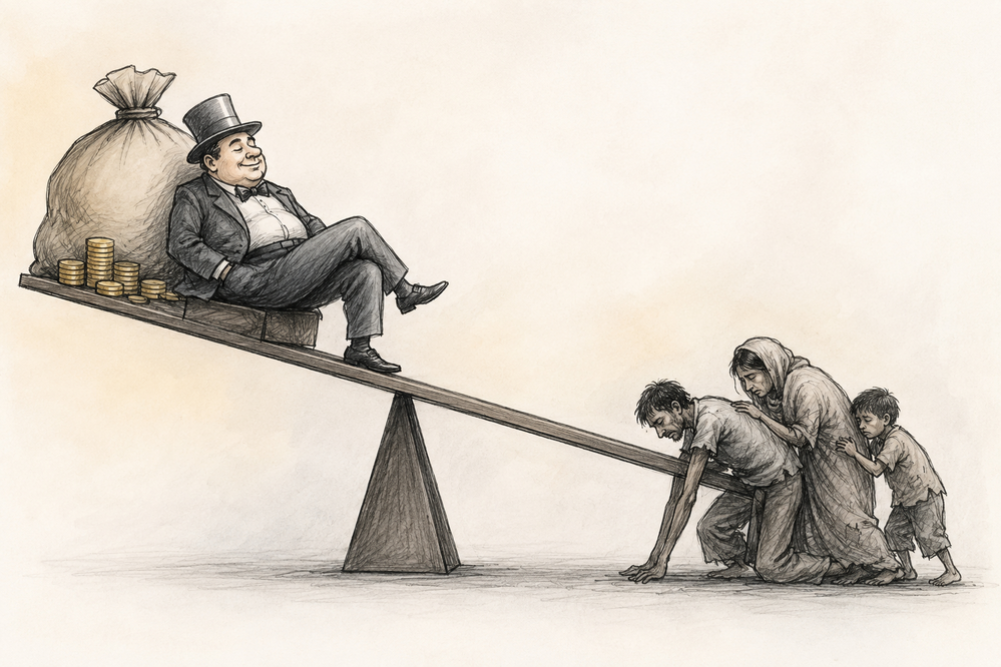
Nepal's economic crisis cannot be resolved through a neoliberal economy that brings no change to the economic lives of ordinary people, increases the number of poor and lower-class individuals, makes it difficult even for the middle class to make a living, and serves only the interests of a limited group of capitalists.
We use Google Cloud Translation Services. Google requires we provide the following disclaimer relating to use of this service:
This service may contain translations powered by Google. Google disclaims all warranties related to the translations, expressed or implied, including any warranties of accuracy, reliability, and any implied warranties of merchantability, fitness for a particular purpose, and noninfringement.
On 7 Falgun 2082, Rastriya Swatantra Party (RSP) unveiled its election manifesto in Surkhet, Karnali. The top leadership of RSP also declared that the lagging Karnali should no longer be left behind. Economically, Karnali is a province with a large population of poor people. The National Living Standards Survey has shown that about 27 percent of Karnali’s population lives below the absolute poverty line, while 52 percent are in a state of multidimensional poverty. However, at the manifesto launch event, Dr. Swarnim Wagle stated that RSP is a party that prioritizes the middle class. The party is dedicated to protecting the interests of the middle class, but its slogan of liberating the people of Karnali from poverty is inherently contradictory.
While debates continue over RSP’s lack of clarity on economic-political ideology, Dr. Wagle clarified at the Chitwan General Convention that RSP is a party that believes in a ‘liberal economy’ and that the ideology it will adopt is neoliberalism. There was no ideological discussion on this idea presented at the convention. With Wagle’s idea automatically passed, it becomes clear that neoliberal economics is RSP’s economic ideology. Although it is said to accept social justice and a welfare system, a market-controlled neoliberal system perpetuates inequality and financial oppression. If RSP forms a government, it appears that the neoliberal economy practiced for the past 30 years will be further strengthened. The neoliberal economy, which favors capitalists, markets, intermediaries, and the elite class, not only hinders the development of an independent economy, but also makes the lives of the economically weaker classes and communities even more difficult.
Neoliberal Economy
Neoliberalism is a system based on an open market economic system that institutionalizes and intensifies economic inequality worldwide. This system allows the open market to operate without dispute, fundamentally focusing on profit generation. Neoliberal capitalism, which is considered to have started practically and in policy terms since the 1970s, now dominates globally. In such a system, capitalists can accumulate immense wealth by exploiting global labor, resources, and technology. According to data from last year, 12 of the world’s richest people possess more wealth than 4 billion people with weak economic status. Even if a country is wealthy, the compulsion for a large population to remain poor is a product of the neoliberal capitalist system.
The neoliberal economic-political system is an anti-humanitarian system. In such a system, humans are only workers, consumers, and sources of profit. The market uses humans merely as commodities for buying and selling.The neoliberal economic-political system is an anti-humanitarian system. In such a system, humans are only workers, consumers, and sources of profit. The market uses humans merely as commodities for buying and selling. In this system, profit becomes the primary and mandatory condition, even above basic human needs such as food, education, and health. This economic system, where capitalists openly capture markets worldwide and fulfill the interests of a certain class, makes capitalists ever richer while pushing a larger number of people into poverty and weakness.
Naturally, the role of political parties is important in operating political power. The neoliberal economy seeks a political system and leadership that suits its interests. Therefore, wealthy individuals who have already captured economic power are now campaigning to capture political power. In economically powerful countries, capitalist elites have come to play a leading role in state power. A political system where political parties and power are captured based on capital works primarily for the interests of the capitalist class. In such a system, the economic lives of the poor, workers, and laborers are not a matter of concern.
Not only that, but violence becomes inevitable for the continuation and expansion of the neoliberal economy. Colonial rule was imposed to seize Africa’s gold, diamonds, timber, uranium, and other resources, while continuous wars have been waged to capture Arab oil and minerals. In the neoliberal capitalist system, capitalists seize state power and use war as a weapon for economic dominance. This has pushed the world into a continuous cycle of terror, conflict, and violence.
To expand neoliberalism, capitalists and powerful countries politically manage economic policies so that there are no obstacles to foreign investment and profit generation. In this process, large and capitalist powers increase foreign debt, promote foreign investment, and, through open market policies, replace the internal production of economically weak countries, reducing them to mere consumers. Through debt, investment, and other resources, Western countries extract more than 65 billion US dollars annually from Africa alone. This data clearly shows how global capitalist countries exploit poor and weak nations. Thus, neoliberal capitalism is an economic system that legitimizes the plunder of poor, weak, and resource-rich countries.
From a political perspective, neoliberalism and fascism are complementary to each other. To expand a market-controlled economy for a certain capitalist class, rulers are needed to protect profit-seeking capitalists rather than the people. On the other hand, rulers need the support of capitalist powers to operate arbitrary governance. In this way, democracy based on justice, equality, and freedom cannot be strong under a neoliberal system of governance.
A state that fully embraces the neoliberal economy is not accountable to the service of its citizens. It leaves the responsibility of economic management to the market, promotes large capitalists, and displaces small investment industries and businesses. Not only that, it brings health, education, and so on under market control and transforms them into commodities. A state that adopts trade liberalization restricts imports and makes the country economically dependent. Therefore, the neoliberal economic-political system protects the interests of a limited capitalist and dominant class but strengthens the vicious cycle of financial oppression on the majority of citizens.
Neoliberalism in Nepal
Nepali society passed through a feudal production system for a long time. Due to the extravagance of kings, maharajas, their associates, and feudal lords, a huge gulf of economic inequality developed in Nepal. Rigid patriarchy made women victims of economic deprivation, while the caste system prevented a large population from accessing economic resources. The landlords and capitalist class of feudal society still belong to the elite class. The neoliberal system fundamentally serves to protect the interests of that same capitalist class.
In Nepal, it was mainly after 2047 BS that the Nepali Congress promoted the practice of a neoliberal economy. Although Congress theoretically based itself on democratic socialism, in practice it embraced the neoliberal economy. After that, Congress and the Communist parties continuously participated in governance, but they could not challenge the neoliberal economy; instead, they continued to promote it. For example, the then CPN (Maoist) raised the issue of a self-reliant economy based on equality and justice. The Maoist movement made a significant contribution to changing the political system, but no work was done to develop an alternative economic system. The Communist parties, which fought against the feudal production system, continued the same neoliberal economy when they came to power. Political parties that succeeded in changing the state system could not contribute to building an economic system suited to the characteristics of Nepali society.
The government formed under RSP leadership through elections also appears to have made the promotion of the neoliberal economy its main policy. Especially, RSP, which emphasizes the expansion of the middle class, has also, to some extent, favored capitalists and traders in its policies, programs, and budget. On the other hand, most government ministers are representatives of the middle and upper classes, so they pursue politics that protects the interests of the middle and upper-middle classes.
The government has been increasing both internal and external debt. According to data up to the end of last Asar, 2 trillion 974 billion 900 million in debt has been taken, of which nearly 1 trillion 600 billion is external debt. However, this borrowed money does not appear to have been used for productive work. On the other hand, Nepal has talked about creating an environment for foreign investment, which may be successful in some contexts. But a government that does not take steps to increase domestic production, build national capital, and move toward a self-reliant economy cannot solve the country’s economic crisis; rather, it appears to be worsening.
On the other hand, the state has been claiming to increase GDP. Even if there is improvement in the country’s GDP based on foreign investment or open market economic policies, there will be no change in the lives of ordinary people. Instead, certain capitalists may become even richer, while the number of poor people is certain to increase at the same rate. Therefore, an economy that transforms the standard of living is necessary for the Nepali people. An economic-political system that provides liberation from poverty, deprivation, and scarcity, and from violence and discrimination, is what the people need. Nepal’s economic crisis cannot be solved by a neoliberal economy that does not bring any change to the economic lives of ordinary people, increases the number of poor and economically weak, and makes it difficult even for the middle class to make a living, or that serves the interests of a limited number of capitalists.
Without transformation in the economic sector, there cannot be a fundamental transformation of Nepali society. The kind of neoliberal economy claimed by Finance Minister Wagle does not appear capable of solving economic inequality, crises, and problems. For this, it is necessary to build an alternative economic system based on the study of the causes of economic crisis in Nepali society, the state of poverty and its underlying structural causes, class formation and development, and the success or failure of the economic policies Nepal has adopted.
The neoliberal capitalist system places the highest priority on the market. However, an economy that centers on humans and humanity, not the market, helps establish financial equality. Nepal’s economic policies or programs are made by certain individuals or groups. There must be mandatory participation and inclusion of the community in the theoretical formulation and allocation of the economy. Similarly, if diversity is accepted in economic policy-making or budget allocation and a community-based budget formulation system is developed accordingly, it is possible to develop an alternative economic system. There is a need for broad debate on building an alternative socialist economy to the neoliberal economy, which keeps the country and people trapped in the cycle of poverty and financial exploitation.