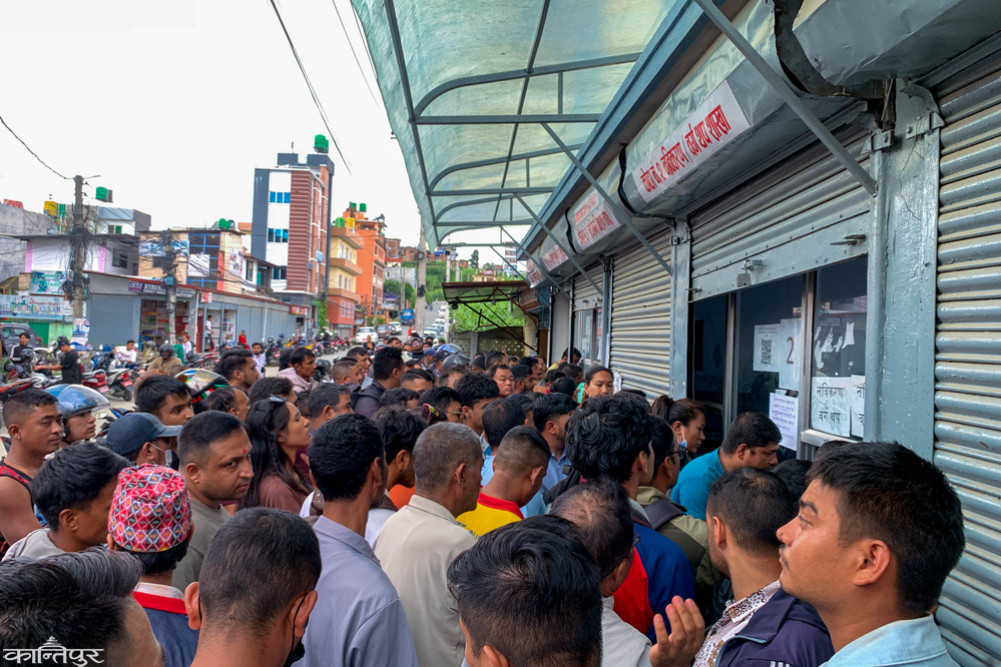
Even now, people who visit government offices for various services, big or small, are still facing the invisible obstacle of the “system down” issue. As a result, it is clear that the concept of “Digital Nepal” has not become effective in practice.
We use Google Cloud Translation Services. Google requires we provide the following disclaimer relating to use of this service:
This service may contain translations powered by Google. Google disclaims all warranties related to the translations, expressed or implied, including any warranties of accuracy, reliability, and any implied warranties of merchantability, fitness for a particular purpose, and noninfringement.
Visiting government offices to receive services is a compulsion for citizens. These government offices are the regular points of contact between the state and its citizens. Only when such offices are as citizen-friendly as possible does a positive sentiment toward the government grow among the public. In Nepal, however, citizens’ experiences at government offices are generally not positive. Due to reasons such as rude behavior from staff, the compulsion to pay extra money, cumbersome procedures, and the web of middlemen, dissatisfaction with government offices has persisted among citizens.
For these reasons, the government has introduced the concept of ‘Digital Nepal’ to increase transparency in services, eliminate middlemen, and ensure service seekers do not have to visit offices in person. However, as a strong and practical system has not come into use, citizens continue to face difficulties. Even now, those who go to government offices for both minor and major services encounter the invisible obstacle of ‘system down.’ As a result, it is clear that the concept of ‘Digital Nepal’ has not become effective in practice. If the government does not update its technology and human resources in line with the times, public perception of government offices will remain negative.
The government is found to issue short deadlines and unclear information for citizens to fill out forms. This creates a sense of haste and confusion among the public. As a result, pressure increases at the offices. The system also comes under strain.Last Friday and Monday at 11 a.m., 85-year-old Savitridevi Udas went to the Ward 31 office of Kathmandu Metropolitan City to renew her identification card. She had to listen to staff repeatedly telling her that the ‘system is down’ all day. With the start of the new fiscal year, elderly citizens like her have been going to ward offices to renew their social security allowance identification cards, only to hear the same ‘system down’ response, waiting all day and then returning home. Similarly, on Monday, Bhagwati Phuyal from Katunje, Bhaktapur, went to the Transport Management Service Office in Sallaghari to renew her scooter’s bluebook. As soon as she reached the office gate, she learned—‘the system is down.’
She had gone there for the same purpose three days earlier as well. At the end of the last fiscal year, repeated problems in the digital system related to land administration affected services at land reform offices across the country. Overall, offices with the highest number of service seekers—such as land revenue, transport management, and the Department of National ID and Civil Registration, as well as municipalities—have been experiencing repeated problems with their digital systems. However, no serious efforts have been made to improve the situation.
The impact of ‘system down’ is felt most by the elderly and those service seekers who are busy with various jobs and businesses. For the elderly, traveling to government offices is difficult and risky. While convenient roads and transportation in large cities like Kathmandu reduce hardship and risk, elderly people in remote areas have to endure much more suffering. Moreover, since they often have to bring another person to assist them, that person’s work or studies may also be affected.
Even after making all the necessary arrangements and reaching the office, when their work cannot be completed, it feels as if the elderly are being punished. On the other hand, many people are engaged in various professions and businesses. They have to somehow manage their time or even take leave to visit government offices. But if their work cannot be done, they too face problems. For example, Sunil Parajuli, who drives a vehicle carrying Chinese tourists, went to the Transport Management Service Office in Sallaghari on Monday for the second time to renew his bluebook. His response was: ‘I’m fed up with running around again and again.’
The digital systems/software used by most offices are operated by the staff themselves. Some citizens can also use them directly. In addition to the problem of ‘system down,’ such systems are incomprehensible for many users. They have not been developed with concepts such as citizens’ educational levels, access to technology, familiarity, or ease of use in mind. Therefore, the government should prioritize the development and implementation of citizen-friendly digital systems.
On the other hand, the government is found to issue short deadlines and unclear information for citizens to fill out forms. This creates a sense of haste and confusion among the public. As a result, pressure increases at the offices. The system also comes under strain. For example, all local levels are currently operating the system simultaneously for the renewal of elderly allowance identification cards. Moreover, when all wards across the country log in at the same time from 10:30 a.m. to 2:30 p.m., the system struggles to cope. Therefore, instead of increasing the pressure on citizens all at once, the government should make tasks like renewals a regular process.
The systems we use here are not regularly updated. This causes delays in work or situations where work cannot be done at all due to ‘system down.’ On the other hand, the capacity of such systems should automatically expand according to user load. Because user load is not always the same. However, when systems are installed to handle only low loads, problems begin as soon as the load increases.
Therefore, updating the system should be done regularly. Additionally, conditions for regular updates and uninterrupted operation of the system can be set at the time of procurement. Such measures may increase costs, but the cost of operating the system cannot be greater than the convenience citizens receive from services. Therefore, the government must be serious about the management aspect. Mainly, if stopgap systems are installed and citizens are regularly troubled, the slogan of ‘Digital Nepal’ will not be meaningful.
In conclusion, digital service is the demand of the times. But it must be reliable. It must be citizen-friendly. If problems in the digital system are caused by tampering, solutions must also be sought. It is contradictory to call it a digital system while service seekers still have to visit offices repeatedly. This only increases public dissatisfaction with the government system. Ultimately, it breeds anger toward the state itself.