Can a relationship be established between national parks and local communities in which conservation does not simply mean restrictions on local lives? Is it possible to find secure livelihood alternatives for people living near forests? Can local knowledge be incorporated into conservation management?
We use Google Cloud Translation Services. Google requires we provide the following disclaimer relating to use of this service:
This service may contain translations powered by Google. Google disclaims all warranties related to the translations, expressed or implied, including any warranties of accuracy, reliability, and any implied warranties of merchantability, fitness for a particular purpose, and noninfringement.
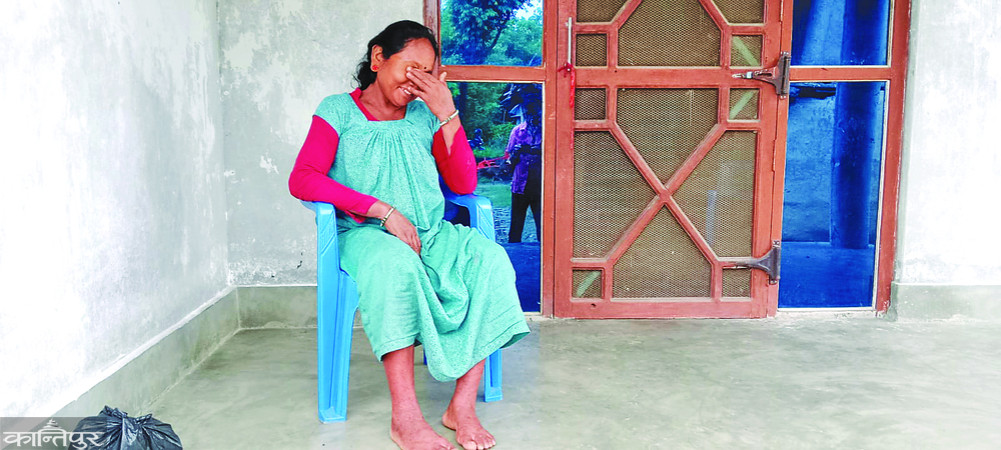
Suknidevi Chaudhary’s house is in Bagfata of Bhimdatta Municipality. It lies right next to Shuklaphanta National Park. Between her house and the park flows the Gobariya River. On one side of the river is the forest, on the other, the settlement. Water runs between these two geographies. On the map, these places appear separate. But in Suknidevi’s life, they have never been apart. Her life flows between all of these.
She lives on the edge of the forest. In fear of the forest. In need of the forest. And under the shadow of the laws the state has made over the forest. Early this week, one afternoon, she entered the forest with her daughter, daughter-in-law, and other women from the village to pick mushrooms. There were 16 of them in total. They had not gone to conquer the forest. They had gone to bring back a few wild mushrooms and fiddlehead ferns. But that day, the forest did not let them return. They were lost in the forest all night. They sat at the base of a large tree. It rained. Elephants trumpeted. The night passed in fear of snakes and wild animals. In the morning, they searched for the way again. Eventually, they found their path by following the sound of a vehicle. By the time they reached home, it was already afternoon the next day.
Pause here for a moment and think. Night does not fall in the forest all at once. First, the brightness of the sky gradually fades. The green of the bushes disappears. The branches of the trees begin to turn black. People’s faces slowly start to look like the face of darkness. Suknidevi and her group did not even realize when evening fell. There are no clocks in the forest. Without the sun, there is no sense of time. Then suddenly someone says, “It’s dark now.” After that, everyone looks at each other. Darkness has arrived in the forest before them.
After night falls, the forest reveals another side of itself. The trees visible during the day turn into sounds at night. Some branch sways. Some leaf falls. Somewhere a bush rustles. Far away, a bird calls out once and then falls silent. After that, it is fear that interprets the meaning of those sounds. Suknidevi says, “Even when a leaf fell, it made my skin crawl.” A leaf fell, but for them, it was not just a leaf falling.
“Is it an elephant?” someone whispered. “Be quiet,” came another voice. In the forest, even fear speaks slowly. If you speak loudly, you only hear yourself. That’s why that night, even fear was whispering. Somewhere far away, an elephant trumpeted. First once, then again after a while. Then from another direction.
The forest became vast. How far away were the elephants? No one knew. But sound distorts the sense of distance. A distant sound seems close. Sometimes a nearby sound seems even farther away. Sixteen women sat in a circle at the base of a large tree. The tree was not their home. But that night, the tree served as their home. The tree did not give them shelter. But it gave them its presence.
Was there a snake in the bushes? They did not know. But in the darkness, anything unseen could be a snake. Every sound of a leaf could be the sound of an animal. Every sound turns a person inward. To run would be to go deeper into the forest. So they sat quietly.
The sky became their roof. The wet earth, their floor. And each other’s bodies, their walls. No one spoke loudly. No one dared to sit apart. At night, fear is greater when people are alone. When sitting together in a circle, fear is shared. When people lose their way in the forest, they sit together in a circle. Perhaps democracy is also such a circle, where fear does not belong to just one person.
Suknidevi and her group sat quietly. It was raining—drip. Then a moment of silence—drip. Then some unknown sound. Someone hugged their knees. Someone held the hand of the woman sitting next to them. Someone tried to look up at the sky. But the sky was not visible. In the forest, night can even hide the sky. That night, for them, was not just a night. That night was a long wait—a wait for morning. A wait for home. A wait for light. At some point, Suknidevi wondered—can a night really be this long?
But night has its own clock. In the forest, time is measured not by a watch, but by fear. They did not know what time it was. How much of the night had passed? How long until morning? They had only one guess: “It must be almost morning now.” But in the forest, morning also arrives first as a sound. A faint touch of light on the leaves—the darkness thins, and finally, the sky is visible again through the trees.
That morning, for them, hope appeared before sunrise. Even before it was light, they remembered home. “Banwa me raat kasik bital, kana karra ba” (How did the night pass in the forest? It’s hard to say). Indeed, some nights do not pass. They leave the body and settle in memory.
And for the first time, through the leaves of the trees, the pale color of the sky appeared; the forest was the same forest. The elephants were in the same forest. The snakes were somewhere there. The path was still lost. But the darkness had lifted. Sometimes, before finding the way, what people need most is light. That morning, for Suknidevi and her group, it was that light they found first. Sometimes, it is not people who get lost in the forest, but the paths. Those who are lost need a path. In the morning, they found their way. But for us, there is still a path left to find—not between the park and the settlement, but between the state and the citizen.
“Hamar manai banwa me herail baat” (Our people are lost in the forest), said Jograj Chaudhary, Ward Chair of Bhimdatta Municipality–19, explaining that the search began after hearing this news: “Families came and said, our people are lost in the forest. Then we started searching.” This sentence may sound ordinary. But within the words “our people” lies an entire community.
Are we trying to understand poverty not through statistics, but through the kitchen? What is the price of mushrooms? Which household need does fiddlehead fern fulfill? How many livelihood options do people living near the park have? Poor people do not choose risk. Many times, they choose the lack of options. If the state understands them only as “locals sneaking into the forest,” the story remains incomplete. If it sees them only as victims, the story remains incomplete. They are people who make decisions, understand risks, and run the economy of their lives. But their options are limited. These limited options are the very question of democracy, where a woman is thinking—what to cook at home today? And at the same time, the state is thinking—how to protect the forest? Until the answers to both questions are sought in the same place, the problem will keep repeating.
The forest’s survival is the nation’s pride, but if the family living by the forest loses its livelihood, that is their personal problem—this very inequality is at the root of the tension between conservation and citizens.So the question is not—will Suknidevi enter the forest again or not? The question is—why do they have to face the same risk again? Can such a relationship be built between the park and the local community, where conservation does not only mean prohibition over local lives? Can safe livelihood options be found for people living near the forest? Can local knowledge be made a part of conservation management? These are the questions that must be answered.
That’s why, if we see this only as an incident, we miss its greater meaning. Because here, there is not just the forest, but also the state. And the citizen. And an old problem in their relationship. The state mobilized all its formal resources to search for the missing. But Suknidevi and her group were not found. They found their own way home. In this scene lies a deep contradiction of our times. The questions that should be asked are often not asked, because our conservation policy centers the forest, not the people living by the forest.
They did not go into the forest for recreation, but in search of their small economy. It is a small economy. But in the life of a poor person, the small economy is the big economy. We count the big development projects. We count the big numbers in the budget. But we do not count the value of a handful of fiddlehead ferns that reach the kitchen. The state’s plans often begin to fail right where the citizen’s life begins.
In the modern language of conservation, the forest is called a “protected area.” Then boundaries are drawn—here is the park, there is the settlement, here are the wild animals, there are the people, here is conservation, there is encroachment. But life is not lived along such simple lines. Suknidevi’s house is next to the park. Their lives are not completely separate from the forest. But the law wants a clear distance between the forest and the citizen. The attempt to create this distance is not wrong in itself. Wildlife conservation is necessary. But the question is—who pays the price of conservation?
If the responsibility of protecting the forest is also that of the local community, then why should they alone pay the price of the restrictions that come with conservation? If the forest is a national asset, then the benefits of its conservation should also be national. But often, the benefits are national, the costs are local. The forest’s survival is the nation’s pride, but if the family living by the forest loses its livelihood, that is their personal problem—this very inequality is at the root of the tension between conservation and citizens.
The state says—no matter what is done, locals cannot be stopped. Its advice is that people must be aware themselves. But the citizen’s question is also simple: “Who will create a system so that we don’t have to enter the forest?” In this very question lies the real relationship between the forest and the citizen.
It is easy to keep citizens away from the forest. But the harder question is, how will their lives continue once they are kept away from the forest? The state usually does the first. It forgets to do the second. It is easy to impose restrictions. It is hard to create alternatives. That is why conservation policy often appears successful by blaming the citizen: “You entered the forest, you broke the rules, you were not aware.” But the question is not asked—why did you have to go into the forest? What is being done to prevent such incidents from repeating next monsoon?
Those who earn from the forest see conservation as an opportunity. Those who struggle to light a fire in their kitchen see the forest as life. So the question—whose forest is it? This is not the story of citizens lost in the forest—it is the story of a state that arrives with all its resources in a crisis. But before the crisis, the state is not present enough in the lives of its citizens.
The conflict between the park and the settlement is not new. It is said that 32 commissions have been formed to find a long-term solution for displaced and affected families. Commissions were formed, reports were written, recommendations made, governments changed, ministers changed. But no solution came. The affected kept running to Kathmandu with every new government. When will the Shuklaphanta Reserve victims get justice?
In the end, Suknidevi and her group returned home. They found their way, but now the state must also find a path—between the forest and the citizen, between conservation and livelihood, between law and life. Because the country is not safe just because the forest is safe; the citizens living by the forest must also be safe. Only then can we say—the forest survived, and so did the people.
Suknidevi and her group were lost in the forest for a night. They returned home. But the path lost between the forest, the citizen, and the state has yet to be found. The state, too, is still searching for its way.