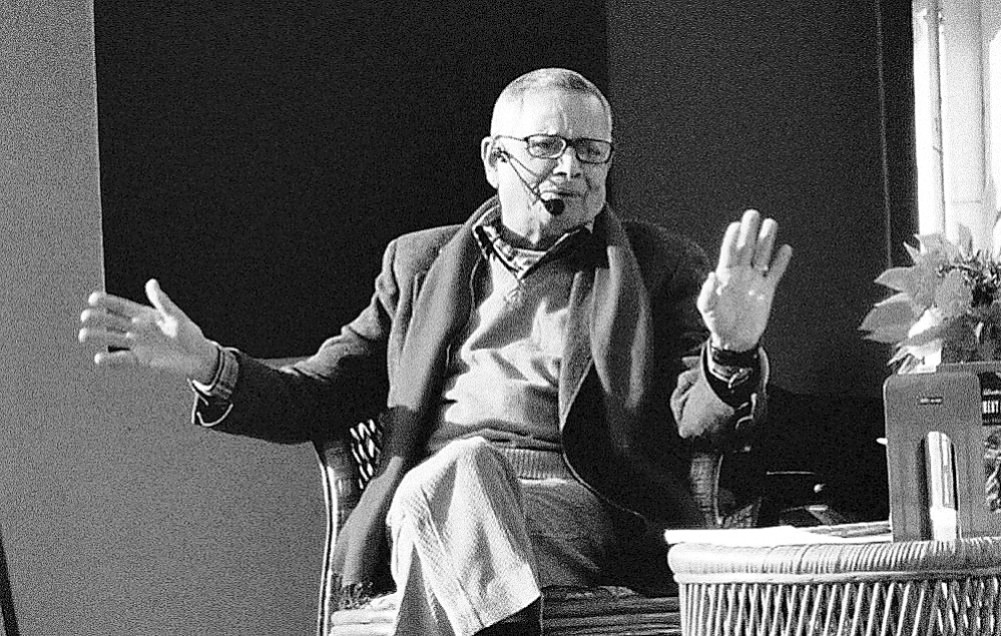
Dr. Pandey had willingly chosen an unusual kind of ordinary life, abandoning everything he could have done if he had wanted to. He had neither pride nor guilt for living there with minimal contradiction between faith, behavior, and daily life - just a simpleton.
We use Google Cloud Translation Services. Google requires we provide the following disclaimer relating to use of this service:
This service may contain translations powered by Google. Google disclaims all warranties related to the translations, expressed or implied, including any warranties of accuracy, reliability, and any implied warranties of merchantability, fitness for a particular purpose, and noninfringement.
Sometimes the limitations of expression are clearly felt. When it was difficult to find any other suitable sentence to present Devendra Raj Pandey's great departure other than 'And he became silent', the word that came to mind was 'Param'. The dictionary defines Param as the greatest or smallest and the most or the least. The contradiction inherent in this word turns the ordinary into the extraordinary and the extraordinary into the ordinary. Both the limits of the semantic contradiction are one - the ultra-large and the ultra-microscopic ≤ abundance and emptiness.
If he were alive to debate this word, then his scientific mind and atheistic vision would have considered it the final destination - a region of space and time coordination where gravity is so powerful that no particle, let alone electromagnetic radiation like light, can escape from there. This border from which there is no return is called the event horizon, a zero point with no beginning or end – a black hole. And then, perhaps with a smile, he added – ‘Let’s leave all that to nature, let’s return to the issues of strengthening democracy and public welfare.’ Perhaps, this is why Dr. Pandey – for at least four decades, that address had become his pronoun for his fellow warriors of all ages – was an extraordinarily ordinary man with a unique balance of immense curiosity and certain practical interests.
Yes, Dr. Pandey ‘was’ – a past tense verb. The feelings expressed about him, the remembered incidents, the repeated stories, the legends created and his humorous satires that brought a smile to our faces have now become a past that will never return. But the lives he touched were transformed in such a way that at least three generations—his contemporaries, his fellow travelers after him, and his grandchildren’s generation—will not easily forget him. To his contemporary colleagues, he was a professional who achieved great things at a young age. His decision to abandon a high position as the Secretary of the Ministry of Finance for the sake of his faith and take to the streets against the authorities was a display of audacity contrary to the established customs of bureaucracy.
In a dictatorship that did not distinguish between rules and exceptions, even principled administrators were routinely forced to follow orders against their instincts. In a crowd of other conformists, he dared to be an exception. There is a famous verse in contemporary Hindi stage poetry – ‘If principles are challenged, it is necessary to confront them/If you are alive, it is necessary to look at them.’ Dr. Pandey did not immediately become the unannounced but well-known leader of three generations of fighters dedicated to promoting human values and democratic culture.
Pandey was a living man, and he will remain so in his memory. It is a risky business to judge the future by remembering the past of great people. History is rewritten or made to be rewritten. Statues are demolished. The hero of a period can be considered an anti-hero or a villain in the course of time. However, he was not a ‘great’ man – his greatness lay in remaining an ordinary man throughout his life. Perhaps that is why it feels uncomfortable to write about him. He did not want a khukuri, did not use guns, did not establish factories, did not start a business family .
Pandey was a man when he was alive, and he will remain so in his memory. It is a risky business to judge the future by remembering the past of great people. History is rewritten or made to be rewritten. Statues are demolished. He became a minister for a while, and did not seek any such post again . He became a secretary – perhaps he could have been the chief secretary – but he did not want to sit around waiting . He did not establish any pillar of fame . He wrote books, but not to express his views≤ to produce a ‘bestseller’ . It is true that he wrote poetry in the latter half of his life, but he did not go towards publishing epic poems by piling up rhymed words . It is very difficult to write about Pandey because he had willingly chosen such an unusual kind of ordinary life, where he had neither any pride nor any guilt for living with minimal contradictions between faith, behavior and daily life – just, Mastamaula .
His family background was higher than that of the average Nepali. The circle of relatives had narrowed with age. His character of staying connected with his extended family by putting aside differences remained. Even though he was strict with his friends, he could not ignore their small weaknesses. Even though his morale was somewhat weak as his body was decaying, he had not given up the habit of waking up with hope every morning. As long as his health supported him, he worked confidently - even if he could do nothing else, his habit of directly and indirectly encouraging the fighters of the second and third generations never went away.
But after all, Dr. Pandey was also a man. Sometimes angry, sometimes disappointed. Learning from his mistakes but repeating the same mistakes again. Sometimes incomprehensible stubbornness, sometimes flexibility to melt and become like water. No one's life moves in a straight line, he said, voluntarily choosing a challenging life with countless ups and downs. Some colorful moments of achievement - Leading participation of independent citizens in at least two successful political movements in 1990 and 2006.
Failures - The economic self-reliance model was started, but it did not gain the expected momentum. A political party was formed, but it was not able to run it. A little bit of joyful envy – ‘Oh Khagendraji, how sweetly you have written.’ Joy at the success of young comrades-in-arms – ‘Bhaskar has become a doctor.’ Sometimes immense sadness – ‘How fast and how corrupt these Maoists are!’ Sometimes hard as a rock – ‘Whatever the seven parties say, democracy without a republic is no longer acceptable.’ Although unusual, he was an ordinary man – that is why he would talk sweetly about refined cuisine, quality wine, neat clothes and attractive tourist destinations even when he had reached a point where he could turn a blind eye and control his movements.
Echoes of the past
Marshall McLuhan, a leading and visionary scholar of the interrelationship between communication and society, is a scholar who is quoted more than he is read. There is a reason for that. His sayings like ‘the medium is the message’, ‘worldgram’ and ‘every society respects its living conformists and dead rebels’ have become part of everyday conversation. Those who collaborated with him must have understood Dr. Pandey with his shortcomings. The generation that considers books and articles as the main medium has been impressed by his scholarship, expertise and strong concept of development after reading Dr. Pandey. (a) Social media users find his curiosity about technology, interest in cricket and faith in the new generation attractive. But McLuhan’s last saying about him does not match – he was a rebel rather than a conformist, but he did not have to wait for death to be respected. There is rarely an example of a person who once came into contact with him not becoming his lifelong admirer despite numerous disagreements.
The columnist first met him in the 1980s. The Cancer Prevention Organization was going to organize a program with the slogan ‘Don’t blow up precious lives’. The organizer of the program, Basant Chaudhary, agreed to the proposal to invite Dr. Pandey from among the intellectuals and Vanira Giri from among the writers as speakers. Since it was an awareness program, both the presenters were ready when the poet met and requested. After the invitation letter for the program was printed, the responsibility of delivering it was also taken up. With the enthusiasm of a writer, the poet Giri discussed the points of her presentation.
Dr. Pandey met the poet for the second time in his office of an organization called IDS in Old Baneshwor. After the invitation letter fell into his hands, as he was taking out a card from the envelope, his eyes fell on the royal adjective of the chief guest of the program – whether it was a princess or a princess. He tore the remaining cards out of the envelope without taking them out and threw them out the window – ‘What happened to you? The royal family at an awareness program too!’ Later, when he recounted the incident, his comment was – ‘I should have thrown them in the dustbin, I had the sense not to throw them out the window!’
The second disagreement is even more bizarre. A meeting of civil society activists – which cannot be called a meeting because there is a lot of bickering and bickering – used to be held in a small room of an NGO in Anamnagar. Words like civil society movement instead of civil society and leader instead of leader were introduced from that meeting at the proposal of the columnist. In the course of the chatter, another proposal was made – if a political awareness program is also held in the crowd of Shivaratri, the message of democracy will reach the common people and the risk of arrest will also be reduced. Dr. Pandey laughed – ‘You are an atheist, such a thing does not come to mind.’ He was the protestors’ universal π proposal was not implemented and instead a series of public meetings began to directly challenge the government.
Third disagreement During the meeting held during President Jimmy Carter’s visit in 2007, Dr. Pandey and the columnist happened to be together, so each other’s presentations were heard. Dr. Pandey, dressed in a suit, gave his views on the management of the Maoists, democracy, the constitution and the challenges of development. Although the columnist, who arrived on a motorcycle in a dusty state and in informal clothes, felt somewhat awkward, he did not feel uncomfortable at all in raising the issue of Madhesh. President Carter was not only an almond farmer but also a big businessman, but he was asked, “Have you heard the East Coast’s sneer that the shoes of the Americans in the South are dirty?” He shook his head as if he hadn’t heard, but his facial expression was saying something else. Dr. Pandey, who had heard the expression, “The treatment of the Madhesis in Nepal is even worse,” made a brief comment as they were leaving together, “The point may be right, but the place to raise it is not right.”
The last disagreement probably occurred after the 16-point conspiracy of 2015. In his assessment, that political agreement made while ignoring the Madhesis was necessary and important. When the conflict began and the conflict escalated, he was ready to go to Pushpa Kamal Dahal at the personal request of Baburam Bhattarai, who was still a Maoist until then, but it was too late. Like the then Prime Minister Sushil Koirala, Dahal had already accepted Khadga Prasad Sharma Oli, the ethnic chief of the Khas-Arya community, as the country's paramount leader. He was not ready to accept until much later that the disputed constitution had widened the deep gap between Madhesi and non-Madhesi Nepalis. Although he accepted the belief that the constitution would be more regressive if amended, he considered rewriting it risky. His nature of clearly stating his views, patiently listening to disagreements but remaining firm in his decisions must have made him acceptable even to his critics.
Urgent discontinuity
It is not necessary to mention the experiences related to consensus on basic human values and beliefs such as freedom, equality, fraternity, secularism and equal justice, as Dr. Pandey was one of the few people in the hegemonic community committed to such issues. Along with traditional liberalism based on individual freedom free from external restrictions, force, and government interference, the inevitability of gender equality and inclusion for the marginalized and federalism for the excluded was becoming acceptable to him. But despite all his progressive beliefs, he was fundamentally a moderate - his belief that if the right path could be taken, the goal of democratic socialism could be reached, albeit slowly. That belief was perhaps the source of his inexhaustible energy.
I remember a review meeting between some protesters after the second people's movement came to a halt in 2006. The left-leaning protesters were in the mood to start a party or at least seek participation in power with the parties. The young people with a combative tendency still had the energy to continue the movement by raising new issues. Dr. Pandey seemed confused. एकातिर सत्तामा भागीदारी खोज्ने हो भने नागरिक आन्दोलनको स्वतन्त्र अस्तित्व हराउँछ र अर्कोतिर रोजगारी, धारा, बत्ती र महँगीविरुद्ध निरन्तर खबरदारी गरिरहने हो भने ट्रेड युनियन र उपभोक्ता समूहजस्तै हुन पुगिन्छ भन्ने पंक्तिकारको विचार कसैले रुचाइरहेका थिएनन् । नागरिक आन्दोलनले संख्या वा लोकप्रियताभन्दा पनि पछाडि हट्न सक्ने नैतिक बलले गर्दा स्विकार्यता प्राप्त गर्छ भन्ने धारणा महात्मा गान्धी र जयप्रकाश नारायणको उदाहरणका साथ प्रस्तुत गरिएपछि डाक्टर पाण्डे र खगेन्द्र संग्रौला नागरिक स्वतन्त्रता जोखिममा पर्ने हो भने पुनः सडकमा उत्रिने संकल्पका साथ आन्दोलनलाई विराम दिन सहमत भएका थिए । निष्कर्ष न त पूर्णता हो, न त कुनै अन्त्य । निरंकुशताको आभास पाउनासाथ डाक्टर पाण्डे ओछ्यानबाटै कुर्लिन्थे खगेन्द्र दाइ अहिले पनि सडकमा उत्रिन तम्तयार रहन्छन् ।
डाक्टर पाण्डे अनिश्वरवादी भएकाले सायद उनलाई सनातन दार्शनिक परम्पराको ‘सत्यम्–शिवम्–सुन्दरम्’ भन्दा अमेरिकाको प्रगतिवादी युग (करिब सन् १८९०–१९२०) को धारणा आकर्षक लाग्दो हो । वेदान्त दर्शनको व्याख्यात्मक परम्परामा ब्रह्मको सत्यस्वरूप जब कल्याणकारी रूपमा अभिव्यक्त हुन्छ, त्यसलाई ‘शिव’ भनिन्छ र जब त्यही वास्तविकता मानव चेतनामा रस, आनन्द र सौन्दर्यका रूपमा अनुभूत हुन्छ, त्यसलाई ‘सुन्दर’ भनिन्छ । सत्यको खोज दार्शनिक, वैज्ञानिक, अनुसन्धानकर्ता तथा ऋषिमुनिहरूको कार्य हो । कलाकार, साहित्यकार, संगीतकार तथा अन्य सर्जकहरूले सुन्दरताको रचना गर्छन् । सत्य र सुन्दरले व्यक्तिलाई संवेदनशील, करुणामय र आत्मचिन्तनशील बनाउँछ । सत्यको खोज एवं सुन्दरताका लागि आराधनालाई एक थरी विशिष्टता चाहिन्छ । त्यसैले समाजका सबै मानिस न त दार्शनिक हुन्छन्, न कलाकार । सत्य र सुन्दरले पूर्णता भने शिव अर्थात् सत्कर्ममा पाउँछ । प्रत्येक व्यक्तिमा शिवत्व हासिल गर्ने सम्भावना रहेको हुन्छ ।
जुनसुकै कर्तव्यनिष्ठ व्यक्तिमा अन्ततः अद्वैत वेदान्तको ‘शिवोऽहम्’ भाव अन्तर्निहित हुन्छ । त्यस अर्थमा सदाचारी र कर्तव्यनिष्ठ भएकाले सायद डाक्टर पाण्डे कतिपय धर्मपरायण व्यक्तिभन्दा बढी ‘आस्तिक’ थिए । बिर्सनु मानवीय प्रवृत्ति हो । उनलाई सम्झिनेहरूलाई पनि नित्यकर्ममा फर्किनै पर्नेछ । तर ‘शिवोऽहम्’ हुनुको आनन्द भने कमैले भेट्टाउने गर्छन् । पर्यटनको निहुँमा काशी गइराख्थे डाक्टर पाण्डे । फागुको मदनोत्सवमा तीन पुस्ताका सहभागीहरूलाई घरमा आमन्त्रित गरेर रमाउँथे । जसरी शीतको थोपा देदीप्यमान महासागरमा विलीन हुन्छ, ‘परम’ अन्ततः परममा विलीन भए । उनका प्रशंसकहरूले आ–आफ्नो अन्तर्मनमा ‘शिव’ को खोजीभन्दा बढी उपयुक्त श्रद्धाञ्जली उनका लागि अरू केही हुन सक्दैन ।