There are some things the government needs to do, such as facilitating access to capital and investment for startups, developing infrastructure, and making laws 'startup-friendly'.
We use Google Cloud Translation Services. Google requires we provide the following disclaimer relating to use of this service:
This service may contain translations powered by Google. Google disclaims all warranties related to the translations, expressed or implied, including any warranties of accuracy, reliability, and any implied warranties of merchantability, fitness for a particular purpose, and noninfringement.
The closeness between human life and technology has now reached its peak. Every day, people are getting a lot of technology in the course of their lives. From education to treatment, from entertainment to information, technology is connected. On the other hand, people are striving to make new developments in the field of technology. More efforts are being made to solve and facilitate the small problems of people.
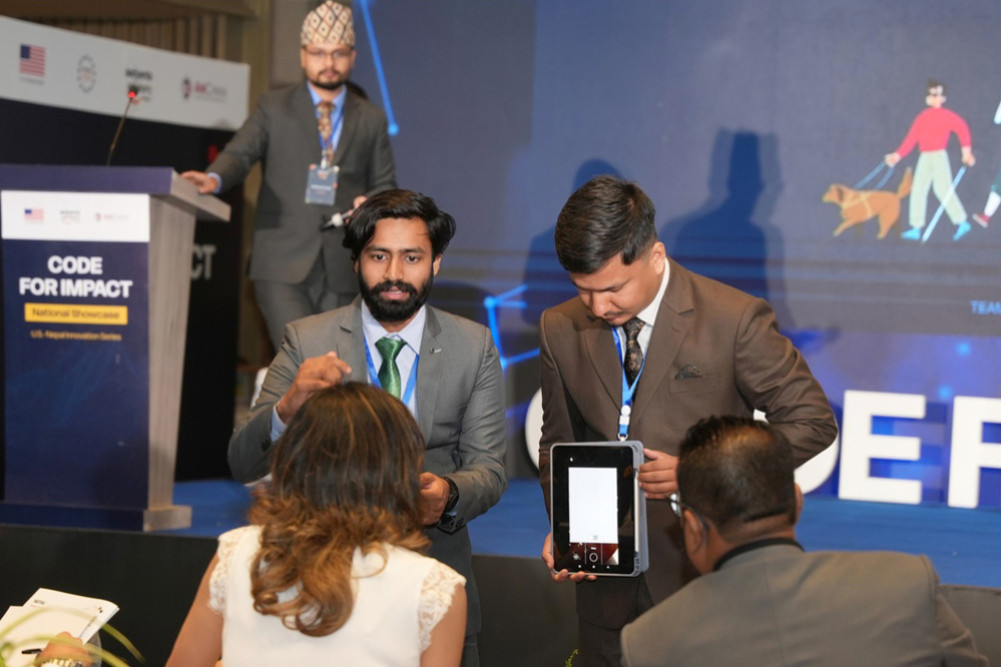
Now, the development of technology is no longer just a matter of concern for big and well-known and multinational companies. The encouraging initiative of ‘startups’ has also been seen in this. Not only countries that have reached the peak of development, but also the youth of countries that suffer from a lack of resources like Nepal have made remarkable progress. In the recently organized ‘Code for Impact’ hackathon, 190 different companies presented ‘startups’ that solve problems through technology in the fields of health, education, tourism and inclusion. The seven companies that were declared the best present the expanding scope of startups in the technology sector.
‘Startup’ is usually the stage of using ‘ideas’. There are risks and opportunities in it. If the government facilitates, the possibility of risks is reduced and opportunities are increased. Therefore, arrangements should be made to easily get loans based on the uniqueness of ‘ideas’. ‘Aashirvad Care’ has launched a service to provide treatment and care facilities to senior citizens who are getting old and suffering from health problems at their homes. Similarly, ‘Access Code’ group has developed ‘NepAI’ technology to convert Braille into digital characters or Unicode so that everyone can read it. ‘Data Hiti’ has developed the concept of the ‘Elytra’ app with the aim of facilitating cross-border transactions. ‘CAD Coder’ has developed a platform called ‘Dose’.
This startup works to connect patients, doctors, hospitals and drug stores in a single network. In the tourism sector, ‘Neptu’ is helping tourists find new and overlooked destinations through AI. ‘Synoptic’ has created an environment for children with autism or learning disabilities, who have difficulty speaking, to learn vocabulary through augmented reality (AR) technology. The ‘AgriSense’ app, developed by ‘Mithila Coder’ of Janakpur, guides farmers like an expert from planting seeds to harvesting crops.
If we examine the work of the companies that have been awarded, it is clear that they have worked hard to bring technology and human life closer. Generally, technology development is done targeting large groups and has a profit-oriented objective. However, if we look at the seven startups mentioned, the target group seems narrow. However, it can be very meaningful for the relevant target group.
For example, there are more than 145,000 visually impaired people in Nepal. They have difficulty in doing regular work and accessing employment opportunities. However, with the technology to convert Braille into digital characters or Unicode that can be read by everyone, not only will regular work be easier, but employment opportunities will also be wider. It is estimated that about 300,000 children in Nepal are affected by autism. The technology developed by 'Synoptic' will contribute to their learning. Similarly, the technology developed by 'Mithila Coder' will help farmers solve the problems they face due to the lack of experts.
The experience of the coming days will have to be examined to clarify the extent to which the developed technology will provide relief to the target group. But the aforementioned startups do highlight the ability to identify the problems of a specific group and help find solutions to them through technology. Such references show that the ability of Nepali youth in the field of technology is unique and competitive. For that, the government and the concerned bodies should facilitate their capabilities to be ‘exposed’, to make them more competitive, to make the developed technologies user-friendly and to connect the technology to the lives of the common man. Looking at the examples of many countries in the world, ‘startups’ that have solved local problems and developed ‘solutions’ that can be used locally have become commercially successful and have become ‘unicorns’. In our country too, startups like Khalti and eSewa have now emerged as successful companies.
In a situation like Nepal where there is a large rural workforce and the problems are diverse, the government, educational institutions, and the private sector all have a special role to play in identifying common problems and developing technologies that facilitate their solutions. Not much work has been done in the concept of venture capital, angel investment, and incubation centers to invest in startups. Even though the government has promised to support startups in the annual budget for a decade, the expected success has not been achieved. The Industrial Business Foundation has been criticized for giving loans to ordinary coffee shop businesses in the name of startups.
There are some things that the government should do. For example, facilitating access to capital and investment for startups, developing infrastructure, and making the law ‘startup’ friendly. In the policy and program for the current fiscal year 2082/83, the government has stated that it will create a ‘Startup Nepal Portal’ and provide services such as company registration, tax exemption, seed capital, etc. in a single day. Finance Minister Swarnim Wagle had also said in the budget statement that a minimum of 1 percent of the capital expenditure has been allocated for science and technology research and innovation. Like in previous years, we should be careful not to waste this commitment.
‘Startup’ is often the stage of using ‘ideas’. There are risks and opportunities in it. If the government facilitates, the possibility of risks is reduced and opportunities are increased. Therefore, arrangements should be made to easily obtain loans based on the uniqueness of the ‘idea’. Similarly, the government should prioritize the work of building IT parks with high-speed internet and continuous electricity in terms of infrastructure. The government itself should increase investment in technology-focused universities or educational institutions.
If a situation can be created where students can test their small ‘ideas’ in such facility-focused educational institutions, their ‘ideas’ will flourish further over time. The private sector should also increase investment in technology. Especially, successful industrialists of the older generation should understand the changes in the times and increase their presence in the technology sector and in the process, they should connect startups. Banks and financial institutions should also start the practice of providing loans after analyzing ‘ideas’.