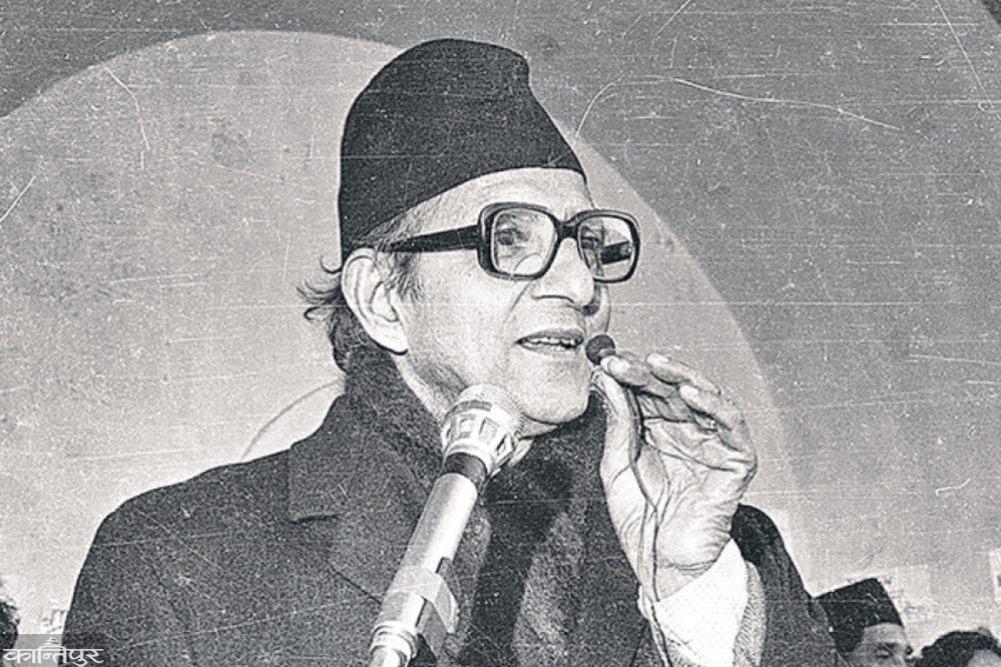
The true blueprint for the freedom, rebellion, and identity that today's generation is searching for can be found in the thoughts and lifestyle of BP Koirala.
We use Google Cloud Translation Services. Google requires we provide the following disclaimer relating to use of this service:
This service may contain translations powered by Google. Google disclaims all warranties related to the translations, expressed or implied, including any warranties of accuracy, reliability, and any implied warranties of merchantability, fitness for a particular purpose, and noninfringement.
Every year on 6th of Shrawan, we remember BP Koirala. We discuss his political contribution, democratic socialism and literary heights. However, today, in 2083 (2026), while this discussion is going on in Nepal, a serious question arises, ‘Is BP relevant to today’s new generation, i.e. ‘Gen-G’? How much do BP’s speeches and old speeches touch today’s generation, which is running at the speed of the internet, watching the world in 15 seconds of Reel and TikTok, and is looking for an alternative by saying ‘No Not Again’, tired of the chaos of the country?
From the outside, it may seem that there is no connection between Gen-G and BP. However, if we look deeper, the real blueprint for the freedom, rebellion and identity that today’s generation is searching for is found in BP Koirala’s thoughts and lifestyle.
Rebellion and the courage to question
Gen-G's 'Attitude' and BP's Nature Today's Gen-G is dissatisfied with the established structure, archaic thinking and the political syndicate of the 'grandparents generation'. They question, challenge the established narrative. BP Koirala was the biggest rebel of his time. In the world of Rana rule, blowing the trumpet of democracy, not bowing down to the king's autocracy and being able to have different opinions even within his own party were his rebellious instincts. BP had already practiced the political and ideological form of 'disruption' that today's generation does on social media. BP used to say, 'Make your own decisions.' Today's generation is also not ready to bear anyone's burden, it wants to walk its own path.
Alternative to 'crony capitalism': democratic socialism
Today's young generation is suffering from extreme consumerism and economic inequality. On the one hand, there is a lack of employment, on the other hand, the concentration of resources and means in the hands of a few limited people. The essence of 'democratic socialism' that BP put forward decades ago is connected here. BP had said, 'When planning Nepal, remember the face of the farmer who plows the plow.' In today's language, that means 'inclusive development' and social justice. The good governance, equal opportunities for all, and the foundation of a welfare state sought by Gen-G are BP's socialism.
BP's style and openness
Gen-G likes 'aesthetics' and 'vibe'. BP Koirala was not just a leader, he was the most 'total' and modern-minded personality of his time. His 'cowboy hat' style and deep study of world literature made him a 'global citizen'. He was not dogmatic in his views, he was 'open-minded'. If today's generation were to read the literature he wrote on the subject of sex, psychology and human existence, they would be amazed. Whether it was 'Teen Ghumti' or 'Narendradai's' psychology - BP tore down the barriers of society at that time, which is what today's generation is doing through social media and art.
Nationalism and Global Outlook
Gen-G's 'Attitude' and BP's Nature Today's Gen-G is dissatisfied with the established structure, archaic thinking and the political syndicate of the 'grandfather generation'. They question, challenge the established narrative. BP Koirala was the biggest rebel of his time. Today's Nepali youth are global. They are updated with trends from around the world, but there is also a concern that they will lose their identity at some point. BP Koirala's definition of nationality was not limited to geography. The way he firmly upheld Nepal's sovereignty on international forums (such as the United Nations) is a matter of pride for today's generation. BP's stance that balanced and respectful relations with neighboring countries should be maintained is even more relevant in today's geopolitical situation.
Where is the challenge?
The problem is not in BP's ideas, but in those who do politics by selling BP's name. The tendency to garland BP's picture but throw his ideas in the dustbin has distanced the new generation from the Congress and the entire old party. It is not that Gen-G did not try to recognize BP, it is that they did not like the pretense of those who claim to be 'BP's followers'. BP has left behind many ideas, policies and principles for Nepal and Nepalis, which policies are still equally relevant today. If those policies can be implemented now, the country can be transformed. However, BP's ideas may seem irrelevant to those who refer to the Blue Revolution because he is associated with the Congress. However, the concept of Nepali society and socialism envisioned by BP will remain alive for ages.
Today's Gen-G should not just see BP as a picture of a closed room or a chapter in a history book. BP is an 'idea'. The idea of freedom, the idea of the rule of law and the idea of uplifting the oppressed classes of society. On BP's birth anniversary on 6th of Shrawan, it is necessary to 're-brand' BP's rebellious spirit, modernity and socialism in the language of today's digital age instead of just reciting old memoirs. Only if the energy of Gen-G and BP's vision are combined, will the country take the right direction.
Freedom is very dear to every person or human being. No matter how much you feed and nurture a caged bird, its desire is to fly freely in the sky. That is why BP's statement that 'Man lives not on bread, but on brains', which he had been saying since then until his death, is equally relevant today. The fight for freedom, which has been fought for many times, including torture, imprisonment, and even death, has reached today's democratic republic. However, the current government, which does not understand the struggle for democracy and the essence of the democratic system, is trying to kick the concept of democratic socialism for economic and fundamental rights. Such behavior cannot create the society envisioned by BP for Gen-G.
In fact, the democratic socialism envisioned by BP does not accept any kind of dictatorship and authoritarian rule. BP was clear that such a regime cannot respect the basic rights of the people and make people happy. His thinking, analysis and perspective are becoming more and more relevant in today's world led by science and information technology. Therefore, democratic socialism seems to be the best path for the modern society embraced by the new generation. In such a situation, no power can use the unimaginable changes that have come in the field of science and technology by creating algorithms to suit itself. Since the authoritarian, despotic, one-party dictatorship system in the world has completely failed and become irrelevant, the ruthless attempt to push people to the brink of death by using the rod of law and fines is certain to prove unsuccessful.
Ganesh Nepali and today's society
Ganesh Nepali of Mugu died while attempting self-immolation. Nepali society is shaken after his death. And, the cause of death is being analyzed from various angles. Did he choose the path of self-immolation out of impulse or is it the result of the power grab imposed on innocent citizens by the ruling class? This issue has divided society. At such a time, a statement by the great Indian leader Mahatma Gandhi, whom BP considered as an ideal, is very interesting, ‘The morality and competence of any society is measured by the way it treats the marginalized and the helpless.’ These words clearly illustrate the politics of power, strength and madness.
Along with Ganesh, the self-immolation attempts of 45-year-old Ashwin Raut of Kathmandu Buddhanagar and 35-year-old Vivek Mandal of Sarlahi Godaita Municipality have further deepened the gap of mistrust between those in power and the citizens. The mistrust and sarcasm towards the old authorities have been directed towards the new authorities. The series of self-immolations has laid the foundations for saying that the series of self-immolations is the result of the power grab imposed on innocent citizens by the ruling class.
While the Balen government's 100-day brutal review is underway, a series of incidents have also exposed the insensitive activities of the government and the ruling class. Not only that, as BP said, 'The foundation of the nation will not be strong until some section of society experiences injustice' has come true here. The structures and mechanisms of the state should create an environment where individuals can live with dignity. For that, making a collective resolution and vowing to realize the dreams of the Gen-G generation would be a true tribute to BP.