It is unfortunate that the government is trying to stall the publication of the National Human Rights Commission's report and bring the perpetrators to justice.
We use Google Cloud Translation Services. Google requires we provide the following disclaimer relating to use of this service:
This service may contain translations powered by Google. Google disclaims all warranties related to the translations, expressed or implied, including any warranties of accuracy, reliability, and any implied warranties of merchantability, fitness for a particular purpose, and noninfringement.
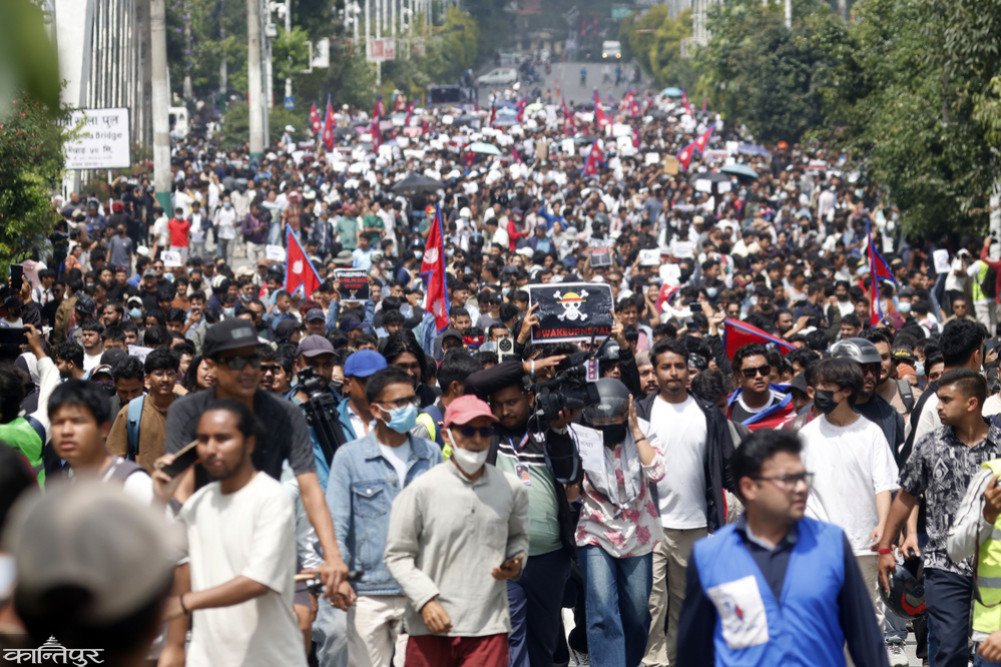
A government committed to meaningful democracy and good governance must necessarily be human rights-friendly. The high level of codified human rights is also a measure of the democratic civilization of that country. How can any powerful government that makes any excuses or suppresses human rights fall? A vivid example of this is the behavior of the then government on Bhadra 23 and 24 last year, the unpleasant reactions that arose from it, and the dangerous situation that arose are fresh in front of everyone. On Bhadra 22 last year, the then government arbitrarily misused the Social Media Usage Guidelines 2080 and completely banned 26 social media platforms that were running in a direct attack on the freedom of thought and expression granted by the Constitution, and the resulting dissatisfaction among the people. The country has been trapped in a complex and difficult situation. The bill to bring social media under a clear legal framework has been left pending in Parliament and the situation has taken an unimaginable form when attempts were made to level the issue with the guidelines.
On 23 Bhadra, 19 people died on the spot and 23 more died in hospital when security personnel opened fire on them during an attempt to surround the parliament building. A total of 42 people, including 5 more in Sunsari and Jhapa, died. Three Nepal Police ASI Milan Rai, Havaldar Amrit Gurung and police constable Uttam Thapa, who were deployed on duty, were brutally murdered in the anger of the protesters. Government weapons were looted, prisoners were taken away from prison, and Singha Durbar, the Supreme Court, the parliament building, important government buildings, industrial and commercial establishments, private houses, properties and vehicles were looted, arson and vandalized, causing property worth more than one trillion rupees to be damaged.
It is a sad fact that the government is trying to stall the publication of the National Human Rights Commission report and bring the guilty to justice. The government should not make public the report with suggestions prepared by the investigation committee formed under the coordination of Honorable Member Lily Thapa on behalf of the National Human Rights Commission after a detailed study of those incidents and the loss of life and property, and should not try to bring the guilty to judicial investigation and the law. The report, published on June 13, is a serious attack on democracy, transparency and accountability by the current government, which has reached the 'burning Singha Durbar' (power) on the foundation of the same movement, from the blood of human deaths to the rubble and ashes of property damage. Such a step to hide the silenced voices of citizens and the weaknesses of the state is grossly undemocratic. No matter how much we oppose such a coercive action that stifles the right to information and protects the guilty, it will be of little use.
Former Chairman and former Chief Justice of the National Human Rights Commission Kedarnath Upadhyay, former members Mohana Ansari, Sushil Pyakurel, Professor Kapil Shrestha, Gauri Pradhan, Dr. Gauri Shankarlal Das and former Secretary Kedar Poudel have met and pressured the Commission Chairman Tap Bahadur Magar to make the full text of the report public. It is the mandatory responsibility of the state to immediately make the full report public to protect the justice and rights of the citizens. The government should not take the perspective of cost, benefit and loss of anyone while implementing the legal provisions of the basic human rights of the citizens. Let us not forget the fact that the level of our National Human Rights Commission has declined due to the wrong actions of the government in the past.
The reality is clear from the standard of government sensitivity towards human rights in Nepal, the level of government impartiality or rabbiya towards the incidents of Bhadra 23 and 24 last year. While the entire Nepali people want an investigation into the Bhadra 24 incident, the current government, adopting the Gen-G movement, sometimes seems to think that only the incident of 23 should be investigated and action should be taken. However, such a unilateral and biased request for action is not justified and acceptable in any sense.
Human rights and issues directly related to it fall under global jurisdiction. Therefore, if a question is raised by one country about human rights within another country, it is not called interference in internal affairs. In today's world, it has become ubiquitous that a human rights violator or a criminal of one country involved in crimes against humanity cannot be a guest of another country. Meenakshi Ganguly, South Asia director of the international human rights organization Human Rights Watch, rightly said, “Until the transitional justice process meets basic standards for prosecuting the accused in Nepal’s judicial system, such rights violators cannot be immune from being tried in other countries as international crimes under universal jurisdiction.”
Sensitive and long-standing issues such as transitional justice, religious conversion, gender-based violence, women’s and children’s rights, the rights of persons with disabilities, the rights of Dalits and indigenous peoples, intersectional discrimination, access to justice, and citizenship through mother’s name are always a priority. These issues are deeply related to the protection and promotion of human rights.
Today, there are 10 international human rights treaties and resolutions in force in the world – the Universal Declaration of Human Rights, unanimously adopted by the United Nations in 1948, the Declaration on Civil and Political Rights, the Declaration on Economic, Social, and Cultural Rights, Convention against Torture, Convention against Genocide, Geneva Convention, Convention on the Rights of the Child, Convention on the Elimination of All Forms of Discrimination against Women and the United Nations Charter. Nepal is a signatory to all these treaties. Being a signatory to the conventions of international organizations means having the necessary institutional structure and commitment in national laws for the unwavering implementation of the convention and behaving accordingly.
It is ridiculous to seek human rights with a lawless and anarchic mentality instead of having the tendency to properly utilize human rights in accordance with the law. Human rights increase responsibility in citizens and do not allow them to be loose. Singing or listening to music loudly is a human right, but to the extent that it disturbs neighbors with loud noise, it cannot be called your only human right. To that extent, it is not a human right, but a human duty. Rights without duties can be terrifying. Rights without duties can also be a source of chaos. Democracy remains enriched and meaningful only if human rights are properly utilized.
The government's comfortable mandate of almost two-thirds parliamentary majority does not mean that it has been given a license to do whatever it wants while in power. The lack of legal guarantees and institutional structures to protect and promote human rights in Nepal has not weakened the status of human rights. As a permanent source of human rights, we have specific laws such as the Constitution of Nepal (Part 3 of the Constitution guarantees 31 fundamental rights), the National Human Rights Commission Act-2068, the Anti-Untouchability and Discrimination Act, the Human Trafficking and Smuggling (Control) Act, the Domestic Violence (Control and Punishment) Act, and the Child Rights Act. The main administrative body for formulating and implementing the national action plan on human rights is the government, the Office of the Prime Minister and the Council of Ministers.
The status of the National Human Rights Commission, its reports or documents as provided by the constitution, cannot be the same as other commissions and their reports or documents formed by the government according to its needs, convenience and decisions. Therefore, the acceptability or acceptability of the report of the National Human Rights Commission and the report given by the Gauri Bahadur Karki Commission is different from the report of the National Human Rights Commission.
The National Human Rights Commission, including the Law, Justice and Human Rights Committee of the Parliament, the Truth and Reconciliation Commission, the Commission for Investigation of Enforced Disappeared Persons, the National Human Rights Commission, constitutional commissions, the Women's Commission, the Dalit Commission, the National Inclusion Commission, the Indigenous Nationalities Commission and the Madhesi Commission, and other constitutional bodies related to human rights work to protect the rights and human rights of the relevant classes.
Why does the human rights situation in Nepal become weak and sometimes controversial? Nepal's transitional justice law has failed to meet international human rights standards. The government must introspect for its objective conclusions. While introspecting, one may recall the famous cartoonist Pogo's dialogue, 'We have found our enemy, and it is us.'
If the government also wants to eliminate the signs and signals of turning away from the judicial path of punishment by looking at the crime and adopting the path of punishment (impunity) and retaliation by looking at the person, it should immediately make the report of the National Human Rights Commission public and start the process of action accordingly. This is seen as a test of the government's judicial test by all national and international stakeholders. If the government has any disagreement, it should have made its disagreement public.
The fact that the government has received a convenient mandate of almost two-thirds of the parliamentary majority does not mean that it has been given a license to do whatever it wants while in power. Doing only what you like and what benefits you is not an indicator of the legitimacy and relevance of the ruling party. No matter how much dishonesty and deceit you do on such serious issues, the future will definitely dig it up.