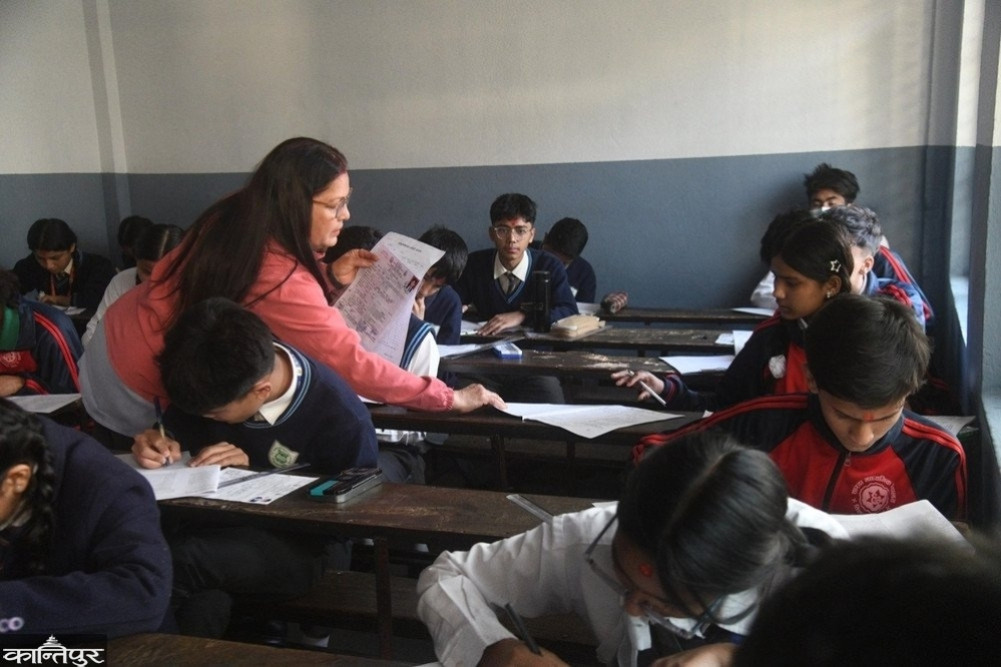
What knowledge and skills will be needed in the future due to technology? Uncertainty has increased. In this regard, students should now be taught - how to continuously change? How to continuously learn? The upcoming curriculum should address these topics.
We use Google Cloud Translation Services. Google requires we provide the following disclaimer relating to use of this service:
This service may contain translations powered by Google. Google disclaims all warranties related to the translations, expressed or implied, including any warranties of accuracy, reliability, and any implied warranties of merchantability, fitness for a particular purpose, and noninfringement.
‘Our curriculum is not up to date’
‘The curriculum is not suitable for the country and the soil’
‘If we want to improve education, the first thing we need to do is change the curriculum’
‘Textbooks are inappropriate, they are dirty, they need to be changed’
There are many such popular sayings – of politicians, educationists, education experts, activists or teachers. Many teachers do not know the difference between textbooks and curricula. This is also the slogan that is used with every new education minister and new government. But, unfortunately – the curriculum is changed without implementation.
The curriculum is not the main obstacle to our education not being good for a decade or two. The system of delivering learning through textbooks to students is problematic. In that sense, the main problem is that the curriculum is not suitable. It is possible to accept that some complications will improve in the future, but accepting this reality in the curriculum to be created now should be the starting point for curriculum revision. The source of the education problem is not only within the Ministry of Education or the education sector.
At present, the school curriculum format development task force, which was reconstituted after the formation of the previous interim government, is in the initial stages of work. The task force has an ambitious plan to develop a curriculum with broad public participation in the format that was traditionally made with limited consultation as a 'technical subject'.
The examination system is generally seen as a part of the curriculum. It also guides teaching and learning. So far, the reform of the examination system has been limited to changing the scoring method. What is really needed is a reformative assessment system that promotes creativity with diversity and memorization in the examination. For this, the written exam based on memorization at the end of the class needs to be changed. Our education system is still enjoying the colonial power of practicing the rigors of examinations and their frills. Even just by changing the questions, education can be taken beyond the practice of cheating and cheating.
Instead of reading someone's biography and asking about the facts of the biography, if you look at the class and ask who might have a biography that matches it or how much of that biography you can match, the issue of cheating or cheating will disappear. Such exams can be written without all being written, and can be oral, including individual homework, group work, 'closed book' and some 'open book'. This alone will transform our education system in many ways.
What and how many subjects should be included? Another priority is the issue. There is an idea of how many subjects there are, and how many are 'needed' to create a globally competitive workforce. Which subjects are necessary in terms of the needs of the country and society? That should be taken into account. As society becomes more complex, it is natural for subjects to be added. The main thing is that it is not necessary to take exams on all subjects. The main point is that many additional optional subjects can be included, which if passed will be good and arrangements should be made not to fail. English language and mathematics can also be included in such subjects. After the basic level, we can go to the credit system.
How many subjects should be reviewed for consistency? Especially how many abstract subjects are kept in small classes. They need to be moved to the back. At least until the basic level is passed, it is necessary to provide basic knowledge of science and the skills necessary for simple living. This includes subjects from producing food for oneself to keeping family accounts. School level should be considered as a period of learning skills and gaining enthusiasm for further education rather than producing and earning.
Our curriculum should include subjects that are not or are not emphasized. One of the main aspects of this is the emphasis on painting. Our students who have reached a high level in science do not even know how to draw a human figure or a table. Children who have not been to rural areas are unaware of songs and music. Song and music literacy is essential in our school education.
Another aspect that needs to be added is self-care and maintenance. There is also a huge gender inequality in this. This should be brought into the scope of learning and evaluation. Another aspect that is completely absent in our education is volunteering and donation. This topic is also related to savings. This aspect must be included.
The subject that our curriculum does not cover is the self-acquired, cultural and family prior knowledge of the students. This should also be included in the evaluation system. Expanding on this, their involvement in productive work should also be included. We must remember – how did we change the productive youth of the previous generation into consumers? Involvement in such a production system promotes self-reliance and entrepreneurship in students.
In addition to the number of subjects to be included in the curriculum, there are many dilemmas about whether to include this or that perspective. Basically, the main question is whether we should make our products competitive in the so-called global market or whether they should be in line with local needs. Of course, there is no clear answer to this and a balance is necessary. However, if we try to strengthen the roots, there will be plenty of branches and flowers, branches and flowers cannot help much in forming roots. One approach would be to make the world competitive to earn money immediately. However, if we want to remain a self-reliant and independent society in the long run, we should emphasize on producing manpower rooted in the locality.
Another dilemma is whether to include religious or moral or value education subjects. We know that despite being a Hindu state, our schools do not take students to Pashupatinath or Guhyeshwari, while in practice secular industrial countries teach students from a young age what they should and should not do when going to church. Here, they are taught to insist that ‘I belong to this religion’, but the schools do not teach its basic values. How is the religion practiced in your own or your neighborhood implemented? It is necessary to know that.
Moral or human values education does not mean much - for two reasons: First, many things that should or should not be done are included in the law now, and following those laws as much as possible is enough. Second, moral education is not something that can be taught by teaching - it is something that can be learned by following. Parents and teachers at home should present themselves as role models and teach this. Rather, it would be more relevant to have an environmental subject that teaches basic skills in producing food, or a critical study of traditional technology or history may be important.
When talking about traditional technology, the topic of electronic technology comes to the fore. Aspects ranging from communication skills to coding come to the fore. There is a need for knowledge, but the use of artificial intelligence has also killed creativity and has even caused problems in mental health. Its balanced use and teaching are the subject of study.
Due to technology, there has been an increase in uncertainty about what kind of knowledge and skills will be required in the future. From this perspective, students should be taught - how to continuously change? How to continuously learn? To remain oriented to the needs? The upcoming curriculum should address the issue of preparing such skills and attitudes.