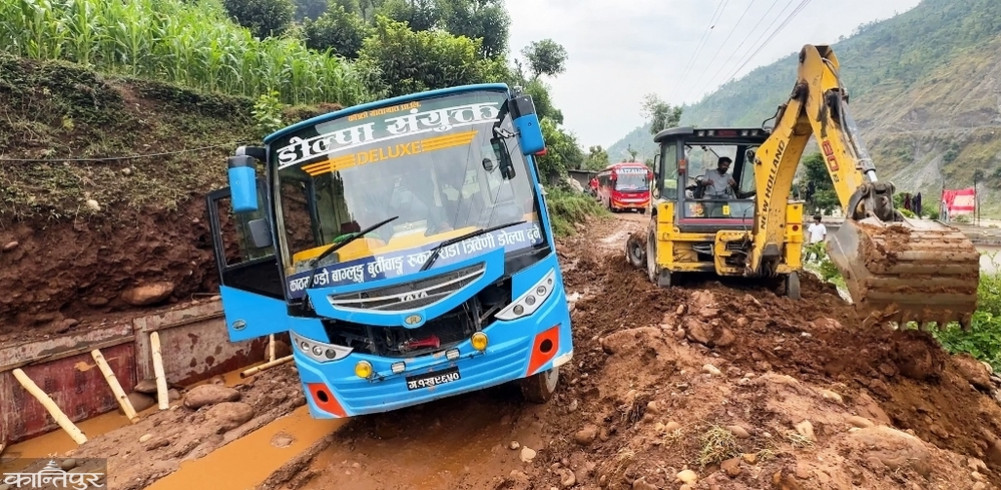
Drivers should not be encouraged or pressured to take risks during the journey. Drivers should also not take unnecessary risks and cause accidents.
We use Google Cloud Translation Services. Google requires we provide the following disclaimer relating to use of this service:
This service may contain translations powered by Google. Google disclaims all warranties related to the translations, expressed or implied, including any warranties of accuracy, reliability, and any implied warranties of merchantability, fitness for a particular purpose, and noninfringement.
With the onset of the rainy season, the fear of road accidents arises. During heavy or continuous rains, landslides or road washes away, so travelers are worried about whether their journey will be completed or not. Many people who travel long or short in Nepal choose or are forced to travel by road. However, it is not completely safe.
At present, the risk of landslides has been assessed on various sections of 80 highways across the country. Therefore, the risk of vehicular movement is being affected or will increase. Measures should be found to make travel safer by considering past accidents and the current road conditions. For this, the vigilance, interest and initiative of passengers, drivers and government administration are essential.
Landslides are occurring daily in Tuinkhola on the Narayangadh-Muglin road section. The risk of landslides always increases during the monsoon season on various sections of the Kanti Highway, BP Highway, Nagdhunga-Muglin Road, Koshi, Karnali, Kaligandaki Corridor, Sanfe-Martadi Road, Bhalubang-Pyuthan Road, Surkhet-Nepalgunj Road, Mechi Highway, Narayangadh-Muglin Road, Galchhi-Trishuli-Syafrubensi-Rasuwagadhi Road. Most of the roads in Nepal are built by scraping river banks and safety standards are not fully met, which increases the risk of accidents. On the one hand, the quality of the roads themselves is deteriorating, on the other hand, human efforts to make the roads in use safe are also not strong. Due to this, road accidents are a regular occurrence for Nepal. They increase even more during the monsoon season.
The government should also prioritize the work of building safe holding centers for vehicles in places. Holding centers should be built in places where vehicles can be safely parked, especially in the event of heavy rain, landslides, and road washouts.
At this time, the government should do something by keeping the road sections that have landslides or are assessed as at risk of falling into a special center. Arrangements should be made for passengers to easily know the condition of any road section. The government is responsible for publishing information on mobile SMS, social media, and websites and making citizens accustomed to following it. Similarly, travel should be banned on risky road sections as long as the risk persists. Equipment and manpower should be mobilized to be able to remove landslides immediately if they occur. In fact, 155 pieces of equipment have been mobilized on various sections of highways across the country to remove landslides since the onset of the monsoon. An additional 122 pieces of equipment have been deployed. This is a positive aspect. Its effectiveness should be seen in the coordinated deployment of equipment. There are some main factors in road accidents - road structure, bad weather conditions, and the condition of drivers and vehicles. The condition of roads is found to be pathetic in hilly and mountainous regions. During the rainy season, the condition of such roads becomes even more risky. In mountainous terrain, there is a possibility of landslides and road blockages or vehicles falling into them. The lack of a system to provide adequate information about the condition of the road, the inability to completely ban travel in risky areas, drivers and passengers trying to travel at their own risk, and the inability to immediately repair the road if it deteriorates have increased the risk. Nepal's difficult geographical conditions have also created obstacles to some work. There are also administrative and technical weaknesses.
The government should also prioritize the work of building safe holding centers for vehicles at various places. Holding centers should be built at various places so that vehicles can be safely parked, especially in the event of heavy rains, landslides, and road washouts. In Asoj 2008, 35 people died when a landslide buried a microbus and a passenger bus parked in the Jhaple River along the Nagdhunga-Naubise road. Vehicles had stopped there, thinking it was safe, after the landslide started to occur along with the heavy rain, but the landslide occurred right there. Many passengers traveling through that road section had also appealed for rescue at that time. If there had been a safe holding center around that area, so much damage could not have been done. The government should learn lessons from such incidents and adopt safety strategies.
Accidents and deaths may be just news or statistics for others, but they are everything for the passengers and their families. Therefore, the role of passengers is also essential to avoid risks. To ensure that their journey is smooth and safe, passengers should get sufficient information about the condition of the road they are traveling on. It is wise to get information about landslides, risks of landslides, or road blockages and travel after assessing the situation. Drivers should not be encouraged or pressured to take risks during the journey. Drivers should also not take unnecessary risks and cause accidents. If all parties are responsible, the chances of accidents are low.