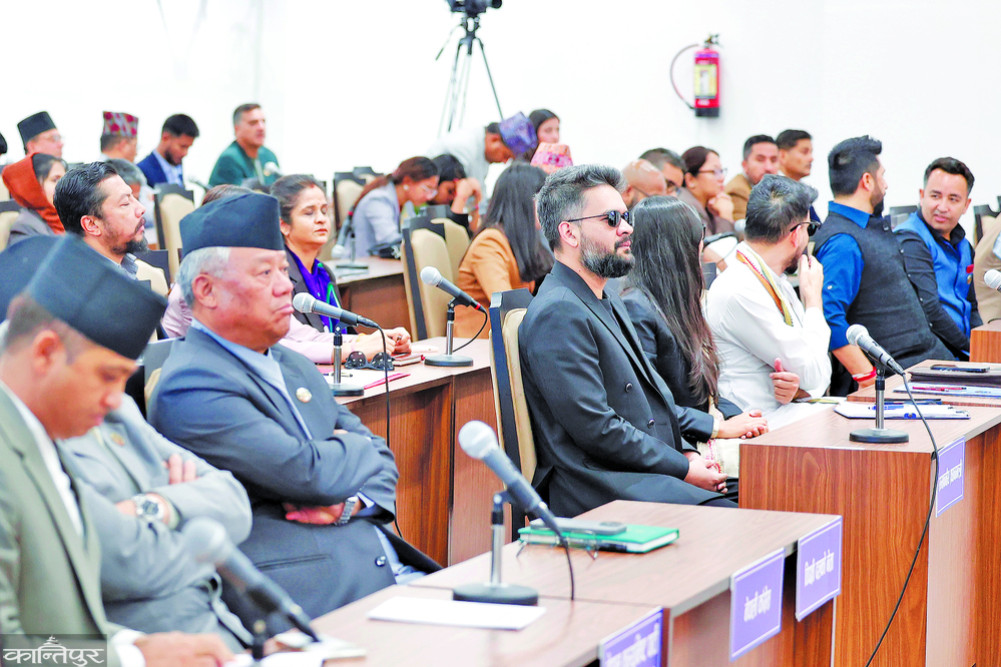
The Balendra government's haste is understandable - to develop the country quickly and win the hearts of the people by doing more than they have done before. But the signs are not looking very encouraging.
We use Google Cloud Translation Services. Google requires we provide the following disclaimer relating to use of this service:
This service may contain translations powered by Google. Google disclaims all warranties related to the translations, expressed or implied, including any warranties of accuracy, reliability, and any implied warranties of merchantability, fitness for a particular purpose, and noninfringement.
Nepal's parliamentary practice seems strange. Even in the non-party Panchayat system, the Prime Minister used to answer questions raised after the King's address. Therefore, no system arose from air, water, and soil because the forms of all those systems are similar. Moreover, the basic values and practices of democracy are the same all over the world (universal). Even though the practices of democracy are taken from the West, those values automatically become indigenous. The use of the parliamentary system started in Britain and all Asian-African countries have imitated it.
In the parliamentary system, the Prime Minister is elected by the Parliament. Therefore, the Prime Minister and the Parliament complement each other. But ironically, today, managerial chaos is seen in the character of Nepal's political system. Because the Prime Minister has always evaded the Parliament but has embarked on a new style of running the government. Even in the directly elected presidential system (America), the President is always coming into contact with the Congress, no matter how bitter or sweet it may be. The current President Donald Trump is seen talking to the media more and more actively. Although his activism seems to be more than necessary, he is adept at informing the public in a democracy.
Prime Ministers or ministers before Balendra used to waste more time on inaugurations and speeches. He is far from this. This is also good. He seems to be working from morning to evening, but the results are below expectations. As a byproduct of the Gen-G rebellion, the country today has a government led by Balendra Shah. This government has gained legitimacy because it was elected through a democratic system. Since it has a strong majority in parliament, its role can be more effective than that of previous governments. The government's priorities, style, and process maintain its people-oriented base. But in the prime ministerial parliamentary system, in every meeting of the House of Representatives, the leader of the main opposition party criticizes the Prime Minister and parliamentary practices, saying that this parliament has not recognized the Prime Minister and is not even trying to recognize him.
Sometimes the RSVP chairman steps forward to speak on behalf of the Prime Minister, sometimes another minister. While President Ram Chandra Poudel was reading the policies and programs of his government handed over by Balendra Shah himself, he left the House in the middle. He did not even go to greet the President. There has been no explanation for such an indecent demonstration so far. There has been no response from the Rashtrapati Bhavan.
Prime Ministers or ministers before Balendra used to waste more time on inaugurations and speeches. He is far from this. This is good. He seems to be working from morning to evening, but the results are below expectations. The government's success in the 100-day assessment is only average. There is a big gap between the media's figures and the government's claims. Those in the government show even very small works in the figures. Although agriculture, water resources and tourism play a major role in Nepal's economic development, there has been no significant progress in agriculture and the agricultural sector. The tradition of farmers suffering from lack of fertilizer every year has not changed yet.
No government is seen working on the infrastructure development of the area frequented by Indian tourists. The tourism sector has not been helped by running Pokhara and Bhairahawa international airports. Lumbini has increased the importance of Bhairahawa, but no government has been able to show the ability to resolve the problem of not being able to operate international flights.
There is a high possibility that India will build a similar airport in Kushinagar across the border or that the environment will divert religious tourists from Bodh Gaya, Sarnath and Kushinagar and return them to India.
Since Nepal has a great importance in tourism, the concerned minister has more responsibility for its development. But he must have the enthusiasm, confidence and vision to lead. Only by developing the ability to mobilize the bureaucracy by mobilizing means and resources for development can energy be brought to leadership. It is not that all these works should be done in the first 100 days of the government, but it requires diplomatic ingenuity and strategy. The Balendra government's haste is understandable - to develop the country quickly and win the hearts of the people by doing more work than before. But the signs are not very encouraging.
Shah must first have a minimum understanding of what kind of system leader he is. Democracy is a very complex system and it is different from dictatorship or absolute monarchy. Although dictatorship sometimes helps in rapid economic development, it cannot achieve overall development. Even though South Korea achieved economic development under the leadership of Park Chung-hee, the people had to struggle and sacrifice for democracy. If we think that Nepal should do the same by showing the example of Singapore, we will take a different direction. The development of Singapore was due to the thinking of three or four leaders there, the political environment, etc. Since Singapore is a small city-state and the process of building a political culture there is different, its development story is different. It cannot be compared to Nepal.
There are many countries that have developed rapidly in democracy. It should be noted that many countries in the United States and Europe have developed under liberal democracy. In Nepal, King Mahendra had said in 2017 that what others could not do in 100 years by taking power by military force would be done in 10 years. The non-party Panchayat system and his active and 'mighty' leadership were made the means of development. The same Mahendra understood that this was not possible and said that the next decade would be development-oriented after 10 years. Although some economic infrastructure was built, there was no significant development in the economic condition of the Nepali people. Although it was said to be a system without alternatives, in the end the people not only threw away the system, but also ended the monarchy that was said to be entrenched.
Nowadays, there are those who argue that the current parliamentary system will only increase instability and that a direct executive is needed in the name of stability. The ruling party also seems to be in a similar dilemma. Nepali leaders and intellectuals also draw conclusions without deep study and thought and later regret it. It is found that such practices have been carried out in matters ranging from the system to the policy level. They start looking for a model for a new system saying that there is political instability. Sometimes it seems that a Nepali proverb, ‘putting medicine for a headache on a pillow’, has come true. Nowadays, there are those who argue that the current parliamentary system will only increase instability and that a direct executive is needed in the name of stability. The ruling party also seems to be in a similar dilemma. However, not a bit of attention is paid to why its neighbors in South Asia have not embraced such a system and are concluding that they are going for a parliamentary system even if they do. Even in countries like the US, the trend towards presidential authoritarianism is increasing, and everyone who believes in democracy is worried. They are arguing that President Trump’s working style and thinking are not positive for democracy.
Many countries have given examples of directly elected presidential systems being unstable. In Latin American, European and some other Asian and African countries, there are frequent incidents of people overthrowing their rulers due to popular uprisings. The main reason for this is the tendency to create a leader-based system in the name of democracy and the incompetence of the government. The government itself loses credibility due to the weakness of the government's performance or lack of delivery capacity in line with the aspirations of the people. The parliamentary system serves to cushion such anger to a large extent. If you study the debate of the Constituent Assembly of India carefully, you can know its usefulness. It reduces the importance of parliamentary mathematical games by transforming politics into a managerial development process.
The majority obtained by the Rashtriya Swayamsevak Sangh (RSS) proves that there is no managerial fault. The current problem is the weakness of the leaders' commitment to the system, the Prime Minister's working style and distaste for procedural norms. In democracy, essence and process complement each other. When the process is violated by focusing only on performance, the democratic system does not succeed and tends towards dictatorship.
Development and democracy do not collapse only when the government changes. There have been seven prime ministers in Britain in ten years, but the system is the same. All prime ministers have left for reasons within their own party, not due to parliamentary distrust. In an underdeveloped country like Nepal, the possibility of a government falling is more likely due to lack of political culture and opportunistic tendencies.
In a democracy, the responsibility of the one who takes the reins of the government for overall and balanced development is profound. Much depends on the coordinating role he plays. How sensitive the prime minister is to parliamentary dignity, what kind of relationship he has with the opposition, and how much ability he has to coordinate while enjoying interaction - these are the issues that reflect the importance of the parliamentary system. The issue of Walendra's relationship with his own party is also becoming a topic of debate today, and it is being communicated from within and outside his party. On the one hand, there is a Prachanda majority government in parliament, and on the other hand, what is the status of the leader of that government within the party - it is becoming a matter of speculation. If the old game of division within the party continues and the party insists on having so many members on its side, the fate of the Rashtriya Swayamsevak Sangh (RSS) will probably not be different from that of other parties.
The first convention of the Rashtriya Swayamsevak Sangh (RSS) has begun to give the impression that the seeds of such a trend have been sown. In this context, the question of what the status of the president will be is equally important.
In fact, the Rashtriya Swayamsevak Sangh (RSS) is a party built by the initiative and leadership of Ravi Lamichhane. Without him, the party is unlikely to have any dignity. Since the fact that the Chitwan convention gave him the role of president, considering it to be more important, has been mentioned in his party's announcement, speculation has now begun about what the future role of Walendra will be. He joined the Rashtriya Swayamsevak Sangh (RSS) only after being assured of the post of Prime Minister before the elections. He is more interested in maintaining the efficiency and popularity of the post of Prime Minister than building an organization. This is natural, but since he is not in control of the party and has his own style of running the government, the lifespan of this government cannot be determined. In the past, such majority governments have also fallen due to personal reasons. Therefore, if the old political culture is seen, the stability of Walendra cannot be confirmed. But the possibility of the Rashtriya Swayamsevak Sangh (RSS) remaining a major party cannot be ruled out. The alternative to this is the Nepali Congress because the chances of other parties are low in the current context. The energy and thinking ability of the current leadership of the Congress are being seen. The role, style and managerial commitment of the opposition party leader are also likely to increase public confidence in the Congress. There is a high possibility that the RSS will continue to suffer losses due to Walendra's stubbornness. Although Ravi was seen as a mature leader after the parliamentary elections, he has fallen behind in today's context for various reasons.
The nature of the ongoing parliamentary exercise has not been confirmed. It is not possible to say how long such managerial chaos will continue. But even though this causes losses to Walendra, democracy is getting stronger. The opposition, although weak in numbers, is playing a pressure role. As the ability to choose who is good and who is bad among the people has increased, party leaders are forced to be more accountable. But the responsibility lies with the leadership to decide whether to maintain the current bizarre practices in the name of innovation or to take some binding decisions to bring parliamentary practices back to their proper place and complete the five-year term.