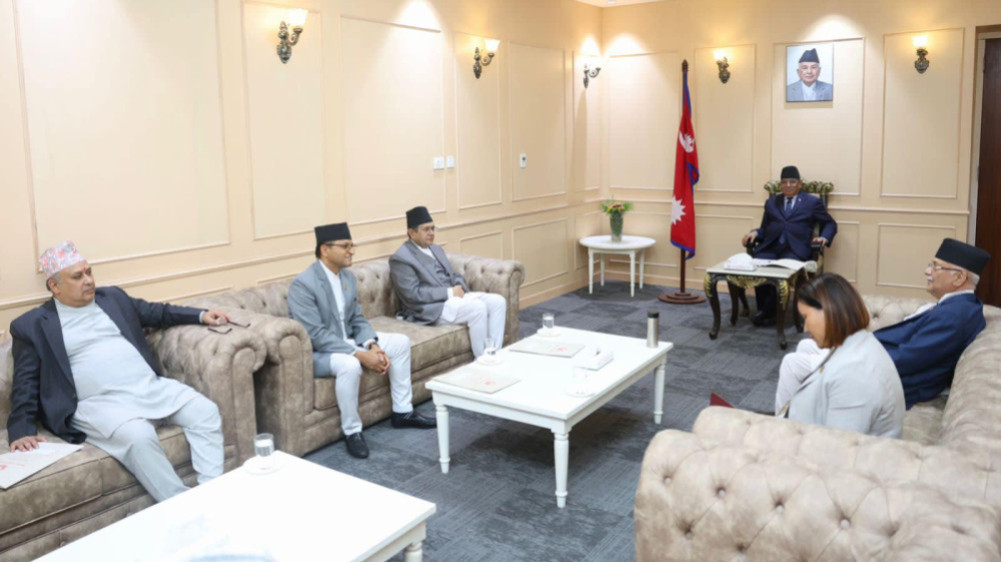
The Constitutional Council has become an invisible power center as the Prime Minister is willing to allocate quotas in appointments with the understanding that the judiciary will not interfere with his decisions when it pleases the Chief Justice, and the Chief Justice's desire to appease the executive and get his relatives appointed has increased.
We use Google Cloud Translation Services. Google requires we provide the following disclaimer relating to use of this service:
This service may contain translations powered by Google. Google disclaims all warranties related to the translations, expressed or implied, including any warranties of accuracy, reliability, and any implied warranties of merchantability, fitness for a particular purpose, and noninfringement.
The Constitution of Nepal has mentioned the objective of making the judiciary independent, competent and effective in the preamble of the constitution. In addition, various provisions have been made in various articles of the constitution to make the judiciary independent.
Looking at the constitutional development process alone, several arrangements have been made to make the judiciary more independent and competent in the constitutional monarchy period rather than the Panchayat period and in the republican period rather than that.
The arrangement of having the Chief Justice as the head of the judiciary has been made since the establishment of the Chief Justice (1997) till date. General Bahadur Shamsher Jabra became the first Chief Justice during the tenure of the Chief Justice established in 1997. He was followed by Basanta Shamsher in 2002 and after the achievement of democracy on Falgun 7, 2007, Ballabh Shamsher Jabra became the acting Chief Justice of the Chief Justice. In 2009, Hari Prasad Pradhan is considered the first Chief Justice of the Supreme Court. I am of the opinion that it is not appropriate to count them at the same level as the Chief Justice since the previous Chief Justices were also generals, that is, military officials.
When the Supreme Court was established on 8th Jestha 2013, the Chief Justice of the Supreme Court, Hari Prasad Pradhan, was given continuity as the first Chief Justice of the Supreme Court. Here too, an interesting fact is that he was an Indian citizen of Nepali origin. Article 30 of the Interim Administration Statute 2007, which required Nepali citizens to be Nepali citizens, was amended to add a provision that non-Nepali citizens can also be made the Chief Justice or Judge of the Supreme Court, making him the Chief Justice, and later giving him continuity.
When counting the Chief Justices who have been in office since the establishment of the Supreme Court, the current Chief Justice is the 32nd Chief Justice.
I have mentioned this brief fact because we are very experienced in producing and raising Chief Justices, but if we were to research which Chief Justice out of the 32 has contributed to the constitutional and legal history of Nepal and how many timeless interpretations he has made, it would be difficult to count even the fingers of one hand.
We have been plagued by the ironic practice of making the judiciary more independent in the constitution after each change in the constitution, but in practice, the Chief Justices do not seem to be independent any more than in the previous constitution. We have ample experience of Chief Justices being seen as helpless, bound, afraid and terrified in the constitutional monarchy period rather than the Panchayat period and even more so in the republican period. The increasing trend of the shadow, fear and terror of the executive following the post of Chief Justice even in the republican period is an attack on modern democracy and advanced consciousness.
By trampling on the minimum dignity of democratic consciousness and clear constitutional provisions, we have made one sitting and another retired Chief Justice the Prime Minister during the republican period, and now we have made a judge of the fourth rank the Chief Justice. We do not know how many more and what kind of practices we will have to endure.
Whatever the reason and whoever the reason, the continuation of the trend of one after another attacking the independent judiciary by trampling on the minimum dignity of democracy and the rule of law, it is clear that Nepal's democracy is not safe and free from fear.
The current constitution has made various provisions to free judges from direct interference and surveillance by the executive with the aim of making the judiciary more independent, capable and effective. The Chief Justice and judges of the Supreme Court can be removed from office only if a two-thirds majority of the House of Representatives passes an impeachment motion, their benefits cannot be reduced, their salaries are paid from the Consolidated Fund, matters pending in the court cannot be discussed even in Parliament, their decisions are final and such decisions cannot be reviewed by any body or authority other than the judicial process, and any intentional contemptuous writing or summons against their decisions or orders is considered a criminal contempt. If we are to resort to a common Nepali proverb, there is no provision in the constitution and law that can affect the position and service facilities of the judges and chief justices of the Supreme Court. Compared to the independent judiciaries of the world, our judiciary ranks high among the constitutions that constitutionally guarantee independence. The Supreme Court has been given sufficient freedom in terms of both function and policy. But has it been realized in practice?
Let us recall some events not from the distant past, but from the recent past. Why was the writ petition filed regarding the dissolution of the House of Representatives and the formation of a new government after the demolition of Bhadra 24 last year, which violated the constitution, not heard on time? Why was the decision on the dispute over the appointment of constitutional body officials appointed by the then government against parliamentary hearings made only a year before the end of their six-year term, and why did the decision become one of the most criticized decisions in Nepal's history? Why was the hearing of the writ petition filed against the withdrawal of various criminal cases filed against the current ruling party president in the name of unconstitutionally amending the charges made irrelevant? Why were the writ petitions filed regarding important constitutional disputes and ordinances refused to be registered? Why has the practice of appointing judges at the behest of the executive been made regular ? Why has the mandatory legal provision that the appointment of judges of the Supreme Court and other levels of judges be made before the position becomes vacant been repeatedly ignored ? Why have questions repeatedly been raised in the formation and regular hearing of the Constitutional Bench, which is responsible for resolving important constitutional disputes? All these questions indicate that there is some control and restriction in the functional independence of our judiciary and Chief Justices .
But in today's article, we have only tried to discuss ways to keep the Chief Justice above political disputes and power-based interests . The question is not only about today's incumbent Chief Justice, but basically about the Chief Justices since 2047, that is, during the democratic period . What could be the reasons why the Chief Justices are sometimes 'loyal' to the executive and are drawn into controversy? It is necessary to identify such reasons and if any constitutional provision is found to be flawed in this, it is necessary to correct it through an amendment to the constitution.
Since the Constitution of the Kingdom of Nepal, 2047, we have made the Constitutional Council with the sacred objective of providing autonomy to the constitutional organs and maintaining good governance. Due to the arrangement of the Chief Justice as an ex-officio member of the Constitutional Council, which will be formed under the chairmanship of the Prime Minister with the heads of all three organs of the government, the constitutional arrangement of placing the Chief Justice in the Constitutional Council with the goodwill of promoting transparency, accountability and impartiality was new in the world and a product of Nepal's original constitutional development. At that time, Nepal had also become a subject of praise at the international level for the establishment and structure of this Constitutional Council. In the initial stages, its recommendations for appointments were not criticized much. The personal wishes and aspirations of the Chief Justice were not reflected in the meetings of the Constitutional Council and it was generally understood that he only expressed his opinion in favor of the procedure. Since there was a practice of doing sufficient homework before the appointment and taking the Chief Justice's suggestions seriously, the role of the Chief Justice in the Constitutional Council did not initially become a source of much controversy.
But after the Interim Constitution of 2063 and the current Constitution continued the previous arrangement of the Chief Justice being in the Constitutional Council, it is clear to all of us that the Chief Justice has also started to emerge as an important figure in the center of power. Since he entered mainstream politics after the Maoist uprising in 2063, it was natural for him to seek a stake in state power. The process of seeking that stake also began to be reflected in the appointment of constitutional bodies and judges. The Interim Constitution of 2063 institutionalized it constitutionally. Since Article 43 of the constitution mentioned that the operation of state power would be based on consensus and cooperation, the politics of share-sharing began to be institutionalized in all organs and bodies of the state, including the judiciary, and its impact also began to be felt in the appointments made on the recommendation of the Constitutional Council.
After the politics of share-sharing in state power took an institutional form, there was no possibility that the judiciary or the Constitutional Council could remain untouched by it. For this reason, the recommendations for appointments made by the Constitutional Council began to be widely criticized at the public level, and the presence of the Chief Justice in that council also brought the Chief Justice himself under the circle of criticism.
That transitional provision of the Interim Constitution that the operation of state power would be based on consensus and cooperation was in place only during the interim period, that is, before Asoj 3, 2072, the day the current constitution came into effect. But since the position of the Chief Justice had already emerged as an important power center during that period, even after the promulgation of the current constitution, the Chief Justices continued to feel that they were an important figure or partner in the power center and continued the tendency to seek a share in appointments with the executive or the Prime Minister.
After the promulgation of the current constitution, the alliance between the judiciary and the executive began to strengthen. Relatives of the Chief Justice, business partners of relatives, children of priests and pundits, people from travel agencies who manage travel tickets, partners of the Taskhal, and other close people began to be appointed to various constitutional bodies and judges in collaboration with the Prime Minister. The amount of political interference in the judiciary increased so much that characters who were not desirable to see or hear on the basis of social, moral, and quality, and characters who seemed like full-time political activists, continued to be appointed as judges.
The Chief Justice was also seen as a supporting character in the Prime Minister issuing an ordinance unconstitutionally and holding a meeting of the Constitutional Council on the same day of the issuance of the ordinance and making unconstitutional appointments. Due to the continuation of such a trend, the Chief Justice became increasingly criticized. The Constitutional Council became a place of balance and control between the executive and the judiciary and an illegal power center. As a result, dissatisfaction and criticism of the Chief Justice began to occur at the level of the Prime Minister. As the issue of criticizing the Chief Justice accelerated the rate of erosion of public trust and confidence in the entire judiciary, questions eventually began to be raised about the independent judiciary and democracy itself, and this process is still ongoing.
The head of the executive, the Prime Minister, is ready to allocate a quota of appointments to the Chief Justice with the aim of making the Chief Justice happy and ensuring that his or her decisions made or to be made in the future are not opposed by the judiciary, and on the other hand, the Chief Justices, in their desire to please the executive and get their relatives appointed, are showing a soft attitude towards the executive. The Constitutional Council is developing as an invisible power center. If the Chief Justice is not a member of the Constitutional Council, then there will be no place left for the Prime Minister and the Chief Justice to meet. Therefore, the current constitutional arrangement in which the Chief Justice is an ex-officio member of the Constitutional Council has been proven to be flawed by practice.
There is another constitutional arrangement that requires the Chief Justice and the judges of the Supreme Court to take refuge or shelter from political parties. That is the provision for parliamentary hearing of the Chief Justice. संसदीय सुनुवाइ समितिमा दलीय आधारमा सदस्यहरू रहने र ती सदस्यहरू आफ्नो दलको नेताप्रति जवाफदेही र उत्तरदायी हुनुपर्ने कारणले सर्वोच्च अदालतका न्यायाधीश वा प्रधानन्यायाधीशहरू आफ्नो नियुक्तिको सुनिश्चितताका लागि दलीय शरणमा जानुपर्ने बाध्यात्मक अवस्था यो संविधानले सिर्जना गरिदिएको छ । अझ सर्वोच्च अदालतको न्यायाधीश हुँदा पनि संसदीय सुनुवाइ गरिने र त्यही व्यक्ति तीन वर्षपछि प्रधानन्यायाधीश भयो भने पुनः संसदीय सुनुवाइको चरणबाट गुज्रनुपर्ने अवस्थाले त झन् प्रधानन्यायाधीशको सम्भावित सूचीमा रहेका व्यक्तिले सरकारले गम्भीर रूपमा संविधानको उल्लंघन गरेर गरेका निर्णयहरूविरुद्ध परेका मुद्दामा या त सरकारको पक्षमा फैसला गरिदिने, या त आफूले हेर्नु नपरोस् भनेर नचाहिने आदेश गरेर पन्छिने प्रवृत्ति हामीले दिनानुदिन बेहोरिरहेकै छौं । त्यति मात्र होइन, त्यस्तो मुद्दाको सुनुवाइ संवैधानिक इजलासमा परेका दिन प्रधानन्यायाधीश आकस्मिक रूपमा निरीक्षणको बहानामा काठमाडौंबाहिर जाने वा बिरामी बिदामा बस्ने घटना पनि हामीले अनुभव गरिसकेका छौं ।
उल्लिखित घटनाक्रम, तथ्य र विश्लेषणले मागेको स्वाभाविक उपचार के हो भने अब संवैधानिक परिषद्को सदस्यका रूपमा प्रधानन्यायाधीशलाई राख्ने संवैधानिक प्रावधान र सर्वोर्च्च अदालतका न्यायाधीश वा प्रधानन्यायाधीशलाई संसदीय सुनुवाइ गरिने संवैधानिक प्रावधान संविधान संशोधन गरेर हटाइनुपर्छ । राजनीतिक दलको शरणमा जान बाध्य पार्ने संसदीय सुनुवाइ हटाएर नियुक्तिको सिफारिस गर्ने निकायले नै सिफारिस गर्नु कम्तीमा १५ दिनअघि सम्भावित व्यक्तिको सूची प्रकाशन गरेर सार्वजनिक रूपमा उजुरी आह्वान गर्ने र ती उजुरीको सत्यतथ्यको परीक्षण गरेर मात्र नियुक्तिको सिफारिस गरिने सार्वजनिक सुनुवाइ प्रणाली संविधान संशोधनको माध्यमबाट संविधानमा राख्न सकियो भने न्यायपालिकामा भइरहेको चरम राजनीतीकरण र प्रधानन्यायाधीश वा सर्वोच्च अदालतका न्यायाधीशलाई राजनीतिक दलको शरणमा पुग्नुपर्ने बाध्यात्मक अवस्थाको अन्त्य हुनेछ ।
अहिलेको संवैधानिक व्यवस्था र यही प्रवृत्तिले न्यायपालिका दिनानुदिन कमजोर भइरहने छ । कमजोर न्यायपालिकाले निरंकुशता र अराजकतालाई मलजल गर्छ र लोकतन्त्रकै अस्तित्व संकटमा पर्छ । कार्यपालिका निरंकुश र अराजक बन्दै जाने अनि सम्भावित नियुक्ति र अवसरको लालसामा त्यस्ता कार्यलाई प्रधानन्यायाधीश वा हुनेवाला प्रधानन्यायाधीशले सदर गर्दै जाने हो भने न्यायपालिकाको अस्तित्व नै धरापमा पर्न सक्ने निश्चितप्रायः छ । अब पनि यो विषयमा गम्भीर नहुने हो भने सम्भावित दुर्घटनाबाट लोकतन्त्रको भविष्य के हुन्छ भन्न सकिँदैन ।
तसर्थ, यो गम्भीर विषयमा गहन विमर्श गरौं । लोकतन्त्रको रक्षा र सृदृढीकरणका लागि स्वतन्त्र न्यायपालिकाको पक्षमा अभिमत सिर्जना गरौं । प्रधानन्यायाधीश र सर्वोच्च अदालतका न्यायाधीशहरूलाई कार्यपालिकाको शरणमा जानुपर्ने बाध्यताको अन्त्यका लागि संविधान संशोधन गरौं ।