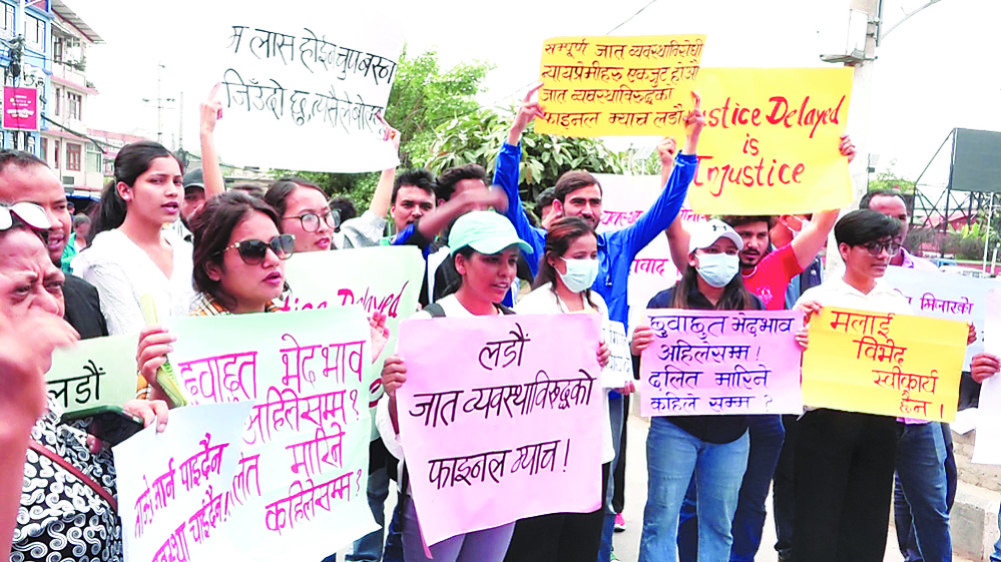
The contradictions between the clauses of Article 24 of the Constitution are not just a matter of legal debate; they are a question directly related to social justice and human dignity.
We use Google Cloud Translation Services. Google requires we provide the following disclaimer relating to use of this service:
This service may contain translations powered by Google. Google disclaims all warranties related to the translations, expressed or implied, including any warranties of accuracy, reliability, and any implied warranties of merchantability, fitness for a particular purpose, and noninfringement.
Article 24 (1) of the Constitution clearly states that ‘no person shall be subjected to any form of untouchability or discrimination in any private or public place on the basis of his origin, caste, ethnicity, community, profession, business or physical condition’. This clause expresses the constitutional commitment to end caste and social discrimination in Nepal. This provision is considered progressive in the direction of ending the inhuman practice of untouchability that has been practiced against the Dalit community in Nepali society for centuries.
However, in clause (4) of the same article, it is provided that ‘no discrimination of any kind shall be allowed in the workplace, whether or not on the basis of caste’. A serious question arises here – if it is said that discrimination cannot be allowed only in the workplace, is discrimination allowed outside the workplace? When clause (1) of the Constitution prohibits discrimination in all private and public places, why did clause (4) mention only ‘workplace’? This point has become a subject of contradiction within the Constitution.
Nepal has defined itself as a state based on equality, inclusion and social justice. In such a situation, it does not seem appropriate to have ambiguity regarding discrimination within the Constitution. The words used in law-making are very sensitive. Every word used in the Constitution has a legal meaning and effect. When clauses within the same article of the Constitution start giving different messages, it creates a problem in legal interpretation. The court has to look at both the words and intent of the Constitution while resolving a dispute. But when there is ambiguity or contradiction within the Constitution, it can also create difficulties in the administration of justice.
The intention of Article 24(1) of the Constitution is to clearly send a message that caste-based untouchability and discrimination are unacceptable in any place in Nepal. The said clause seems to express the constitutional commitment that the state will not tolerate any form of discrimination by using the broad terminology of ‘private and public places’. However, the specific mention of the word ‘workplace’ in clause (4) of the same article has created a kind of confusion in constitutional interpretation. From a legal perspective, although the purpose of clause (4) is to specifically prohibit caste discrimination in the workplace, its linguistic structure may seem to limit the prohibition of discrimination. This may indirectly create the illusion of ‘can discrimination be made in areas other than the workplace?’.
The constitutional principle of viewing the entire article as a whole is certainly applicable when interpreting the Constitution, however, such ambiguity in a supreme law like the Constitution is a serious matter. Especially in a society like Nepal, where caste discrimination is not only a social behavior but has developed into a form of historical structural oppression, there is a danger that even the wording of the law may indirectly protect a discriminatory mentality. According to the National Census 2078, the Dalit community in Nepal constitutes about 13.8 percent of the population, which includes both the Pahari Dalit and Madhesi Dalit communities. Even today, a community with such a large population faces structural inequality in the areas of education, health, employment, political access and social respect. Therefore, any ambiguous provision in the Constitution can raise questions about the constitutional protection of the Dalit community.
Nepal's social structure has historically been deeply affected by caste discrimination. Dalits have been denied entry to public toilets, temples, schools, hotels, tea shops and other social venues, forced to use separate utensils and subjected to inhumane treatment for decades. Although the constitution has made an attempt to establish the foundations of social justice by recognizing untouchability and discrimination as punishable crimes, linguistic ambiguity within the constitutional system itself has the potential to perpetuate discriminatory thinking. For example, if someone tries to misinterpret discrimination outside the workplace by linking it to the limited language of Article (4) of the constitution, it can weaken the protection of the rights of Dalits.
Constitutional clarity is particularly important for marginalized groups. Dalits, women, indigenous peoples, Madhesis, citizens from backward areas and other oppressed communities have secured their rights in the constitution after a long struggle. If the provisions of the constitution are unclear or contradictory, the protection of the rights of such classes may be weakened. The ambiguity of the law always benefits the powerful class and the weaker class is likely to suffer further injustice.
This issue cannot be viewed solely as a linguistic error. A small wording flaw in the constitutional system can have long-term legal and social implications. There are examples of major disputes arising due to constitutional terminology in many countries of the world. Therefore, every word of the constitution should be used with great care. This context clarifies the need for timely amendments and reviews in the Constitution of Nepal as well.
The real purpose of Article 24 (4) was probably to specifically prohibit caste discrimination in the workplace. Because discrimination against Dalits and backward classes in the employment and professional sectors has been a serious problem in Nepal. But even when referring to it as special protection, it was necessary to use language that did not conflict with Clause (1). For example, if the words ‘in any field including the workplace’ had been used, the possibility of such a dispute would have been less likely to arise.
In today's democratic era, the constitution is not seen as a static document but as a living document. Along with social change, review and reform of the constitution is also necessary. It is the responsibility of a democratic state to correct the ambiguities, weaknesses and contradictions in the constitution in a timely manner. Otherwise, public trust in the constitution may weaken.
Nepal has defined itself as a state based on equality, inclusion and social justice. In such a situation, it does not seem appropriate to have ambiguity regarding discrimination within the constitution. Moreover, considering the historical background of injustice faced by the Dalit community for centuries, the constitution needs to give a strong message against discrimination with complete clarity.
Ultimately, this contradiction seen between the clauses of Article 24 of the constitution is not just a matter of legal debate, it is a question directly related to social justice and human dignity. The ambiguous provisions in the supreme law threaten to weaken the protection of the rights of the marginalized classes. Therefore, it is the need of the day to carry forward the constitutional debate and amendment process necessary to make the constitution clearer, fairer and free from contradictions. Also, the government's attention should be drawn to this issue in the debate on constitutional amendments that is currently underway. Only if the constitution can ensure equal security and respect for all citizens will the establishment of true democracy and social justice be possible.