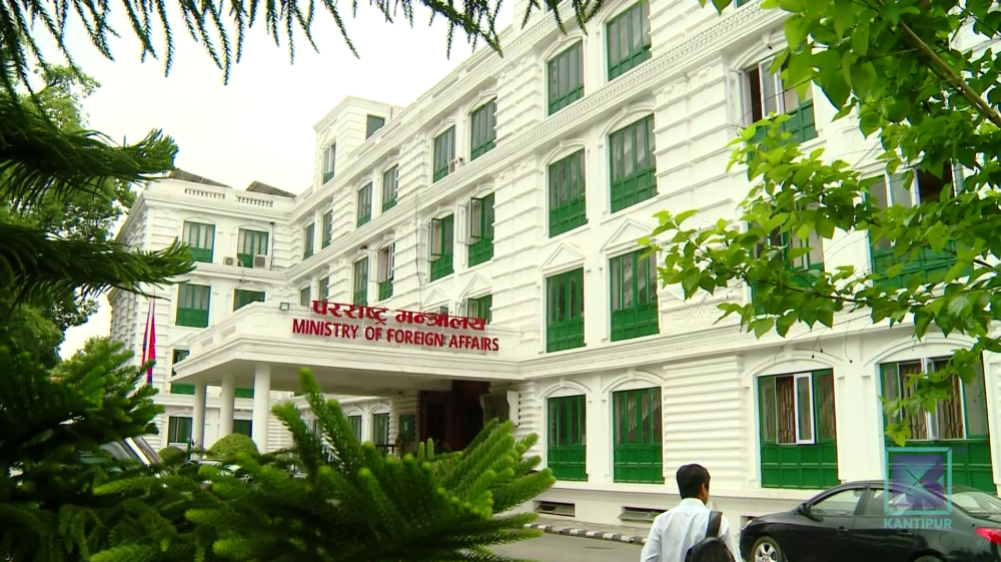
”Yesterday, when military and trade relations were the main areas of foreign affairs, cooperation with a limited number of ministries within the country was sufficient. Now, completely new issues have become the main issues of foreign relations. Without the technical knowledge and direct facilitation of other ministries, offices and agencies, it has become difficult for the Ministry of Foreign Affairs to move forward with negotiations alone.”
We use Google Cloud Translation Services. Google requires we provide the following disclaimer relating to use of this service:
This service may contain translations powered by Google. Google disclaims all warranties related to the translations, expressed or implied, including any warranties of accuracy, reliability, and any implied warranties of merchantability, fitness for a particular purpose, and noninfringement.
Globally, the Ministry of Foreign Affairs and the Minister of Foreign Affairs have received less (and less) attention in national and international news than they did two or three decades ago. At first glance, it seems that the power and role of the Ministry of Foreign Affairs and the Minister of Foreign Affairs have also diminished. It is not that they have diminished, but rather that they have changed. Some of the roles that were once the sole purview of the Ministry of Foreign Affairs have been transferred or transferred to other ministries (whether the parties involved want it or not). Completely new issues have reached the center of world politics. An era has dawned in which many ministries or agencies liaise with foreign countries or international organizations on issues of a similar nature. This has led to the new responsibility of the Ministry of Foreign Affairs to ensure broad national cooperation in foreign relations, comprehensive internal coordination in work focused on national interests, and the consistency of national policies and relations on such issues. It may sound a bit contradictory, especially since the role of the Ministry of Foreign Affairs abroad has diminished and the role of coordination within the country has increased.
Before discussing in detail, let us make a self-declaration. No matter how much the world order changes or there are different practices in other countries, we will determine which ministry to strengthen based on our own needs. We will do it in the way that is appropriate for us to fulfill our own national interests when distributing work. For example, Article 19 of the Korean Government Organization Act provides for the Deputy Prime Minister, in which there will be two Deputy Prime Ministers in the Council of Ministers, one of whom will be the ex-officio Minister of Finance and Planning and the other the Minister of Education. A slightly different story, in Korea's local elections, there is a legal provision to select a total of 17 heads of education in provinces and large cities through a non-partisan electoral system. While the election to select the head of education is held along with the local elections, and in local elections, the mayors of provinces and cities are elected on a party basis. Korea has been able to achieve significant progress in the education sector because of its different management of education development. Of course, the state's priorities determine its administrative organization.
Again, let's return to the subject of the Ministry of Foreign Affairs. Yes, its main job is to kill mice, regardless of whether the cat is black or brown. But in a situation where there are limited mice, there must be a predetermination as to which mice the black cat will try to kill and which the brown one will try to kill. Otherwise, all our cats may just run around and starve. There are many lessons to be learned from the star-rated hotels that are being heated by issues like electricity trade with Bangladesh and climate finance, but the progress is very slow in practice.
Commentary on the decline of the Ministry of Foreign Affairs
In the academic world, the commentary on the decline of the Ministry of Foreign Affairs began since the end of the twentieth century. The book ‘Foreign Ministries: Change and Adaptation’ edited by Brian Hawking in 1999 seems to have broadened the debate on the decline of the Ministry of Foreign Affairs. According to the book, due to globalization and the diversification of characters and issues in world politics, other government and non-government bodies within the country, apart from the Ministry of Foreign Affairs, have also increased their work of communicating and contacting other bodies outside the country. In the same vein, offices that used to go to the Ministry of Foreign Affairs in fear (based on the monopoly of the Ministry of Foreign Affairs on information and relations and having unparalleled authority) to ask, understand, and request are now interpreting it as erosion as they have created a situation where they communicate and contact the Ministry of Foreign Affairs without informing it, or instead send proposals for facilitation or complain. But that is a commentary that is far from the truth.
What is also discussed in that book and what we can easily realize is that when many bodies within the country are busy establishing contacts and relations outside the country, the importance of facilitating them, focusing such contacts and relations only on national interests, ending the danger of duplication, and bringing uniformity in national policies and perceptions on every issue increases. And, isn't that naturally the jurisdiction of the Ministry of Foreign Affairs? In this way, both the role and scope of the Ministry of Foreign Affairs as the ultimate authority in foreign relations have increased.
Such debates seem to be gradually becoming more critical of the role of traditional diplomats. On the one hand, the nature of the work to be done in the Ministry of Foreign Affairs and foreign diplomatic missions has changed. A question from former Canadian Prime Minister Pierre Trudeau is mentioned in many places in such discussions. He asked - If I can read the information sent by diplomats abroad in the morning newspaper, why should the state spend a large amount of money to keep them abroad? In other words, questions arose about the continuity of work that preceded the development of information technology.
On the other hand, issues that were difficult to negotiate alone with the expertise within the Ministry of Foreign Affairs, such as labor agreements, information technology, climate change, energy trade, and terrorism, have become major issues that Foreign Affairs should look at. In addition, another issue that we should be clear about is that in almost all countries, there is a separate ministry or authorized office that looks at and leads such issues at the national level. Yesterday, when military and trade relations were the main areas of foreign affairs, cooperation with a limited number of ministries within the country was not only sufficient, but the Ministry of Foreign Affairs also developed its competence in such areas through continuous relations and contacts in such areas. But now, completely new issues have become the main issues of foreign relations. Not only has the number of ministries and agencies that need to cooperate nationally increased, almost all of these ministries and agencies are in the technical field. Without the technical knowledge and direct facilitation of other ministries, offices and agencies, it has become difficult for the Ministry of Foreign Affairs to move forward with negotiations alone. This has naturally led to a demand for catalytic diplomacy that activates coordination, cooperation, dialogue and partnership among stakeholders from the traditional diplomacy of leading all negotiations itself.
Similarly, amidst arguments, the global economic recession that began in 2008 has terrifyingly established a narrative around the world - the direct and active role of the country's chief executive in the economy is indispensable in modern politics. If we look at democratic countries, we have been seeing and hearing that the parties or leaders who are clear, firm and committed to such issues have received the most votes. During times of economic recession or crisis, the sensitivity of foreign trade and cooperation (especially in the field of information technology) increases and the Office of the Chief Executive leads it, which raises questions about the usefulness of yesterday's diplomatic methods and means. Sun Jing's journal article 'Growing Diplomacy, Retreating Diplomats', published based on an objective study of China, concludes that the role of the Ministry of Foreign Affairs has weakened during the period when China's global diplomacy has expanded due to the direct involvement of top leadership, the increasing international activity of other ministries, and public criticism.
Now, what kind of Ministry of Foreign Affairs?
As mentioned above, there are strong voices in many countries that the changes in function necessitate a radical transformation in the scope and organizational structure of the Ministry of Foreign Affairs. First, there are critical voices that the Ministry of Foreign Affairs itself should take the lead in embracing the changes. Such criticisms are mainly based on the fact that the Ministry of Foreign Affairs has not yet come out of the old thinking and behavior of having a monopoly on information and being the ultimate authority in relations rather than providing services, and that it has not paid enough attention to the development of motivation and diplomatic capacity at the office and other levels within the country in catalytic diplomacy. Once again, I would like to emphasize that a new era has dawned in which national-level coordination and cooperation are the main basis for the authority of the Ministry of Foreign Affairs. Multilateral coordination, inter-institutional cooperation, and the participation of various stakeholders have become indispensable. The rapid development of new diplomatic areas such as city diplomacy, green diplomacy, and digital diplomacy, etc., and the high priority given to them are vivid examples of this change.
Second, there has been an increase in the number of citizens and types of services that need to be provided to administrative services outside the country, and there has been an increase in complaints from citizens abroad about such services. For example, the capacity of the Ministry of Foreign Affairs is compared with the speed and quality of rescue operations carried out by its citizens during a war or natural disaster in a particular country. In many countries, the issue of reforming the Ministry of Foreign Affairs has been politicized by focusing on such emergency and regular services. In other words, a quality service provider Ministry of Foreign Affairs has now become a popular political issue in many countries.
Third, it seems that the Ministries of Foreign Affairs have taken the initiative to address the voices that only those who have retired from the Foreign Service are appointed to foreign affairs-related bodies, committees and training institutions, and that this has led to the entire structure being like a club with the same ability and culture, the organizational culture based on rank is prevalent, and it has become an obstacle to diversity and innovation.
Fourth, as a major solution to address the above issues, a lot of effort has been made to improve the methods of entering the Foreign Service, that is, the selection system. Of course, the system of understanding and managing the Foreign Service Examination as an 'elite examination' like that of the UK is still in place in many countries. But now, many countries have started the practice of selecting in three stages. In the first stage, there is a language test, in which one or another language is tested along with the national language of the country, English. It seems that those who pass this stage will be tested on their theoretical knowledge of international relations and foreign affairs, and in the third stage, they will be allowed to enter the service only after participating in a certain period of educational programs in bodies under the Ministry of Foreign Affairs.
Fifth, ‘value-based diplomacy’ is currently popular all over the world. Focusing on the national strategy mentioned in the National Security Policy, Foreign Policy and other strategic documents, the Ministry seems to determine the values that give high priority to its policies and programs and specify all activities including the organizational structure on the basis of that. Looking around the world, it is clear that new values and strategies are being developed, mainly focusing on issues of national importance such as economic security, climate, energy and information technology cooperation.
Sixth, after such values are determined, the Ministry of Foreign Affairs seems to change its organizational structures such as divisions and branches, keeping national needs at the center. Seventh, but when the values and strategies are completely new, simply changing the human resources or divisions within the Ministry of Foreign Affairs is not enough. In such a situation, the Ministry seems to be developing the necessary strategies in that area by forming thematic expert committees. It is clear that the activities carried out through such committees, such as meetings, conferences or publications, are used as strategic tools for harmonizing national policies on international issues. The Ministry of Foreign Affairs, which is active in such activities, also seems to have further strengthened its legitimacy in the changing world politics. And, finally, the empowerment of training and research centers under the Ministry of Foreign Affairs to carry out all these activities has become a popular topic all over the world.