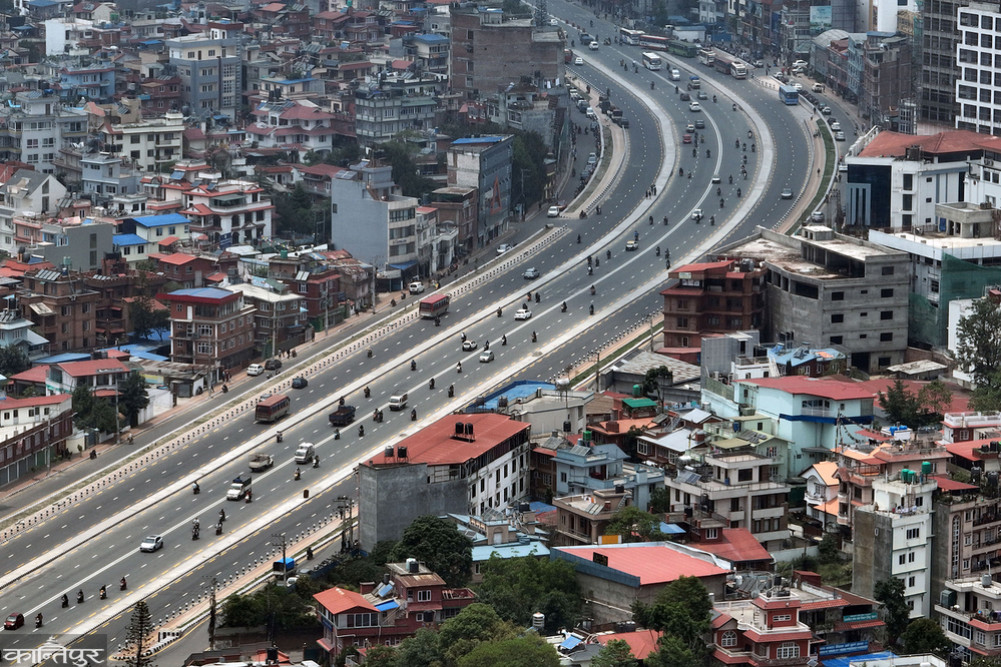
Rather than focusing on providing basic social security, reducing inequality of opportunity, and providing shelter and food for the displaced and homeless, the government is focused on taxing low-income people on everything from electricity to education and health.
We use Google Cloud Translation Services. Google requires we provide the following disclaimer relating to use of this service:
This service may contain translations powered by Google. Google disclaims all warranties related to the translations, expressed or implied, including any warranties of accuracy, reliability, and any implied warranties of merchantability, fitness for a particular purpose, and noninfringement.
Development is the improvement in the living standards of the people of a certain country. Nepal, which has been trapped within the traditional definition of economic development and social literacy, has been waiting for a real transformation for decades. By leveraging this chaos and the public anger generated by the incompetence of the old political parties, a new 'alternative force' has succeeded in reaching the reins of power. Although such an incident has happened before, the Nepali people also felt that something would really be different this time. It is natural to feel that way. But the definition of development seems to be different for this alternative force, the 'RSVP', where rather than improving the physical living standards of the citizens, their main goal is to shine the outer shell of the city and show 'cosmetic' changes.
The current operating method of the RSVP confirms this irony, in order to achieve that artificial beautification, this force seems ready to displace the working class and even oppress them.
‘How to eradicate poverty?’ This question has been under discussion for a long time. In my personal opinion, the answer is very simple, that is – socialism. However, for the sake of argument, let us define this question differently, staying within the capitalist (bourgeois) structure.
‘How to eradicate poverty in neoliberal democracy?’ Our arguments now will revolve around this assumption. Even within this ‘traditional’ framework, the solutions are as clear and well-known as textbooks. Such as a strong social security mechanism that guarantees that at least the basic needs of every citizen are met, the formalization of the informal economy, affordable housing and protection of labor. These are just some of the solutions that have been implemented in many places where there is social democracy. However, the current approach of the state towards informal labor is very aggressive. On the one hand, the authorities are destroying the traditional alcohol production of the indigenous community on the streets under the pretext of illegality, while on the other hand, the country is spending billions of dollars annually on importing foreign alcohol.
Nepal's recent political upheaval was nothing more than a directionless journey, which changed the characters but left the underlying power structure completely intact (the power structure of the previous regime remains intact). In fact, the state is not an impartial arbiter of class interests, it is just a tool for one class to rule over another. And, the ruling class here is the capitalist (bourgeois) class.
Here, elected representatives are not accountable to the people. There is no provision for their immediate recall, so they can neither be held accountable nor responsible . This is why the Prime Minister can get away without addressing the parliament and threaten his critics with imprisonment for abusing state power. The state is a part of class rule, this is an irrefutable truth.
Balen Shah is not a unique person or let's say he is not a new political phenomenon. When the material conditions of society demand a specific type of ruler, then historical necessity always brings such a character to the surface. Balen Shah is just the Nepali version of this historical rule. For some time now, public sentiment in Nepal has been growing in favor of a technocratic strongman, i.e. a ruler like 'Lee Kuan Yew'. However, what the common people are not able to understand is that Lee Kuan Yew did not build a prosperous nation for ordinary citizens, wage laborers or common people like you and me.
Lee Kuan Yew did exactly the same thing, focusing only on external appearance and 'aesthetic' (aesthetic) development. Such a development, which is purely targeted only for the upper-middle class and the elite class, i.e. the bourgeoisie. In this sensitive time when air pollution is increasing day by day, instead of choosing the path of green growth and sustainable development that protects trees, Balen is aggressively advancing the 'Sunset Law' that cuts down trees to build skyscrapers.
The middle class rejoices when the slums are demolished, but without any proper alternative, real life and a thriving community have been destroyed. The populism of the Rashtriya Swayamsevak Sangh (RSS) has made it clear that the ruling class that accumulates wealth and exploits the workers, who send their children abroad to earn commissions and banks to benefit from remittances, is not the problem, but the poor people who live in the worst areas just to survive are the problem. In addition, they are imposing more and more taxes on the general public by giving tax exemptions and tax evasion to businesses.
Currently, a proposal is being discussed regarding fines for traffic rule enforcement. Of course, fine people, enforce the law, but only after providing infrastructure. Most roads do not have proper lane markings, there are potholes everywhere, traffic lights do not work in many places, zebra crossings have been removed. And, some places where zebra crossings once existed have been completely removed and never repainted, so there are no zebra crossings now. Traffic police are sometimes absent from their posts and even appear rude during regular checking of licenses and blue books.
Driving under the influence of alcohol or without a license is a different matter. However, considering the condition of Nepal's roads, sometimes driving while following all the rules is even more dangerous. Rules implemented without infrastructure only create problems for the public. And, this is just a way to extort more money from the common people, the working class and the middle class.
The Nepali people (especially the middle and upper-middle class) seem to be longing for a strongman and that is exactly what they are getting. It will take them time to understand what is happening, but in the blink of an eye we will be transformed into a mass surveillance state.
That is the nature of the state. That is why the state is moving towards development for the rich, looking good in the eyes of the rich, and showing a shiny country to foreign guests. There is no focus on providing basic social security, reducing inequality of opportunity, giving the displaced homeless a place to live, clothe and eat - the focus is on taxing the lower income groups on everything from electricity to education and health. The tax that our Finance Minister Swarnim Wagle calls 'Jamma 100 rupees', 'Jamma 300 rupees', while many people in Nepal earn less than that.
Therefore, we need to unite as a class of people against the bourgeois nationalists and the fake leftists to firmly confront the 'techno-fascist' trend and bring a new wave of socialism.