It is necessary to strengthen the capacity, manpower, and service quality of local health institutions by gradually linking health insurance registration with public services including national identity cards, birth certificates, passports, driver's licenses, and social security.
We use Google Cloud Translation Services. Google requires we provide the following disclaimer relating to use of this service:
This service may contain translations powered by Google. Google disclaims all warranties related to the translations, expressed or implied, including any warranties of accuracy, reliability, and any implied warranties of merchantability, fitness for a particular purpose, and noninfringement.
The US spends about $5.7 trillion annually on healthcare, which is about 350 times more than Nepal's annual budget. Per capita healthcare spending there is about $15,000 annually, which is almost double the average of other developed countries. Despite such huge spending, the average life expectancy in the US is only about 78 years, while countries like Japan and Norway have achieved an average life expectancy of 82-85 years with much lower healthcare spending.
The experience of the US, the world's richest and technologically leading country, shows that healthcare can be extremely expensive and that high healthcare spending alone does not ensure excellent health outcomes. Healthcare in the US is expensive, relatively less effective, and limited in access due to complex private insurance systems, expensive medicines, high administrative costs, vested interests, and unhealthy lifestyles.
Nepal should learn from this to practice fiscal discipline, sustainability, and promote healthy lifestyles. But it should emphasize the effective implementation of its constitutional commitment to health as a fundamental right. Although the National Health Insurance Program was launched with this objective in mind, challenges related to financial sustainability, service quality, and institutional management have raised serious questions about its future.
Health Insurance Financial Crisis
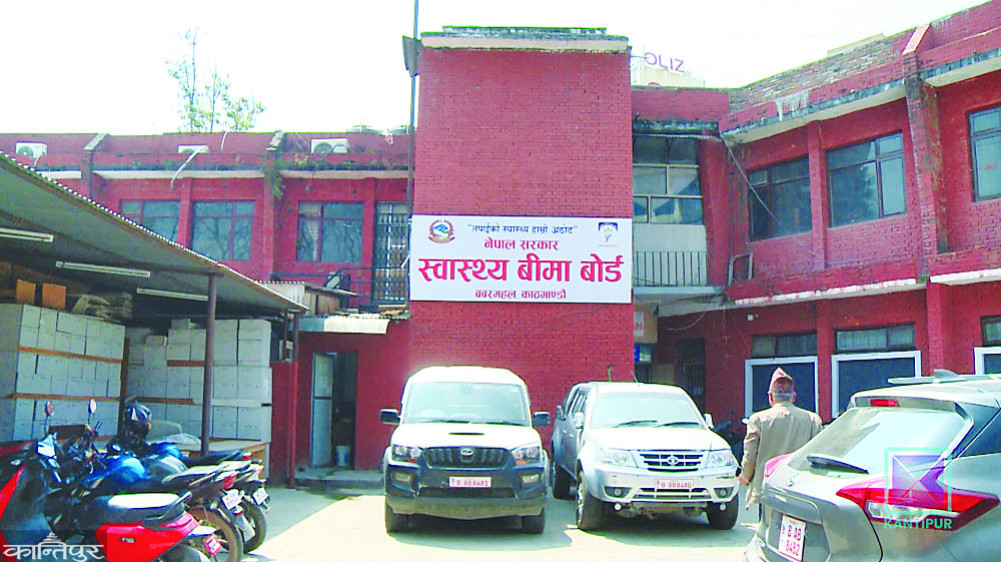
Nepal's National Health Insurance Program is going through a serious financial crisis. In recent years, annual medical claims have reached about 24-25 billion rupees, while premium income and government grants have only raised about 14 billion rupees. As a result, there is a financial deficit of about 10 billion rupees every year, due to which hospitals are left with billions of rupees in reimbursement payments, and some government, community, and private hospitals have started limiting services to insured patients or withdrawing from the program. According to the World Health Organization (2023), about 51 percent of total health expenditure in Nepal is still borne by citizens from their own pockets, which is one of the highest in South Asia. As a result, serious illnesses or emergency health problems have plunged thousands of families into debt, forced them to sell their assets, or pushed them into poverty. Therefore, effective management of health insurance is a national priority linked to the health security of citizens, economic stability, and poverty reduction.
Integration of the health financial system
Currently, the Health Insurance Board, the Social Security Fund, and various government health assistance programs are being operated separately. The current budget has adopted a policy to gradually integrate these programs and operate them through the Health Insurance Board. But policy announcements alone are not enough. A clear action plan, institutional coordination, and a common digital system are needed. Just as South Korea established a national health insurance system by merging hundreds of health insurance funds in 2000, Nepal should gradually bring health insurance, social security, and other public health assistance programs under a unified national health fund.
Expansion of the scope of health insurance
According to health economics, when insurance is completely voluntary, the problem of 'adverse selection' arises, in which only sick and high-risk people participate, and the insurance fund may face a financial crisis. To address this challenge, the current budget aims to bring about 90 percent of the population under the scope of health insurance within the next three years. But effective implementation is more important. According to the Health Insurance Board's 2081/82 annual report, although about 33 percent of citizens have insurance at least once, only 20 percent are actively insured. According to ADB, lack of information, confusion in accessing services, and limited availability of quality service providers are the main reasons for low participation. Therefore, it is necessary to strengthen the capacity, manpower, and service quality of local health institutions by gradually linking health insurance registration with public services such as national identity cards, birth certificates, passports, driver's licenses, and social security.
Contribution according to financial capacity
As suggested in the 'Health Insurance Reform Recommendation Task Force Report, 2081', to ensure the financial sustainability of the health insurance program, if the government fully bears the premium of the extremely poor, disabled, and helpless citizens, provides partial subsidies to low-income families, collects a fixed premium from middle-income families, and requires relatively higher contributions from high-income citizens, this system can become more just, inclusive, and sustainable. However, due to the lack of reliable data on income and assets of citizens in Nepal, universally accepted criteria for identifying the poor have not yet been developed. Therefore, it is necessary to regularly update the government-issued poverty identification card and adopt scientific methods such as ‘proxy means testing’ by integrating national identity cards, permanent account numbers, social security, housing, vehicles, electricity consumption, and local level data.
Supplementary private health insurance
The mixed model of supplementary private health insurance, which has been successfully implemented in countries with universal health services such as France and Australia, should be studied in depth. While ensuring basic health security as a mandatory and universal right, additional facilities such as special rooms, urgent services, additional medicines, or specialized treatments can be provided through private insurance. The successful experience of these countries has shown that this model will provide citizens with some choice in health services and reduce the financial pressure on the public system. In addition, in Nepal, if the Health Insurance Board can provide such additional facilities in collaboration with private hospitals and insurance companies, it can also be linked to health tourism.
Payment system reform
To reduce the liability of health insurance, the central level should effectively implement bulk procurement of medicines, promotion of generic medicines, price regulation and strategic service procurement, with which Taiwan and Thailand have achieved remarkable success. It should be mandatory for hospitals to approve reimbursement claims only after OTP (one-time password) or digital authentication received on the patient's mobile phone. In addition, to reduce the moral hazard seen in this system, promotion of healthy lifestyles, effective referral systems, scientific co-payments and digital claims verification systems are necessary to control unhealthy behavior of the insured (ex-ante moral hazard) and unnecessary tests or treatments by providers (ex-post moral hazard). Adopting a 'DRG' (Diagnosis Related Group) payment model instead of the current 'fee-for-service' system in treatment reimbursement can help control unnecessary expenses.
'Gatekeeping' system
Nepal's health system is largely an 'inverted pyramid', where patients go directly to large hospitals for even common ailments. Therefore, it is necessary to implement an effective 'gatekeeping' system by making local health posts, basic hospitals and primary health centers the first gateway, and to improve service quality through proper incentives for government health workers and a 'star rating' system for hospitals. In addition, to control lifestyle diseases that are responsible for more than 70 percent of total deaths, physical education can be made mandatory in schools, a 'sugar tax' on high-sugar and processed foods and some of its revenue can be mobilized into the insurance fund, and preventive measures such as Japan's 'Metabo' program can be adopted. The expansion of digital health and 'hub-and-spoke' telemedicine systems will increase access to specialist services for citizens in remote areas and will also help reduce travel and other costs related to treatment.
Towards self-reliant health insurance
Health and health insurance are not just a matter of personal health, they are the cornerstones of economic security, social justice, human capital development and national development. Amidst limited revenue sources, a large informal economy and development challenges, it is imperative for Nepal to make health insurance financially self-reliant and sustainable in order to implement its constitutional commitment to the right to health. Through honest political commitment, effective financial management, a prevention-oriented health system and strong primary health care, Nepal can build a strong foundation for healthy Nepalis and prosperous Nepal by making health insurance reliable, inclusive and self-reliant.