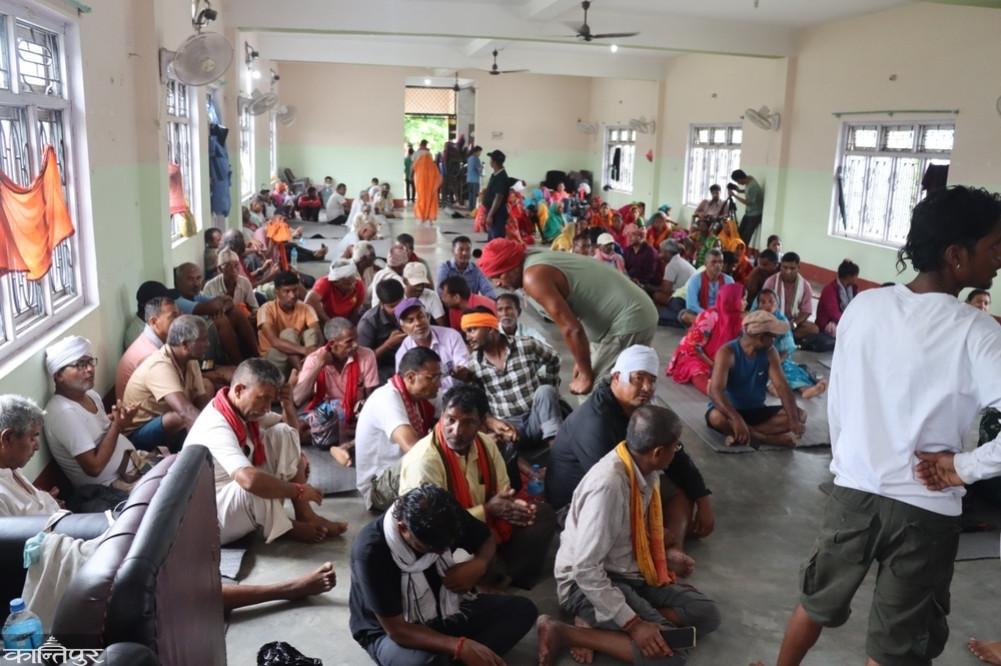
Looking back at the past, meter badge victims had protested in the past as well and an agreement had been reached. However, it could not be fully implemented.
We use Google Cloud Translation Services. Google requires we provide the following disclaimer relating to use of this service:
This service may contain translations powered by Google. Google disclaims all warranties related to the translations, expressed or implied, including any warranties of accuracy, reliability, and any implied warranties of merchantability, fitness for a particular purpose, and noninfringement.
Although borrowing and lending for financial management is a natural practice in Nepali society, it has a moral standard. There is a predetermined public information, process, and legal solution regarding the issues and processes of borrowing and paying off loans from banks and financial institutions. However, many issues in transactions between individuals are determined by need and trust. There should also be a logical scope for that.
However, 'metering' has become such a trap that the disadvantaged sections of society have fallen into a pit from which they can never be lifted. Strong legal and administrative initiatives are needed to end the financial crime called 'metering'. The agreement reached to stop the latest 'pedal justice march' of metering victims that began on 25th Asad has given a positive message. If the agreement reached between the government and metering victims on 1st Shrawan is implemented, the lower classes of society will get relief.
The cycle of meter interest begins with the conditions and documents prepared by the lender while taking advantage of the borrower's compulsion when giving a loan. Things like setting interest rates several times higher than the legally prevailing rate, applying cyclical interest rates (interest on the interest amount as well), making a pledge of the amount more than the loan taken, and forcing the borrower to keep the land in their own name are done.
The agreement reached to stop the latest 'foot justice march' of metered rate victims that began on 25 Ashad has given a positive message. If the agreement reached between the government and the metered rate victims on 1 Shrawan is implemented, the lower classes of society will get relief. The lender takes advantage of the borrower's compulsion and ignorance. When a loan is given, the interest amount rotates 'like a meter'. Borrowers with weak financial and educational qualifications are also burdened by the interest rate. Even after paying off several times the principal amount, the loan is not considered complete. They are forced to surrender their movable and immovable assets to the lender. There are also examples in society of people who have not been able to get rid of their debts even after paying most of the money they earned by going abroad for employment at meter interest.
Metered rate victims from East Jhapa to West Kanchanpur used to walk to Kathmandu to get rid of the financial crimes against them. After staging a sit-in in Kathmandu for months, an agreement was reached with the government. For example, a five-point agreement was reached on 1 Asoj 2079 and a four-point agreement on 28 Falgun 2080. In the meantime, the government had also formed a commission under the leadership of Gauri Bahadur Karki to solve the problems of metered rate victims.
However, the problems of metered rate victims did not end completely. That is why on July 25, meter rate victims started a 'foot justice march' from Tritiyagachhi in Janakpur, Dhanusha. What happened this time was that the government stopped them in Nijgadh. The initial agreement was made there. The final talks were held in Kathmandu and an agreement was reached. This context can be taken as an example of how the suffering of the victims can be reduced to a large extent with the government's active participation.
According to the agreement reached on July 1, the government will declare meter rate as an economic crime and take a proposal for its complete abolition to the next cabinet meeting. Once the proposal is approved, it is mentioned that documents such as fake tamasuk, vistibandhak, chinnuwa pass and compulsory checks will automatically be invalid and revoked. The Ministry of Home Affairs will prepare a draft of a special act on meter rate control within three months. The proposed act will include the formation of a separate tribunal to hear meter rate cases, return of the victim's property and appropriate compensation.
According to the agreement, the legal source of funds and proof of banking transactions will be mandatory in the verification of loan transactions through the ward office. In the new law, making documents of more than the actual amount, adding interest to the principal, not paying the borrower, charging exorbitant interest, threatening, physical or mental abuse, forcibly signing blank checks or papers, and destroying property will be defined as crimes.
Looking back at the past, metered rate victims had also protested in the past and an agreement was reached. However, it could not be fully implemented. Since those who charged metered rate were often activists of established parties or influential people in society, the government, political parties, and administration were not able to take strong steps. On the other hand, there were also weaknesses in the legal structure and the government's determination. A strong government has been formed at this time. Traditional political parties and their structures have become weak. Therefore, it is expected that the agreement will be effectively implemented and the trap of metered rate will end forever.
The suffering of metered rate payers is not only related to being trapped in a financial hole. It is also linked to physical, mental and sexual violence. For example, the police arrested a metered rate payer in Shrawan 2080 after it was revealed that a woman from Lalitpur had been sexually exploited and robbed of her house after she failed to repay the principal and interest of five hundred thousand rupees she had taken for treatment. Many such incidents have been made public in the past. That is why the government's support is essential for full compliance with the agreement and for the safe and dignified life of metered rate payers.
On the other hand, the process of obtaining and paying financial transactions and loans should also be facilitated. Because, even if metered rate payers are considered an economic crime, the financial needs of people will not end. A lender must be found to fulfill the needs. Therefore, the government should also facilitate the process of taking loans from banks and financial institutions. Programs to increase financial literacy should be implemented.